The Neil Ashton Podcast
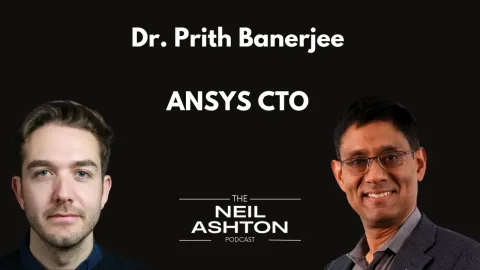
Dr. Prith Banerjee — Ansys CTO
Watch on YouTube
Dr. Prith Banerjee — Ansys CTO
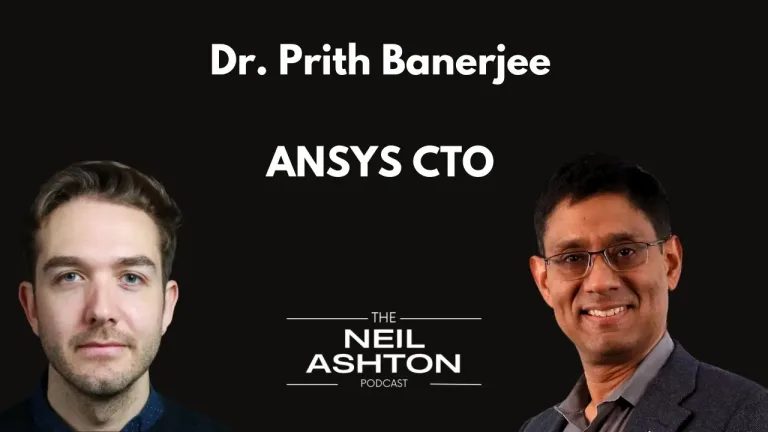
YouTube video
Watch this episode
YouTube is contacted only after you choose to play the video, keeping this page fast and private by default.
Listen to the audio
Episode overview
In this episode of the Neil Ashton Podcast, Dr. Prith Banerjee, CTO of Ansys, shares his extensive journey from academia to the corporate world, discussing the interplay between academia and industry, the role of startups in innovation, and the transformative potential of AI and ML in simulation. He emphasizes the importance of solving real-world problems and the need for collaboration between academia, startups, and large corporations to foster disruptive innovation.
He discusses innovative business models for data sharing, the intersection of data-driven and physics-informed approaches, the role of open source in AI innovation, the potential of foundational models in computer-aided engineering (CAE), the future of quantum computing in simulation, and offers advice for aspiring innovators and entrepreneurs. He emphasizes the importance of collaboration, data governance, and the need for interdisciplinary approaches to solve complex problems in engineering and technology.
Chapters
- 00:00 Introduction to the Podcast and Guest
- 05:18 Dr. Prith Banerjee's Journey: From Academia to CTO
- 09:10 The Role of Academia, Startups, and Industry
- 17:22 Advice for Startups: Motivation and Market Sizing
- 24:04 The Impact of AI and ML on Simulation
- 35:07 Future of AI in Physics and Simulation
- 36:10 The Power of Data in AI Models
- 40:33 Incentivizing Data Sharing for Better Models
- 42:55 Physics-Driven vs Data-Driven Approaches
- 47:30 The Role of Open Source in AI Innovation
- 52:06 Foundational Models and Simulation Data
- 58:22 The Future of CAE and Quantum Computing
- 01:06:29 Advice for Aspiring Innovators
References and links
Transcript
This transcript was created from the corrected YouTube captions, with names and technical terminology reviewed. Download the corrected SRT file.
Hi, and welcome to the Neil Ashton Podcast. In each episode, we explained some of the fascinating ways that science and engineering are changing the world around us. We talked to leading engineers from elite level sports like cycling and Formula One to some of the world's top academics to understand how fluid dynamics, machine learning and supercomputing are bringing in a new era of discovery. We also hear some of their life stories, their career advice, the lessons they've learned on the way that I hope will be helpful to you too. So sit back and enjoy this episode. Hi, and welcome back to the Neil Ashton Podcast. So today I have a very special
guest in Prith Banerjee, who is the CTO of Ansys, somebody who I am honoured to have on the podcast because he truly is at the position with the knowledge to answer many of the questions that I have been wondering myself, but also asking many of the guests on this podcast. So to ask the CTO of one of the largest and most important CAE companies in the world was a great honour. And I hope it, it's good for you as well to actually hear from, you know, the person really at the top of one of these big companies. And he's an amazing individual. Actually, I, I watched some videos of interviews with him over the past few months and I
was so impressed by his understanding of these emerging areas, but also the way that he was able to explain it in such a simple way. And you'll see him do this in the interview today that really shows that professor in him. And actually, let's talk about what his background is. Well, he was a professor for more than 20 years, publishing more than 350 papers, supervising, you know, nearly 40 students. So really had an amazing career on its own as a professor in Illinois, but then went off to the startup world. And we discussed a lot about this need for people to sometimes go from academia to startups to, you know, fully
exploit the ideas they have. But then he went into the corporate world and became, you know, CTO of companies like ABB, HP Labs, Schneider Electric, and now Ansys for the past six years. What an incredible individual to have gone through those three sort of main stages, I guess, of, of, of the world that you could be in, you know, academia, startups and and industry. It's amazing because it's also one of those questions I've often asked people on the show, you know what, what do you think about the differences? So here's somebody who's, you know, done it all and I really wanted to ask him some of the topics that I personally have
found interesting at, but I think the community at large who are into fluid dynamics and CFD and HPC and AI are wondering. So I, I put it to him as the CTO of one of the biggest companies in the world. So we had a really deep and I thought interesting discussion about the role of machine learning and artificial intelligence in CAE. We've already dived into some of the details, discussed at length about foundational models. He came out with some really interesting stuff and, and the honesty that he had as CTO to explain to his board that this really is an important thing that could even see the end of the simulation market as we know
if they don't fully embrace it. So we talked a lot about that. We talked about quantum computing, how that could be a sign of things to come, some changes which Ansys have been working on. We touched on, you know, HPC, GPUs, but we also talked a lot about the role of startups, the roles of industry, what startups should be trying to do. And we talked some advice for students, mid-career and everybody about, you know, what they could do to maybe come up with the next amazing invention. We touched on open-source, closed-source and how we need to work with academia. And then, you know, we finally ended on some advice, I guess,
to, to, to people and, and really finished on what he is quite an inspiring individual. You know, he's written a book. It's really amazing, The Innovation Factory. I can put the link on YouTube if you're watching it. And on that note, you know, if you enjoy this, I really would appreciate it if you did, you know, like it, subscribe it. The algorithms work that way. If you if you like it but don't interact, unfortunately, that makes it harder for others to find it. So I don't often say this, but I'll I'll say it once every few episodes just because it would help. And also if you're watching this on YouTube right now, just to let you know, this is actually
also available in audio only on Spotify and Apple and vice versa. If you're listening to this and you weren't aware, there is also a video version on YouTube. So yeah, I, I, I really was so pleased that he was willing to speak. I found this conversation so interesting, and I hope you do too. So sit back and listen to this interview with Prith Banerjee. What was your journey to being the CTO of one of the most important and biggest simulation companies in the world? How did you how did you get there? I'm sure others would love to have your position and your job. So could you tell me a little bit more about your career and
how you got to where you are today? So, so Neil, first of all, thank you very much for inviting me to this. So I started my career in academia. I have got my PhD in electrical and computer engineering from the University of Illinois Urbana-Champaign, and I started as a professor at Urbana. I spent the first dozen years going through the ranks becoming a full professor, and I was the founding director of Computational Science and Engineering Program at UIUC. Illinois has the National Center for Supercomputing Applications, a big place for HPC. And I used to do and my research was on developing parallel algorithms and parallel compilers.
So I've always been working in the HPC area. So my last two years at Illinois, I was a founding director of computational science and engineering, which is the field of computing of high performance computing using HPC to drive sort of science and engineering. So computational physics, computational chemistry, computational electromagnetics, all of those things. And as it turns out, 30 years later, I have landed up in this job. So that's sort of the connection. And then after Illinois, I went to Northwestern. I was then at the University of Illinois Chicago. So hardcore academic for about 20 plus years. After that, I made a hard turn
into the corporate world. I was head of HP Labs, and at HP Labs I used to lead a lot of work on on high performance computing. We used to build this really super-duper high performance servers, so a lot of cool work there. And then I became CTO at ABB, a power and automation company based in Zurich. And then I became CTO at Schneider Electric and another power automation company based in France. About six and a half years ago I I joined Ansys as the CTO. So this is my third CTO job. And what Ansys does is we are the leading modeling and simulation company in the world. We take the world around us, which is governed by the laws of
physics. And we take that physics, which is explained as second-order partial differential equations. And we solve those physics through finite element methods, finite volume methods using things like Fluent, which is our fluid solver, in things like Mechanical, which is our structural code, in things like HFSS, which is an electromagnetic solver. And my role as CTO is to look at all these amazing products, what is the future of simulation? What kind of technologies can be used to drive future products? And in my role as CTO, I look at things like AI, machine learning, right? How does AI/ML improve simulation? HPC, how do you use HPC to accelerate simulation?
How, what do you do with sort of cloud, right? What do you do with platforms or digital engineering? So that is I have the coolest job in the company. Yeah, looking at the future future of simulation. Yeah, which is why you're absolutely perfect guest on this podcast, because your job is literally to answer, I guess some of the questions that that that people have. But maybe I love the fact that you have had such a great academic career and going into industry. And it's one of the themes I often ask people, you know, academia or industry, what's the benefits of both? So what do you now, having done both, what do you see as the
role of academia? Where, where can academia help, let's say, in advancing CAE and where does industry need to do it? And where is the overlap? Absolutely. So so since you're asking a career question, I I actually bypassed one part of my career. So I've actually had three phases in my career. I was in academia for 20 years, but in between academia in the large corporate world, I was in the startup world. I did two start-ups, One was AccelChip; one was BINACHIP. And these were companies started out of technologies from the university, from one from Northwestern and one from the University of Illinois. And I did those while in
universities you can actually go on sabbatical. So I left, I took leave from the university, did my first startup, came back to the university, the second startup came back to the university. So, and literally the reason I went from the academic world to the corporate world is because of the startups, right? So in the, So now let me ask you the question. In academia, what people do is to solve fundamental problems, right? Really, I mean what I call Horizon 3 futuristic research problems, right? Where we are trying to really understand what is the absolute the fundamentals of of, of technology, right And he worked with graduate students and I
have had in my 20-plus-year career right in academia, I have had 37 PhD students and 40-plus master's students with whom I have published more than 350 technical papers in IEEE conference in this and IEEE Transactions of that and so on so forth. So that's the world of academia where you're, you're researching, you're discovering new things and you're publishing that work in the latest journals and conferences, right? It's all about creating new knowledge and then transferring that knowledge to brilliant students, right? So you are educating the workforce in the next World, right? So in academia you have two roles. One is invent, create
knowledge, right? Discover knowledge which you publish and then you train students with the knowledge that you have created, right? Train undergraduate students, graduate students and so on, which are the workforces for all of us, right, in academia and in the corporate world to do. But what academia does not do is we don't build products, right? And literally, Neil, the reason I did the startups was I was frustrated that I was doing all this work, 350 papers, 10-plus patents, doing all kinds of stuff. But nobody cared. Nobody gave a damn right there was because it was not showing up in any product. So when AccelChip was actually created when I ended a
DARPA project called the MATCH compiler and the DARPA PM said, great, this is really awesome. You should should transfer it to a company. So I came to the Bay Area, talked to various companies and say, would you like to use this technology? They said, absolutely, this looks so good, just leave the the software copy with us. And I looked at them in the eye and said there's no way they are going to take this software like the only way this really commercialise if I were to do it myself with my graduate students. So that's kind of why I started the first company, AccelChip. So startups, what they do is they actually take a really new idea, something that the world
has not seen before and get laser focused on that idea and they bring bring that that new product to to the market, right. And I did two of those startups myself and then I came to the large corporate world of HP, ABB and so on, right? But what I have found is the large companies, they don't have a single product like Ansys. We have 70 products, right, in simulation, right? We have Ansys Mechanical, we have LS-DYNA, we have Fluent, we have this Twin Builder, all kinds of products, right? And the role of a large company is to take these products and evolve their products, right, doing continuous innovation. What features should I have in
the next release of Fluent, the next release of, of mechanical and so on? So, but the innovation that happens in in the corporate world is more incremental, right? It is what I call Horizon 1. I have a product. So I used to work at HP, right? You make computers. So, so next version of laptop, right? Is an incremental very important, but something that that you need to do. We have Ansys Mechanical, it's a finite element based structural solver. We are doing the next version, right? It's faster, it's a little better convergence, better meshing, but it's still the same tool, right? So that's what large companies do academia, we invent new things, right?
We are doing a hierarchical octree mesh representation, whatever and you publish a paper and you're getting a patent and so on. But that is not a product. What startups do is take that work in academia and they package it up into this really brilliant disruptive innovation, which I call Horizon 3 innovation, right? The truly disruptive innovation always happens in startups. Large companies actually struggle with with, with with disruptive innovation. In fact, Neil, I have done broadcasts on this. I have written a book called The Innovation Factory, which your readers may be interested in. And the whole premise of this book is how does a large company
like ABB or Schneider or or HP or or Ansys, the companies that have actually worked in the role of CTO, right? How do these companies try to foster Horizon 3 disruptive innovation, right? Large companies doing disruptive innovation and what I say in my book is they they do it through partnership with academia because academia is where the research in this future directions is happening and with startups and bring those so academia and startups to this thing in a concept called open innovation. And that is what I'm truly passionate about. So I know you asked me a question about the difference between academia and a large world.
Academia does discovery of knowledge Horizon 3, but they don't actually make products this disruptive innovation. There are people like me who leave academia and they build a disruptive thing. But in a concept of a startup, a startup is laser focused on that one product, right? The world that has not seen right, very disruptive, but that's the only thing that they do right. So they're they're focused on it. And then they'll do the second product and the third product. Ultimately that will also become a large company, at which point it will stop doing Horizon 3 innovation. It will become like the ABBs of the world right until they
start. They then start working with with with other other startup companies. Yeah. I really like how you put that, that that's kind of what I was getting at. And I have to be honest, particularly coming from Europe, I think, and that it is slightly changing now, there was nowhere near the same startup culture. And it's felt like you're an academia. You know, it was almost a dirty word to try and commercialise what you were doing. You know, that's not pure academia. You know, you just publish. And then there was the large companies, you know, the Rolls- Royces or whatever of the world that I remember were funding it, But it always felt like the
technology transfer wasn't the same. Now, having worked for a US company and and being more exposed to the Bay Area, I'm kind of seeing how you're right. This start-ups. It seems like it's the it's the mechanism in between that allows these new ideas to to form. But what are there any from your time now? I guess looking at start-ups, but also having run a startup, what sort of general advice would you give to start-ups? I know this is a very difficult question to answer, but you know, yeah, like would you, do you go in with the mindset that someone's going to buy you? Do you go in the mindset that you are going to be the next big company?
You know, how do you think about that? Or advice you would give maybe to start-ups trying to come up with new ideas. The way I would think about a startup is if you're doing a startup just to make money, you've got the wrong motivation. The motivation is really you are trying to solve a problem that the world has, right? And you see no solution, right? There's no existing solution from the large companies, right? I mean, you're trying to do this fantastic computer that will solve the world's problems, right? I mean, and the world doesn't have that tool, that solution today. And you have you are maybe half the time the startup founders
actually come from large companies, right? And they say they see a problem and they say, you know what, I'm going to solve this, right? And typically in a large company, the manager will allow you to only work on things that are incremental, right? So you have, as I said, you are working in HP or making laptops, right? If you say to HP, I want to build a quantum computer, right? You imagine we say go away, that that's not what we do, right? So but oftentimes these problems come out and look at you and say this needs to be solved. And you are, you are just, you have this burning passion to solve that problem. And you sometimes your company
manager will allow you to do it right. Then you're lucky. Then the company is actually allowing you to do Horizon 3 innovation. But 90% of the time you will not be able to do it right. And then you say, what, what choice do I have? You should then do a startup, try to follow your passion, follow your dreams and do it right. That's how most entrepreneurs start startups, right? The other way is for academia, academic people, right? And so literally startups come from two ends. Either it's an academic who has solved a really hard problem and say, OK, now we want to commercialize it like me. And again, I am just a very small person, but there's so
many more famous people who came from academia and some absolutely wonderful companies, right? And I mentioned them in my book. And and then there's this startup that happened from. So I would say 80% of the startup founders actually come from the large corporate world, right? And then they have found a problem solve it and then they start one company, they start a second company now with you asked a question, what shop does ultimately, yes, so you, you get motivated by solving the world's problems. But of course there is a second motivation. I I would like to make some money out of it, right. So the way you pick a problem, right, you should pick a problem
that has a large market, right? And so how do you establish the market? That is the hardest thing for a startup entrepreneur to do right and. So oftentimes you say, well, what's the market for GPUs? Well, you can take the look at, look at NVIDIA and and AMD and so on. And it's OK, These are people who are making GPUs, they are selling this many GPUs. And so the market for GPU is this. And if you are a new startup and you do another GPU, you know exactly what that market is, right? What's the market for, for eyeglasses? Eyeglasses. You look at all the people who are wearing eyeglasses. You can say that, but suppose
you are a startup you have you are inventing a device such as blind men can see. OK, that device does not exist. You do a Google search of market for device for blind men per se is 0 because there is no product in that area. I mean, I'm just giving an example. Maybe today there is, but there isn't, right? So then you say, oh, the market is 0, therefore it's a bad idea. I should not do it because those marketing things done by companies like Gartner or Dataquest, right? They are only looking at at markets where products exist, right? What's the market for the cloud? It is $100 billion, right? The market for cloud before Jeff
Bezos invented AWS was 0 right? So right it it took a person of Jeff's imagination says that the market is this if I could build it, right? So then for that, that device that blind men can see, right? I'm the entrepreneur. I'm trying to to find the market. I say, well, how many blind men are there in the world, right, that I know I have 10 billion people on the planet. I don't know, maybe 3 million people are blind. How much would they pay for it? Well, I pay, I go to Lens- Crafters and buy these glasses for $200.00. So at least I'm not blind. But I'm paying something to improve my vision. So my at least I'll pay 200,
maybe 300. So 300 times 100 million blind people. That's the $30 billion market. That's how you size the market. So you have a choice of making a device such that blind men can see. The market is $30 billion versus a chair with 9 legs, right? And the market for that is only $2.00. You should pick the first one, even though that is a harder problem to work on because if you're successful, you will solve the world's problem. And it's a large problem versus inventing a chair with 9 legs, which is a simple thing because you know, I have a chair with four legs. It is easy to do with 9 legs, but the market is only only two.
That's the simplistic way that I can I can I can explain the world of. Startups. And I see that a little bit with simulation is that it is difficult probably in CFD or CAE world to really appreciate the difference I guess between theoretical and would anybody actually use it? You know, like there's a difference between saying, oh, we could make CFD 10 times faster, but even if it was 10 times faster, it doesn't mean everybody's going to pick your software because they may not trust you. They may prefer, you know, So I guess this is where it becomes even harder, doesn't it? When you're, you know, the cloud was such a massive new thing. It's so clear.
I guess most start-ups are more are not as revolutionary, you know, and they're probably the harder ones, aren't they? Because there is a value, but it's sort of harder to to figure out. And I guess maybe this leads nicely because one of the things that a lot of people have seen is a huge growth now in the AI/ML world, you know, obviously for large language models. But I think personally, what's excited me is seeing how much of this is now slowly moving into the scientific world and the potential impact it has on accelerating traditional, you know, CAE codes. And I know you have your own product as well, Ansys SimAI, but I
was just wanting to get maybe some of your thoughts on where you see the use of AI/ML today short term and you know, what's the what's the think big? What's the art of the possible that you think this could become? It's great. That's a great question. So let me explain my thought, right, just by going in the area of simulation itself, right. So I want to explain the problem. So when you're looking at simulation of say, a fluids problem, right, the problem is formulated in the ideal world as Navier–Stokes equations, right? You have the, the governing equations, you have energy conservation, so on. And those are second-order PDEs, right?
So you can write those PDEs. And when you went to college, right? You can take a very simple differential equation, right? Linear, whatever the simplest one you could analytically solve, right, is E to the power -2 whatever sum. This is how the equations go, right? But in the practical world, right, these problems have the CAD geometries are so complicated by the time you take the CAD, define the boundary conditions and so on, and you have the Navier–Stokes equations to solve it, right? It is impossible to solve it analytically. So you have to solve it numerically. So you take those PDEs and you discretise them, right? So you do say finite elements,
right? You take this whatever kind of thing and you break it up into 1000 elements, right? And in each, the finite element method says on each element those governing equations will work. So you solve it on that element with the boundary conditions of the other nodes that are next to you and you keep iterating on you. And that's how all our numerical methods work, right? The trouble with these numerical methods is the trade-off become between accuracy and speed, right? So suppose you solve that problem, the CFD with whatever, with say 1000 elements, right? And you get an accuracy which is about 10% error, which may be
fine for you. I said yeah, I like it, right? And you solve that in an hour. Say I don't like 10% error, I wanted to be more accurate. It is very easy in our world to just instead of 1000 elements do 100,000 elements, right? You do finer meshes and it will be 1% error, right? But then in instead of 1000 hours to run, it will take you 100,000 hours to run, right? So the trade-off of accuracy and speed in our world of CAE simulation CFD is, is this problem right, the accuracy versus speed. And we want both. We want both accuracy and speed. And then furthermore, the third thing is these things are so complicated in terms of convergence.
Sometimes you do these crazy things with the meshing, it doesn't converge. So wow, my God, I didn't converge. Oh, it didn't converge because of this. I should use Mosaic meshing. I should use tet meshing. So there are these zillion tools that I have at my disposal and the the CAE analyst is using all of these things and sometimes it works, sometimes it doesn't. So it's not that easy to use. Imagine a tool out there that'll say, hey, me, run this thing for a a external aerodynamics of a Boeing 777 airplane, right? You just give it in English and automatically it sets the settings for STAR-CCM+ or or Exa from Dassault or Fluent. It just does it like that's the
ultimate Holy Grail. So in our world, the problem is you have to go be accurate. You have to be fast, it has to be easy to use and converge all the time. That is the Holy Grail. So in my role as CTO, I look at all the solvers, I say how can I get to that current state to make it more accurate, faster, easy to use and so on, right. So I have, one of the things is I have a pillar on numerical methods and we are just with advanced numerical methods, right? We are doing without using high performance computing, without using AI/ML. I'm trying to make it faster, accurate, for example doing better meshing, for example using higher order methods,
right? How about using hierarchical octree? So it's a sequential algorithm, but just using smart things in the numerical method itself you make it faster, easy to use, converge all the time and so on. The second pillar is HPC, right? I mean, again, you worked at AWS and you have all those high performance computing, right? So we have we, we, we take, we, we take an algorithm and we parallelise it, put it on 100 processors using shared memory or message passing with distributed sort of data decomposition, all with GPUs. So there are all these different things basically. But this is what I call brute force acceleration, right? I have a job that I have decided
that I will use 1,000,000 elements, right? So because of accuracy I have and it's taking me 1000 hours to run. If I had 100 processors, the best I can get is get 100-times speedup and run it in 10 hours, right? So within that I use shared memory message passing GPUs XYZ and now we are looking at quantum computing also to speed things up, right? But that's what I call brute force parallelism, right? The third pillar that we have is AI/ML, which is sort of your question. So AI/ML has been used in a variety of fields, but we and it has been used in, as you know, for, for recommendation engines for this and so on. Hey, which restaurant should I go to?
It's wonderful for those things, right? Or ChatGPT allowing you to write wonderful poetry and text. But the question that we asked is, can AI/ML be applied to numerical-method simulation, right? And that's when I joined the company six years ago, my CEO said, what do you want to work on? I said, I want to work on AI. And the early work on AI that we did was to say, OK, let's take a black box solver like Fluent which is a fluid solver, right? Give it an initial condition, boundary condition and you get the output. And with this input and output you train an AI model, right? And you see you have this new six- stage neural network, right? And you are you have these
weights of the neural networks. You don't know what the weights are. So you start with some random weights with some random weights on the neurons, right? You, you here is an input, here is the output. So with random weights you will predict an output which will be completely wrong. There is an error at the output. You say now that there is an error. How do I minimize the error? I do backpropagation to adjust the weights of neural networks so that my error is zero for this input output combination. Then I give it a second input with a different boundary condition, different whatever, and with now the previous set of weights.
I run it, I get a predicted output. I have a new output from Fluent. Again there is an error. I said, oh, I need to fix the error. So I do backpropagation to change the weights again. And then I do the third input with the first two set of weights and my third input. I keep iterating. After about 100–200 cases, I kind of get, I converge on the set of weights on the neural network, right? And within that there's all kinds of there's choices, right? Should I have a six-stage network? Should I have a eight-stage network? How many? What's the depth? What's the depth, right? And that ties to the parameter size of your, of your network, right?
But assuming you have done all that, right, that's what SimAI does. So SimAI is a platform which allows a customer to take their problem their sets of designs. Use our tool Fluent for fluid dynamics or Ansys Mechanical for structures or HFSS for electromagnetics. And you, Mr. Customer, use SimAI platform to train the AI models on your problem and then train it for the 1st 100 designs that you have and the 101st design instead of taking 100 hours, it will run in a minute. That's the value proposition. Now the AI is only as good as the data you train it with,
right? So if you train it with this picture of you have an SUV, right? You, you train it with this SUV from Toyota, there are 10 different versions of Highlander, the, the, the 4Runner, the RAV4 or whatever. And then also the SUVs from, from Hyundai and the SUVs from Ford. So you are training it with SUVs, it learns, then you give it an airplane. I have not seen this before. And AI is only good as the data it has been trained on. But you may say, oh, therefore it's not, not not useful. It is actually useful because if you work for a company like Airbus, right, you're making airplanes or Boeing, you're making airplanes.
You're not going to go from one airplane to tomorrow doing a submarine, right? So you're actually doing only airplanes. So it actually works. There is value in subtle variations and that's what designers do, right? There have been thousands of designs of slightly different airplanes or slightly different cars and so on. So there is value in SimAI. But then you ask the question, right, So where is the future? The future is foundational models for AI where the customer will not have to train any set of things. There is no need for a SimAI platform. We, Ansys, will take the world of physics, of fluids around us and we'll train it and that is what we will.
So we will train the AI, just like ChatGPT has trained all the words in the English language, right? And has learned how to speak, how to write poetry. The grand vision of AI with foundational models for physics is to do that. It is an incredibly hard problem, but that's what we are working on. But you, that's interesting because I've often had this debate on the commercial or the economics of that. As in, if you are a car company, you probably have your own cars. Like you said, it's quite incremental and you'll train, you could train using your own data that is proprietary to you.
And you, you would have assumed that the model you would train would be as accurate as possible because it's your cars and your, your, your iterations. Same if you're an aircraft designer. I guess what you're alluding to is if your company or another company could run their own simulations of all of these different things and then train a massive model, will that model be more accurate than the model that the car company has trained themselves? And. Yes, yes, and and and here's why. I'll go back to the Google example. Like Google search is so good because it's a free tool, right? You and I type things on Google
and based on it, they are creating this massive database, right? This PageRank algorithms of this, tied to that and so on. And based on I'm clicking this, right, gives you the list of 100 things, and you click this. And the more you click, that is a more important thing, right? And so if Google were to be only limited to the searches that Prith and Neil only did, that's the only data they looked at, the search would not be as good. The reason Google is good is because they're looking at the 10 billion people on the planet banging on our, on our keyboards, right, for free. They, they, we think it is a free thing. They're not paying us to give
us, give them the data, right? They're using all our information to make the search be better. So in exchange for us getting a free tool, we are giving Google back the knowledge in our head that after I type who is Neil Ashton from AWS, right? That somebody in the world is actually interested in the question of who is Neil Ashton from AWS? And the other question is who is Prith Banerjee from Ansys, right? That is knowledge that is being captured by Google. So now my knowledge is right. Suppose I went to train it only on Airbus designs, right? Think of it as the Google search for only people within Airbus typing their searches versus letting the searches go
to all engineering companies, right? To Airbus and Boeing and Pratt & Whitney and GE, it will be clearly richer. Yeah. That's the value now to make it happen, right? So, so I'll, I'll anticipate the question, right. So where do you get the data from, right? So this is something I'm actually thinking of, right? So to build these foundational models, I will have to get all the CAD files from Airbus and all the CAD files from Boeing. Will Boeing and Airbus be willing to give it to us? And this is the whole thing about Google, right? I just give it. The reason I give the Google example is they created a business model which was free,
perceived free, but in exchange for free they are sucking in their stuff, right? So can I create a model which is an opt-in model where all Ansys customers would opt to give their data in an anonymised way to Ansys to collect the data, run all those things for example on the AWS cloud, right? And the cloud is a great way to train all these models because if it is on-prem, you actually cannot have access to it. But if you are going on the cloud, if every customer, if all CAD designs are done on the cloud, right, it is actually possible. All you need is for Airbus and Boeing and Ford and GM to say you can train the model.
Just don't attribute it to Ford. Yeah, that's. So now we are getting into policy-type things. So it is possible. And so if if that were to happen, it would be more accurate than the Airbus specific result that is the long answer to that question. Yeah, no, no. And I think this is actually something that Max Welling, when I spoke with him, he brought up which was the incentivizing people to share data, you know, exactly, you know, that having some mechanism where either they get paid for it or they get something in return, something that will allow them to overcome the barrier. The, the sort of traditional position of this is our data.
I'm not going to, you know, let anybody else use it to the point where they see a benefit from doing it. I guess the technology piece is the making it anonymous. You know, that's probably the challenging bit is to sort of figure out how to do it. But I guess this is not limited to simulation. This is a broader question, isn't it, to and? And for example, people are now suing DALL-E right for hey, you, you are generating an image based on my I'm an artist. I'm I'm whatever, right? I'm Prith Banerjee. I've written a beautiful picture, right? And you took that picture into DALL-E and now you generate a new picture, right, based on its
hidden knowledge. That's not fair if Prith Banerjee were to say I will give 10 of my pictures to DALL-E or 10 of my poems to OpenAI right and I get one cent for everything that I give every token I give to contribute to this thing, I get one cent. Hey, I am I incentivised in that case, I will not sue DALL-E. So my thing is, I think the whole world of GenAI, all the governance mechanism, so on, is that people getting sued because they feel like their intellectual property is not getting recognized, right? Why do people have patents? Well, they have patents so that they can have royalties based on the patents, right?
That royalties based on the patent, which is this big thing in the world of AI. You have to figure it out how to take that big thing into small, small chunks and to figure a royalty of 1 cent per pixel, right? Literally. I mean, the world will actually go in that area. I I think the world will really figure out it's governance and fairness so that everybody wins. Yeah. No, no, I, I think that's a really good analogy. I, I, I and I agree with you. I think if the data maybe this leads to the other one because often the question is around data-driven versus physics- driven with the logic being that you know, we operate in a
scientific world, we should include physics in the models. But often the argument is we need to include physics because we don't have enough data. And I have followed the progress of you know physics-informed etcetera. But what struck me is to, to my knowledge anyway, most of the successful examples in the public domain have been with data-driven approaches typically and not so much from the theoretically better, but often practically not as convenient. So do you think that is just because it's harder and it will take more time to sort of develop the more physics- informed, physics-inspired, you know, how much do you think that
is a needed science step to really overcome the data challenge and the generalization challenge when it comes to AI for, you know, computer-aided engineering? That is a great question actually. And the answer is there is not enough research that has happened. There's more research that has happened in the data world, right? Purely data-driven method is more general. That's the advantage, right? And and you don't need anything, just do do the data and you do your stuff, right. But it requires enormous amount of data, right to do the right level of accuracy for the models where physics-informed gets you is so so I mean, I just I know you know this, but to your
readers, I will give you a very simple explanation, right? So suppose you are trying to look at fluids data, right? And you are trying to put it into an AI model for fluids, right? You will take the the fluids data here is this velocity, pressure, etcetera, temperature and so on. And this is the distribution, right? And you think the whole thing is is random. It is not because the fluids physics says there is Navier Stokes equation, there is energy conservation, all the stuff that you know from a physics point of view. So the data will not be completely uncorrelated. The data is actually going to be this thing with this turbulence will be constrained to only this
set of things, right? So if the, if there are three things here you are, you are measuring, right? If it is, if you know these two points, you can deduce the third point. It is actually not an independent variable, right? That's the, the, the, the thing about statistics, right? You think not all the things are going to be independent. So the pure data-driven approach assumes everything is independent and it's not. So if you can insert the knowledge of the physics, you can constrain. You say you don't have to search for millions of data points, you can do it with only 1000 data points. That's the power of physics-
informed, right? And the work was, as you know, done by I mean, Karniadakis— George Karniadakis— at Brown University, and we did a lot of work at Ansys we've done a lot of work at NVIDIA on these things. The trouble is when we started doing the physics-informed to incorporate the physics, the computation needed in this, we have not quite figured that out, right? And then then people went towards graph neural networks and then NVIDIA did the work on FNO. So I saw this this lot of research being done and somewhere in there in the Holy Grail is foundational models. And once that thing is invented is like the Einstein theory of
relativity, the the universal thing, something like this will happen where we'll merge the areas of numerical methods and AI. And that I have told my board is when the whole market for Ansys will completely collapse because we have the last 50 years we have worked on, on the fact that it's all numerical methods and so on, right? Numerical methods will no longer be needed. It will all be done with AI, with the accuracy and the speed much, much better than than numerical methods. But we're not there yet. That's where the research is needed. And that actually brings me on to the point then of how, how can we enable that research to
happen. As you said yourself, a very large enterprise will struggle to dedicate resources to fundamental problems because of the pressures of headcount, of incremental product improvement. A start up can do that, but they're not, they have pressure from their VCs to actually deliver something within a, you know, relatively small amount of time usually. So it falls down to academia. But if, let's say foundational models is, as you rightly say, could be a, you know, Eureka moment, you know, a massive moment for the field. The bit that I've noticed is data, you know, you could incentivize people to give you data through, you know, and CIS and, and mechanisms.
But I wonder, therefore, what's your opinion of the open source versus closed source? You know, how much should we be trying to create some open source data that's to help the academia, but not do too much that you give all your IP away and you know, you, you, you lose an advantage. So where does that balance? That is a great point. In fact, let me tell you, the reason that the AI world has worked so fast is because of open source, right? You have things like TensorFlow and PyTorch, these are absolutely open source ways of doing neural networks, right? I mean, you, they could have like Google and so on could have
kept all of those and Facebook could have kept it completely closed, right? And then the world wouldn't have done all this kind of stuff, right? NVIDIA opened up CUDA, right? So CUDA became sort of not, and the code is not open. So, but they have open framework, right? So the combination of open source things like CUDA, open source things like PyTorch and TensorFlow, etcetera, and open source models for the data like ImageNet and all those things that are out there, right? It has accelerated the pace of innovation in the world of AI, unlike other fields like in the world of numerical methods, we at Ansys know something, Dassault knows something.
Siemens knows something and we don't sort of share stuff, right. So there's a paper they'll come from CMU or Stanford, some wonderful people and we, we say, ah, but they are working on, on trivial toy problems. They cannot work on Ansys, but Ansys will not give those tough problems that did not happen in the AI world, that did not happen in the MapReduce world, in the MapReduce world, right? The MapReduce thing was actually openly given away, right? Open source by both Google and and Yahoo. Now why did they do that? That MapReduce framework is a framework that Google needs to improve their searches, right? So it was a brilliant business move for them to open-source Map-
Reduce to the world, right where the smartest graduate students at MIT and Oxford and and CMU, they all work to improve Map- Reduce and it's open source. So all the innovations that coming from the the open source world academic world, Google could put in and make the search even better, right? They did not say here is a search algorithm that we open source that they took a core part of their search algorithm which they are making money off, right, with ads. So I thought that was an absolute brilliant strategy. Linux is another brilliant strategy, right, for for advancing operating systems, right? Which is so we have to actually learn.
So the in our world of CAE simulation, right, there is obviously one code called OpenFOAM. Since you know, fluids, you know OpenFOAM, right? So it's open source, actually OpenFOAM plus OpenAI. I mean sort of is sort of where I think things will happen. But for that you also need that data for the CAD models, right? And so just like ImageNet has created this thing for 2D and 3D images, we need in this area some work on 3D geometries of all kinds of things, on gears and this and and propellers and airplanes and so on. If you can do that, I think that will advance the state-of-the-art. Yeah. And we, you know, we, we
ourselves published a couple of datasets: DrivAerML and AhmedML. That I I am aware so. The which have helped a little bit, but I. Not at the level of ImageNet, not at the level of of. Exactly. Exactly. But the the other bit that I always and maybe I just need to get my brain around this, which is if you're training like a large language model, the text and the data that you scrape up the Internet is in some ways it's sort of the ground truth. Yes, someone has written it, but it isn't a simulation, right? It is someone writing it. If you transfer now to, let's say CFD, I could run simulations of thousands of cars and planes,
but the model will only, well, this is my question. Using, let's say, just a standard approach, it's only going to learn the equivalent simulation settings if it's a RANS approach or an LES approach, or a mesh that is coarse or fine. If I do all my simulations with a RANS, the model's going to learn. So does that mean you have a foundational model of this simulation approach and then you have another foundational model? Or is there some way? Or or you have to curate your data so that you take 10% of the data from RANS, 10% data from LES, 10% data from DNS. That would be the real
foundational model. So getting back to your issue, right? And so the reason, so I'm glad you asked this question because with large language models for words as tokens, you are absolutely right. They have scraped all the words from all the books that people have written, right? Of course, they are not giving the royalty back to the people who have written those things, right, Pop chap, right. They have not generated those. Suppose a next version of Chat- GPT is take ChatGPT to generate all those texts, right? And then you feed it, that would be what your problem would be, right? So and there and, and DALL-E has taken the same approach of
taking all the images on the Internet and use those images to program DALL-E, right? And Sora has done the same thing for for videos, right? So in our world to do the foundational models, it has to be the 3D fields. Now you can actually go and measure 3D fields, right? You you take a car right Google Waymo those cars have videos right. So imagine you you sensorise your car to measure the fluid flow at every small microsecond or micro whatever millimeter of your car right. That is an actual measurement. I mean this is the air how the airflow actually happened on the on the car right that you have to take thousands of cars millions of cars and so on.
It's just ridiculous right. So what I am saying what I have told my board is we Ansys will create the synthetic data through simulation right of all the fluids model. But you are absolutely right, we Ansys Fluent is RANS simulation. So it will not be generating the LES. So we will also have to do the LES and the DNS and for external fluid and for for cars and trucks and so on. So only if you do all of that will be a true foundational model, which is why if ChatGPT took six months and 1.8 trillion parameters, in our world, it is probably a billion trillion parameter. I don't even know what the size of the model is, but it is possible.
I absolutely it is possible and we'll eventually get there. Yeah, it is. It is so fascinating, isn't it? Because that it would be a transformational change. Like you say, you're right to tell your board that it's the honest truth that the tradition of, you know, running your own simulations, if the model was accurate enough and you know, there's a big if I guess on that, it would certainly become a very widely, it would disrupt the market, that's for sure in a, in a big, big way. Let me. Let me make this statement to your readers. I know you know this, but the whole world of physics, right? When Newton observed an apple, he dropped it and it fell down
and he derived something else, right? Just by a bunch of observations in the real world. That data that he fed into his engine right determined the law which is force equals mass times acceleration which is a differential equation right. He deduced the law of gravity by observations. It is therefore possible to observe the world around us and actually we have got work going on with Google DeepMind right. DeepMind is using the Ansys tools to observe the physics and learn the physics. So that imagine you're trying to balance a long pen on your head,
right? Yeah, I'm sure when you're a kid, you did that and you're balancing, right. When you ball, the thing goes on the other side. You you move your hand, right. So they have actually taken that as an example to use Ansys Mechanical to model the world of structures, right? And just by say and thereby train the Google DeepMind has trained the robot arm to do the balancing of this by learning the physics. So it is possible and that is how I think foundational models will work because Isaac Newton generated the physics model of force equals mass times acceleration by looking at the data. By observing the data, AI is
going to observe the physics around us and train the physics models. Every one of those equations can be deduced. Navier–Stokes equations can be reverse engineered by AI. And that would be, it's interesting to bring up the robotics angle to that, because I guess this is the, the, the bigger picture, isn't it the sort of future of manufacturing, the future of robotics? You know, CAE, you don't just simulate for the sake of it, do you? You simulate it to do something. And so you're right, there is a much, you know, broader, broader picture around. However, one thing a sort of counter example to that, I guess, which goes back to your,
well, not a counter example, but another way of thinking about it. You said right at the beginning, accuracy and speed or cost, It's true that all engineering companies are so, you know, focused on that, aren't they? Accuracy, speed, cost. So if your traditional simulation could be fast enough and cheap enough, you don't necessarily need AI, do you? That could be a normal approach. So I was just wondering the quantum piece, everybody brings this up and I would love to get your perspective on how realistic is it and of what parts of you think that CAE could speed up the quantum side of things? Could could quantum speed up the CAE side of things?
Or do you see it still as being too niche and yeah, not? No, no, it's a great question. And actually in my CTO office, so the the first thing I did in my CTO office was to work on AI and now I've got now that that's AI thing is sort of not solved, but at least we have some products out in this area, right? We have started working on quantum for exactly that reason. And the the beauty of quantum is it is a potential for exponential speedups, right? Because if you have N qubits, your speed, your, your, your runtime, your, your speed up is 2ᴺ, right? And so as you typically quantum computing algorithms have been used on problems that are sort of NP-complete to begin with,
right, exponential problems like materials discovery, your optimisation and travelling salesman and so on. And you would think that in our world, right our our problems are polynomial: N cubed. Except that N is huge, N is a million million cubed is a large number, right? So if you can throw a 2 to the power P kind of exponential capacity to solve a polynomial problem order N cubed where N is very large, yes there are benefits. So we are looking at ways these algorithms called the HHL algorithm that you may have heard of that can take a because in all our things like we ultimately we will take our PDEs and and make it into some Ax = b, some matrix vector.
So you are trying to solve some linear system equations. Turns out that quantum computers can solve linear systems of equations like with exponential speed up. So we are looking into those kind of methods at Ansys. It is not going to be next year. It'll not be two years, but definitely within 10 years we'll see quantum computing accelerating CAE simulation. And that'll be interesting. It's almost like you never quite clear what technology will be the one that transforms. You know, the I know it's not a great analogy, but you don't remember 3D glasses. The televisions came out and everyone thought that would be it. We'll all wear 3D glasses.
And at least to my knowledge, it sort of died away because in reality, nobody wants to put those on. Now maybe there's a future one, you know, with the Apple vision, etcetera. But it's amazing how resilient we have been to watching a normal TV, even with all the sort of technology changes. So it does often make me wonder, is it ML, is it quantum? You know will one of them. And actually this quantum ML people are now working on quantum machine learning. So, so, so it is this combination of things that means to your broader question, what I I would say is Ansys is now a company of about 2 1/2 billion dollars, right? And our software originated from
CAE simulation written in Fortran in 1970, right? But then as newer technologies like HPC came in, we took that Fortran code and said, OK, let's put it on a shared memory and with this directive, parallelise it. And then the GPUs came in, well, with this directive, make it run on CUDA and so on. So it has been always retrofitting a piece of thing. And somehow we have OK, now let's work with this. And now the AI/ML came in and let's do it with with TensorFlow. And now let this cloud came in. Let's try to make it on the cloud, right? What if, and this is sort of a thought experiment. I, I asked of my technology, I said, what if you knew that you have access to quantum, to AI/ML,
to cloud, to GPUs, all of those technologies and you to start writing Ansys Mechanical, How would you write it? You would definitely and you have languages like Julia and Python And so on, right? Would you write it in Fortran with the linear algebra? Not at all right. And this is sort of the advantage that startups have. A startup has no legacy. This is what how I try to motivate people. I said if you are a startup, you have the latest widgets, right With with AR, VR, IoT—I don't know what it is right. Put all of that in the blender and out will come something that a large company like Ansys has not had the luxury of doing right.
That's the power of the Horizon 3. And that that's a great sort of circle back to our original point that essentially I think what you're saying is you want the startups to take that challenge to say, I want to start from scratch. Prove to me, Ansys, that a new written code using the latest technology right now could be, you know, exponentially better than retrofitting another code. And that is what would make a startup attractive to you. That's what would change the market. That's what would do it. And it's only really a startup. And the business model is the following, right? Oftentimes I am asked, at Ansys, hey, you are doing this
right with AI/ML, why are you doing this? Is you'll kill your cash cow, right? Because if with AI you know things run 100 times faster, it's not good for the Ansys Mechanical business or fluid business, right? But the response is if I don't do it myself, a startup would do it and destroy me anyway. So I might as well do it myself, right. So it is like the classic case of Kodak. They actually knew of digital printing. It's not like those guys are stupid. They actually know digital thing. But the cash cow from analog was so good that they did not want to disrupt it, right? Motorola knew about digital phones, but they, they, they were afraid of it, right?
So it's always the innovator's dilemma, right? I have a cash cow business, right? Should I do it? And so companies like Apple where Steve Jobs said the iPhone is going to disrupt iPod, but I would rather disrupt iPod myself than be disrupted with somebody else. And whereas a startup has got nothing to lose, right? They're starting with zero revenue, right? So that's the advantage of a startup. And what I write in my book is therefore companies like Ansys, like Kodak, like Motorola need to work with the digital printers, the digital phones, the digital, the quantum or AI-based simulation and embrace them and bring them into your thing, right?
That's the way a company like Ansys can actually stay on top of Horizon 3 Innovations, right? Yeah. And I think that's probably where I think that, you know, Jeff Bezos with his original Amazon leadership principles, the one of customer obsession makes sense if you just focus on what, what would a customer want that typically always works. And that always works. That always. And that has been my defining philosophy. Yeah. Well, maybe to close out, I would love just to get some of your, you know, summarised advice. I guess there's people listening to this who are maybe, you know, coming to the end of their PhDs, They're in industry. They have ideas.
What would be your if you had to summarize? What have helped you to get to such an illustrious position where, where you are now? How What advice would you give to people at the end of this to motivate them in their in their careers? So, so the motivational thing is exactly what I kind of covered in the last minute, right? That they have to just in fact, in my book, I talk about the digital technology that we have today, right? I talk about quantum, I talk about AI, talk about IoT, talk about platforms, all the stuff that is there, right? So here is a kid graduating with a PhD in 2024. When I graduated with a PhD in 1984, forty years ago, I didn't
have those things, right? So you guys have so much more exciting technology at your disposal, right? You have to figure out to solve a world's problem of simulation or base or whatever, I mean healthcare or, or, or whatever problem, right? Try to figure out the combination of quantum plus ML plus cloud plus whatever, right? I mean, how can I solve the world's problem, right? You start with a problem that you're going to solve, right? And you have a choice. You could either work in a large company and just join that and run on that treadmill and, and you'll be guaranteed $100,000– $200,000 salary. You have a home, you, you, you whatever, right?
Or you are passionate. You see, I could take a risk do do something interesting. And, and my son who graduated from Berkeley, he actually chose the path of the startup, right? I mean, he, he, he could have joined many. He had a computer science degree from Berkeley. He could have interviewed, he had interviewed at all the large companies in the Bay Area, but he chose to do a startup and he's working on a startup in the healthcare area. And I, I, I wish him all the luck, right? And, and so he has taken a risk. He has taken a much less compensation in, during the years of a startup with the hope of transforming the world in this healthcare startup called
Sempre Health that he's doing right along with his wife, Anurati. So, so that is the the message. I would like to end it with that. Follow your passion. You have to take some risks in life, right? It is not easy, the life of startup, but if it is successful, you will transform the world and will transform your personal financial situation. But you shouldn't do a startup for the financial. You should do the startup because you really want to solve a really hard problem that the world doesn't know how to solve using the latest technologies that you have. And people have not figured out how to combine quantum plus AI plus HPC plus cloud plus IoT,
right? And you are the first guy who did it, right? It's that interdisciplinary thing. The ability to assimilate is what is unique in the startup. So if take a problem that is really hard and solve it with the gadgets that you have today, which Prith Banerjee in 1984 did not have access to, you guys in 2024 have so much more to work on. Now that that's great advice and that, yeah, the I agree the the passion you need to have, it's a bit like doing a PhD. There's no point in doing a PhD just for the sake of it, or you'll fail, or you'll. You can still attacking my voice, right? I I. Thank. You very much for inviting me
for for the podcast. I really, really enjoyed it. Yeah. Thank you so much. This has been great. Ansys is very lucky to have you as their CTO, so thank you again. Thank you, Neil.