The Neil Ashton Podcast
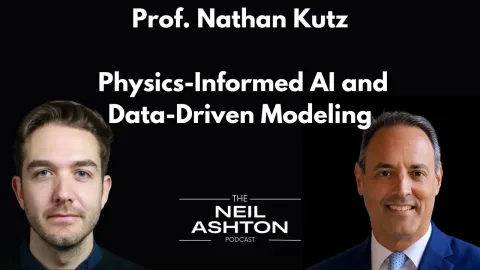
Prof. Nathan Kutz on Physics-Informed AI and Data-Driven Modeling
Watch on YouTube
Prof. Nathan Kutz on Physics-Informed AI and Data-Driven Modeling
YouTube video
Watch this episode
YouTube is contacted only after you choose to play the video, keeping this page fast and private by default.
Listen to the audio
Episode overview
Physics-informed AI, DMD, SINDy and data-driven engineering are the focus of this conversation with Professor J. Nathan Kutz, Director of Physics-Informed AI at Autodesk. Neil and Nathan trace machine learning’s evolution in engineering, the role of physics in trustworthy models, and the future of autonomous agents, design automation and human expertise.
Chapters
- 00:00 Podcast intro
- 00:40 Introduction to Episode
- 05:00 Welcoming Prof. Kutz
- 10:34 The Evolution of Data-Driven Modeling
- 16:13 Understanding the SINDy Algorithm and Its Implications
- 22:14 Comparing Reduced-Order Modeling and Modern Machine Learning
- 28:29 The Role of Data in Machine Learning and Physics
- 34:23 Challenges in Extrapolation and Real-World Applications
- 40:46 Insights from McLaren and Team Dynamics
- 46:07 The Shift from Academia to Industry
- 48:53 Collaboration and Innovation in Engineering
- 51:57 The Role of Human Expertise in Design
- 54:45 Leveraging AI in Formula One
- 57:32 The Future of AI and Workforce Dynamics
- 59:06 Navigating Career Choices in a Changing Landscape
- 01:03:02 The Evolution of Thought in Engineering
- 01:09:06 Preparing for the Future of Technology
- 01:14:04 Responsible Use of AI in Engineering
References and links
- Nathan Kutz doi.org
- Data assimilation and discrepancy modeling with shallow recurrent decoders — Yuxuan Bao, J. Nathan Kutz arxiv.org
- Discovering governing equations from data by sparse identification of nonlinear dynamical systems — Steven L. Brunton, Joshua L. Proctor, J. Nathan Kutz doi.org
- On Dynamic Mode Decomposition: Theory and Applications — Jonathan H. Tu, Clarence W. Rowley, Dirk M. Luchtenburg, Steven L. Brunton, J. Nathan Kutz doi.org
- Data-driven discovery of partial differential equations — Samuel H. Rudy, Steven L. Brunton, Joshua L. Proctor, J. Nathan Kutz doi.org
- Deep learning for universal linear embeddings of nonlinear dynamics — Bethany Lusch, J. Nathan Kutz, Steven L. Brunton doi.org
- arXiv 2605.15187 arxiv.org
- Articraft project page articraft3d.github.io
Transcript
This transcript was created from the corrected YouTube captions, with names and technical terminology reviewed. Download the corrected SRT file.
Hi, and welcome to the Neil Ashton Podcast. In each episode, we explained some of the fascinating ways that science and engineering are changing the world around us. We talked to leading engineers from elite level sports like cycling and Formula One to some of the world's top academics to understand how fluid dynamics, machine learning, supercomputing are bringing in a new era of discovery. We also hear some of their life stories, their career advice, the lessons they've learned on the way that I hope will be helpful to you too. So sit back and enjoy this episode. Hi, and welcome back to the Neil Ashton Podcast. So my guest today is Professor
Nathan Kutz, a true pioneer at the intersection of machine learning, dynamical systems and fluid mechanics. He, he's really been one of the household names in this field and has led to, has been part of many of the key sort of advances and now actually has moved on to play a key role at one of the major companies in the space at Autodesk Research. You know, he, he started his journey at University of Washington. So he earned a degree in physics and maths there in 1990 and then did a PhD at Northwestern University. He returned back to University of Washington and was the chair of the applied mathematics department and was also co- directing the AI Institute in
Dynamic Systems. He's probably best known for his work on the dynamic mode decomposition and DMD and also was a co-author with at his time, one of his postdocs, Steven Brunton on the SINDy sparse identification of non linear dynamics, which really was part of the breakthrough in the push in the mid-2010s, 2016. Well before machine learning for for science and engineering was was such a household thing and then such a you know, a key area. So that arguably they worked on it whilst it was still not clear how how important this space would be. And the work that they did really has proved to be a landmark paper. They also wrote a textbook Data-driven Science and
Engineering, and that was between Steve Brunton and and Nathan. But you know, and of course, many other papers, which we'll link to in the the show notes that that really has been influential in this field. One of the the reasons why he's so interesting is that he's isn't just sort of academic. He actually spent time sabbatical working alongside Formula One with the McLaren team. And we talk in this episode about how that was really influential for his thinking and trying to tackle the more industrial problems. And that ultimately led to him moving over and becoming the director of Physics-Informed AI at Autodesk Research.
And I found this conversation fascinating because we, we sort of went back and forth a little bit on some of the history and the differences between reduced order modelling and, and machine learning and then pivoted a lot to, you know, this, this, this question of is, can we just spend billions of dollars on data and, and will it all be good and we have some foundation model or do we really need to, to have some physics in there to make this more affordable and achievable and interpretable? We we also pivoted and talked quite a lot on the, the agents front and how we see those as being key to distilling knowledge from, from what is very expert driven processes.
You know, we were saying that it's not good enough just to have the access to a, to a highly efficient code to generate data or a, a great machine learning architecture. You need the human knowledge, the processes that often these companies had. And we said that distilling this into agents for those companies could really help them to move faster. And and we finished off looking more broadly at where the world's going with this sort of technology. One of the stand out things that he said, and I fully agree with him, is in this age, the need to think big is more important than ever. Things are moving so fast that actually having that mindset of
really challenging your own thinking is important. And then the final topic was really more career advice to to new people in this space and how they should deal with this changing world of AI and what they should be studying going forward. As with all these episodes, you know, I think we could have carried on for many hours. And I hope I have an opportunity to do that again with Nathan and speak back to him in a few years and see if some of the predictions were were correct. But I certainly learned a lot from this conversation, and I hope that you do too. So sit back and listen to this conversation with Professor
Nathan Kutz. Well, thank you, Nathan, for for coming on this. This has been on my sort of wish list to, to speak to you every time I talk about machine learning related to engineering, to CFD, to any of these problems. You know, your name is very high up the list, some seminal pieces of work and arguably you, you've been working on this way before. This was a sort of buzz word topic, you know, a sort of sexy area to get into. You know, where, where did you sort of start to get into this? What, what was your career trajectory? And when did you see this as like the missing piece to start using some of these machine
learning or reduced order techniques? Yeah, so I thanks for having me first of all, Neil to be here. I'm I'm excited to talk to you as well. And, and, and I would say that I, I, I suppose I got into it just out of pure interest in sort of a very accidental way. I was working when I started as a faculty late 90s, a while ago now. And that was the beginning of my career. I was working a lot in atomic and optical physics. So I was doing theory for mode-locked lasers, lots of computation, lots of modeling, integration of those two together, trying to work with experimentalists. And I really enjoyed that. But around the mid 2000s, what I found was I, I couldn't get
students interested in this stuff. Like a lot of the students just did not want to work on these, let's call them harder physics problems, right, where you had to know some quantum and E&M. They were very interested at the time in neuroscience, like that was the hot applied math fields that everybody wanted to do. And so around 2007, six and seven, I decided, you know, look, having a hard time getting students. I really like the work, but there's so many new interesting areas. And I also had a little bit of, I guess I'll just say it's an academic crisis. I think everybody goes through it a little bit where you kind of get a little bored with what
you're doing. You see that, yes, I could continue this for a long time in my career or I take the risk and do something really new. And of course, this is a little scary when you're more of a senior person because you know, like you're you're like a beginner again. I remember going to this neuroscience workshop where clearly every grad student in the room knew more than me about neuroscience. But they thought, this odd duck, who's like, well, he seems to know something like he's not just an illiterate science person, but on the other hand, doesn't seem to know much neuroscience. And then, you know, to put yourself in that, I would say a very vulnerable position was,
was kind of what I did. And I started actually in about 2006 seven to do neuroscience. And then also at that time seeing some of the data, I thought, hey, there's these data analysis methods. What if I started integrating that into sort of building models? And so that was really the, the initial part of that. I would say I got into sort of, let's call it broadly, maybe I wouldn't, maybe you wouldn't call it that now. It's actually the, the language around what machine learning is and deep, you know, it's, it's almost all deep learning now. Let's call, if you go back 2007 and eight, it wasn't neural networks yet, but I started using a lot of these
methodologies that came out of the data-driven piece. And really part of the incentive there was I saw that there was this great opportunity in neuroscience where we didn't have first principle models, right? Where you didn't have F equals MA, you didn't have a Maxwell's equations. You had data and neurons and people were making up models. And but you're also looking at trying to build models that, you know, populate population levels of neurons. And we just started building these data-driven models back in that time frame, 2007, 2008. And I thought it was awesome. I just really enjoyed the new direction. And then I kind of just pivoted
over to there and started working in data-driven modeling. I started to teach a class on it at the University of Washington. It was 2008. So it was very early on. And mostly I just did it because I, I liked it. I I didn't, I didn't see the what was coming in 10 years, right. I mean, it's, it's funny. You know, you can always brag and. Oh, I saw it. But I mean, really I just did it because I was interested and I thought it was very powerful. And I remember going to some of these optics conferences because I started doing this and I'm like, wait a minute, we can actually start doing some of this to model lasers. And I'd show up these optics conferences and they're like,
what is this stuff you're doing? Like there was like when you're talking about machine learning integration into the modeling pipeline at that point, it was it was so foreign to people. It was like this, you know, this guy's lost his marbles. He does really falling off the wagon in terms of he's way out there. And then, you know, you advance a decade and then everybody is using it, right. Yeah. I'd love to say I saw that, but I, I just did it because I liked it and turned out to be something that everybody started doing. So that was actually my journey into it. And then I built from there. And now I'm just in fear of
getting left behind because like these things, they, what they could do with, you know, is, is unbelievable. Like they work so much faster than I ever did in my whole career. That's funny. So how did you, I mean, obviously the IT looked like 2016 seventeen was like quite big time. Obviously with with Steve as well. Like what? How did, how did the years come up to that sort of seminal piece of work? Yeah. So I the academic year starting 2012 I had brought on Steve as my postdoc. He was at Princeton finishing up and I was very fortunate to get
somebody of that quality. Partly it was there was a 2 body problem. So I, I jointly hired Bing, his wife with Tom Daniel over in biology and myself as we are. I didn't have enough money for two postdocs out of money for 1 1/2. So I put half for Bing and got Tom to do another half and then hired Steve on. And at that time I was already doing some of the data-driven modeling, especially things like dynamic mode decomposition. I had started working on already in 2012/2013. And so already was this regression framework towards thinking about dynamical systems and, and, and then it just turned out that it was just the perfect timing with Steve and
with an amazing group of graduate students and post docs and also a little bit more open space. You know, back then it wasn't sort of nowadays it's almost like there's just so many people working in this area that it's hard to gain any room. But back then it was still pretty early on in the sciences. You know, we have ImageNet, right 2014 that hadn't quite made its transition over to the sciences. I think that would more like 2018, '19, '20 like where they were really getting into it. So we were early on had some free space there and also had less rules I guess. And we just started doing some stuff there. And I think obviously SINDy came
out of that time period and some PDE-FIND, there's the dynamic mode decomposition work and then tying all that together with what was happening also in reduced order modeling. So it just was a really fantastic time. And then Steve then took a faculty position there in mechanical engineering and then we continue to have a really great partnership with our students and postdocs. And it was incredibly productive in terms of starting to build, you know, these data-driven models and trying to bring in machine learning overall into the standard dynamical systems framework. So maybe for people who are not so familiar, how would you, how would you describe SINDy and the
sort of POD methods? You know what, what was the what was the core aim or thing that you were trying to solve? Yeah. So I think, I think there's there's two different aspects here. So, so I always think about physics as sort of, if you go back to like every engineer, they got sort of a classic except for computer scientists. If you want to consider them engineers, let's they're a little different brand of engineer, but almost every other engineer had to take statics and dynamics. And then statics and dynamics. There was only one thing you really did, which is you drew a free body diagram. And then once you drew the right
free body diagram, that was really almost every homework set was just draw the right free body diagram. Because once you draw the right free body diagram, you could actually either sum of forces equals 0, that's statics sum of forces equals not 0. But if you didn't draw the right free body diagram, it was going to be a really hard solve. And the way I think about that in context of what we are trying to do, like even with POD or these, you know, even what we do now with encoders is can I find the right representation or the right coordinate system in which to express my dynamics? And so, so that was already sort of a philosophical idea of like,
hey, we have all this data, you know, it's high dimensional, it looks crazy. But at the end of the day that we can find these some kind of embedding where it's actually looks kind of simple maybe, right. But then what's happening in that space is now you have to have some kind of dynamical system relationships. And so the SINDy part really comes from this idea that if we look at our physics models, all the physics models that we have are really essentially expressions of relationships among derivatives, time and space, right? And it's in most remarkable compression of knowledge that we, I think we have ever developed as humans, right?
You know, you write down Maxwell's equations. You have this, you fit it on the T-shirt, right? You can order online on Amazon this afternoon, you get it right. And you have those Maxwell's equations on your T-shirt. And what's amazing about it is it models, you know, all of our Wi-Fi signals like coming, you know, radar, you know, radio waves, the diversity of what you're modeling in this compact representation, which is, is astounding. Same thing with how we are able to get, you know, when think about quantum mechanics, it's like, you know, 3 terms, right? You have your dispersion term, your potential and, and your time derivative.
And it's, so I think the motivation for SINDy was this idea that we've had tremendous success in history with these compact representations of relationships among derivatives. And so the SINDy algorithm goes directly after that says, well, there's lots of derivatives and derivatives relationships. When you look at this data, how few of these derivative relationships can you use that actually fit the data? And that's where this idea of having a library of potential candidates and, and then sparsely regressed to just a few terms came out of. And it's kind of a philosophical
thing. So I think like physicists like this idea. It's not clear that computer scientists like this idea. Like computer scientists might, I've heard this directly. They feel like, well, that's your, that's your 20th century crutch of physics. Like, that's because that's what, you know what, let's let the computer figure out. Right. So it's still a tension point, but as we talk further about some of the where physics AI is going, I think one of the things that's really incredibly valuable to consider is that governing equations so far, I, I, I think this is true. I mean, it's hard to, you know, these are statements and of
opinions, I guess. But, but really historically, we can see that they've been the most incredible engines of extrapolation in predictions where I've never had data about something that might happen. You know, if I go over there in parameter space, my model predicts like this bifurcation, like the change of the system. And then you can start doing an experiment over there and validate that, right? Whereas machine learning, it's very difficult to predict outside of if you don't have data there, like you're just not going to get it right. So governing equations still, at least in my heart, hold massive value because of this
extrapolation capability that we, I think are going to still need in the future. Yeah, that that's a very good transition point, I guess. Well, first of all, I'd be interested to how you would describe before we get on to the maybe today's debate on machine learning methods and surrogates and, you know, the influence of physics versus data-driven, some more skeptics, you know, we'll, we'll sort of say, ah, this whole buzz now about machine. It's just basically reduced order modelling. We've been doing it, you know, for for ages. How would you define the differences and the similarities between sort of those earlier
reduced order modelling sort of techniques and today with the more sort of transformer based neural networks, what we would call sort of machine learning in a very broad term? Yeah, so early days of reduced order modeling, I think there was still this idea that these POD modes, you know you do the SVD, you have these structures that come out. I think it's still allowed for some flexibility in the idea of an of interpretation, right. So you you would have things that were coming out that you would argue made sense, like so for instance even. POD modes of flow around the cylinder, you look at it and go like I can explain what that is
and and there was something very comforting about that like to have sort of in some sense a basis. And so I think for us, if you look at the 20th century applied math literature and what the impact was, we did a lot of expansions and bases or a transform was a workhorse. We could say look in signal processing, right? Like just do a Fourier transform process everything in the signal domain come back. And we had this idea of interpretability built in because we kind of knew what cosines and sines were. We followed that up even with wavelets. So we and even special functions which were sort of like in mathematical physics, the
foundation of the 1950s and 60s for doing analysis of systems, it was this idea that there is a basis functions. In other words, again, I would call this a nice coordinate system that's sort of interpretable to you. So you can project everything into this, do your work in there, you feel comfortable with it because it's you interpret it and then you can come back and do your and your analysis. And by the way, we're very successful with this, right? And largely we constrained ourselves in the Fifties, 60s and 70s, even up to the 80s to linear problems, because then we could use superposition, we could have solutions which were
linear combinations of these things. And then I think at the end of the 80s, of course, in the early 90s, we had the first computational revolution, which was, oh, I could just throw that PDE on the computer and discretize and start simulating. And so, so I feel like when I went to grad school, I was in grad school in 1990 to 94 and I feel like I was the first generation where there was an expectation you're going to simulate PDEs and ODEs in your thesis somewhere. At that point we had now, you know, desktop computers in the lab. It wasn't like there's some central computer, a DEC machine somewhere in a court, you know, that you run jobs on.
This is now like, oh, it's just sitting here in the office and you're interacting and programming with it. And so for the first time, we are actually starting able to solve nonlinear PDEs because we could just numerically simulate them. And of course, it's very interesting because I think the faculty back then were like, you know, these kids, they don't know what they're doing, understand physics yet they're doing, you know, they're claiming all this stuff. And, and of course, it's sort of true, right, because they were used to solving things, really understanding the problem at some fundamental level and especially doing lots of asymptotic reductions in two
corners of parameter space where you could linearize and say quite a bit, right? That's, that's almost the whole fluid mechanics mantra. It's like, look over here, we have JFM to tell us what's going over there on, right? But then we had that simulation capability and then and then we start saying, OK, but so we still had some interpretation like I'm expanding in Fourier basis or I'm doing finite differences, finite elements. And then, and then from there, from those simulations, then we started a new basis, which was the POD, right? Which is like, oh, let's just build basis directly from the SVD. So we still felt it was very morally equivalent to what we
were kind of doing for. And then the, the transformation now is sometimes it's just really hard to get your head around what happened in this thing. Like I transformer and then I have an attention layer and I got right, I got, I got this decoder that's then being modulate. I mean, right. We, we could see some of the sophistication and some of the, some of the structures are kind of simple, but more and more they're becoming fairly complex and it's really hard for us to decipher what's happening there. But you can't argue often with how well it works, right? You get the results and you're going like, yeah, but I can't beat this.
So I have to, you know, I want to use it. And by the way, I started to appreciate computer scientists a little bit, quite a bit. Because at first, you know, I was like that old grumpy professor, which is like these computer science kids, they don't know any physics. They just go do stuff and they get a, they get a score and they got a cross validation score and they move on with their lives, right. The flip side now is I have grown to absolutely love the fearlessness of a, you're a science grad student. They just like try stuff not encumbered by all this physics knowledge. Like, you know, like if I look at this typical physics student
or engineering or applied math, they kind of are, they're prejudiced by their what they learned. So they're like, they would try to make smart things structures, whereas the computer scientists are just like, just try stuff. What if we did this? What if we did this? And and that fearlessness has led them to unbelievable results. And I think it's going to be left to the applied mathematicians and engineers and theory people to kind of pick up the pieces to try to understand. OK, but what did you what OK in here? I we can now got to dissect this to see what you actually learned here, because somehow it is working. I'm going to give you credit for that.
But I'd really love to understand what this thing's actually learning about the physics, right? And that and I think that's kind of what big next steps that's going to happen in the community. So you'd say almost the and I've I've heard similar things. The interpretability is the key bit like how does this work? Why does it work? What is it that is the knob that has changed that you know, how do you do? And I guess like you say, it's all good when it works, but when it doesn't work, it's like why didn't it work is the question. Yeah. And at least in our standard physics modelling, right, we always had some recourse to like
there was just a few parameters we could sort of, we could actually diagnose why it broke or, or, or went through a bifurcation or there was a transition. Like we had a way understanding what would might happen where in these things. It's a little bit like, I don't know what kind of car you drive, but like when something breaks there, you just automatically have to go to a mechanic because he's caught. The cars are so complex now that you have to have specialist fix it where, you know, I think, you know, when I was a kid, I think there's a lot of people that fix their own cars, right? It was a little bit more interpretable what was happening in that engine.
But now it's like, no, no, no, that everything's run off a bunch of electronic components with all these different pieces. And I think of it like that, like that. And when they break, you just have no idea and started fixing it. Maybe you just train another neural network or the different structure that doesn't break there. Yeah, Yeah, Yeah. I mean, how, how do you see then today because that that just seemed to be the challenge of our time, doesn't it that you are, I mean, I guess out of distribution versus in distribution the train on a bunch of cars. Is it, is it just the case that that is a essentially not unsolvable, but a problem that can only really be addressed
just by having more data that makes that out of distribution in distribution. And so the solution is just keep building bigger and bigger models with more and more data? Or do you feel that that is essentially inefficient and and not a scalable method and therefore you need some ability to, as you say you know, use some modeling knowledge or physics knowledge to be able to model past the data? Yeah, I OK, so this question is hard to answer for, for for one reason, which is not scientific at all, which is just money. When you look at this product, you know, Project Prometheus for
instance, that Bezos is involved with and you look at their what 6.2 billion. Now at some point you ask questions like it's OK, even now being at Autodesk. So first of all, let's if I, if I go back to when I was a faculty, the ability to get data like really say we need to collect this data. It's like, oh, wait, you're going to have to write some massive grants. There's probably almost no way you're going to get the kind of grant levels you need to collect the data you would need. So you have, you're already constrained saying I've got to outsmart this and got to figure out how to do this. Now you move to a company and now I'm at Autodesk.
But even then you're like, yeah, but you it's, it's not clear. There's a few companies, there's a there's the trillion dollar companies, right? That potentially, if they desire to do so, could potentially set up the architecture to just collect the data, spend the billions to do things like this and and do that. Now, that's a brute force approach, but I think the win is so big that they might just say, yeah, we could spend $10 billion because it's going to make us a trillion. Like very few places that can do it. Like, but even Project Prometheus might have the kind of cash resources because my normal answer would be like, it is completely, I think,
intractable to get the kind of data we need to do something with the science problems we need. But when you have 6.2 billion, right, and maybe more, I don't know, like maybe you go like, you know, we can do it. Like we're going to spend $3 billion to collect the data, right? That's higher investment in the in the data. It isn't is that money is to get the data and then now we can build whatever the foundation model we need or so. So that one, I think the jury's still out. I so, you know, it goes right back to, you know, Richard Sutton's right, the the bitter lesson issue, which is so Sutton, I think is right. If you have enough data, right, you really, if you can collect
enough data in an area, it's so far what we've seen, it's almost these machine learning, deep learning algorithms and structures are, are basically unbeatable. But the question is, can you really do this? I, I love also Max Welling wrote a response to this, which was well, yeah. But a lot of times what we're trying to do scientifically is extrapolate. We're trying to build a new technology. So even if I collect all this data, the the goal is to give me a great direction of like actually, I think the future technologies over there, I'd have no data there Now. Maybe I could set up a pipeline, have enough money to to build
the scaffolding for the data to collect on the way out there. But, you know, this is what I learned in my time at McLaren too, is the answer. The fast car is an extrapolation that's far away from where you're starting. Actually, far away is a little bit of exaggeration. Tenths of second. Yeah, well, it feels far away when you're trying to like, you know, the difference between winning the world title. Like, you know, which McLaren did while I was the time I was there, they were like had them MCL38/39, which were winners. You know, you're, you're working at the margins of these updates, they're trying to get you 2/10
of a second, a 10th of a second, 3/10 of a second. But you're also going into a regime that there is no data. I have to actually get this data from simulations, do some wind tunnel to validate that it's there. So that, so whether that's viable, you know, they have $150 million a year budget. I don't know, whatever the cap is, it's a little bit higher than that. Now on that budget, there's no way you could do this, right? Just collect just money there to collect the data you'd need. So, so it's, it's, it's a really interesting question. I, I, there's a group of people that fundamentally feel I will just spend so much money to collect the data so that I can
make it just like language. But physics isn't I physics isn't language either. So if it, so there's still a bit here that we have to figure out. So my own personal belief is, or at least what I'm going to do is embed physics type knowledge into these neural networks so we can do this much more efficiently anyway. Yeah, no, I I've had this, you know, debate many time and you know, that was part of the reason for doing that paper with Johannes and Sid was to try and like try and project out some of this economies of things. But we still, I think even writing that paper, we, we still got to the end. And you know, I can't, I can't
speak to the others, but at least for myself, we still didn't really resolve the fundamental challenge, which is even with all the predictions we made, they weren't reaching the accuracy that was necessarily required. And the some of that accuracy is very deep within the domain knowledge of those companies. And so a Formula One team would argue that they are the only ones who deeply know how to, you know, set up a a case and get it to give the right accuracy. If you just brute force even take an LES model and try and run it even with something like a billion cells, you could quite easily get it very wrong, very wrong.
And even if you gave it 10 billion doesn't actually, but you know you'd you almost then have to extrapolate it all the way to the end, which is to do a complete DNS or something. But then what if you don't know the porosity values of the radiator that they're using? So this I kind of feel that in one sense I agree with you that this does feel a little bit like just a data issue and then, you know, a bit like ChatGPT and others to show that, you know, just put a lot of money behind something you can solve it. But that I guess the difference I would say, which is why I think I would agree more with your approach is it makes sense when the opportunity of the
market is trillions of dollars, which is basically enterprise AI, but CFD, I don't think it's a trillion dollar market. It's probably more than the 10s of billions maybe. So if you spend 10s of billions that makes you assume that you can take the entire market, which you know so from a like return on investment that to me is a harder like balance. Well, and, and it's also interesting for like for some of these companies, we need to do science. And I think you hit on such a critical issue, which is this idea of tolerances. There's you're always going to have to have, I think, recourse to a physical manifestation of
what you're doing. Because if you're if OK. So think about world models a little bit, right? They're just fakes. They look cool. But you know, people who build world models, no lives are dependent upon it. It's not like by going here I could I could die, But if you have these people develop in the world model, I want you to design an airplane for me. Like there's no way I'm getting on that airplane. So there's there's there's sort of these zero failure environments where the tight tolerance is absolutely king. And even I think Bezos is quite interested in this. You know, again, I'm just throwing out this project Prometheus, because I'm just the, the staggering amount of
money that's been invested in it in the space. But you know, he's interested in space travel and rockets and you're like, OK, so those are 0 failure environments. And I, you know, when, when a prompt goes bad like on ChatGPT or Gemini or Claude, nobody gets hurt, right? Really. I mean, at the end of the day, it's like, Oh, it didn't quite get the I didn't die cause of it. But like when you're going to do something like a rocket, right, where people's lives are at stake and you have to have the tolerances or else it's going to that's where I think there's just such a an amazing pressure, right, to get this right. And and it's not clear to me how
AI does that, right. It could be that agentic systems will learn how to do like that's. I think we can certainly program. I think agentic systems to say now that I got most the answer right, my agents are all about doing the tolerance checking and figuring out what experiments have to be run. Because in my view, I think really what happens is I think the agentic system should come back to you and say, hey, Neil, we need to do some experiments because right now I'm starting to hallucinate or at least I'm uncertain my models. And of course it they're not going to actually talk to you. They're going to actually talk to their robot friends and say,
can you do this experiment? Yeah, The kind of result, you know, I need you to do it under these kind of load conditions. So they can, once I get that back, I can proceed along with my iteration. So I think, I think that's going to be key for us somewhere along the way, right. But this tolerance idea is we still don't have a proof of, and it's not good enough. Just have a world model that looks cool and looks right. Yeah, that's, yeah. I think that's fundamentally the also I guess the practical challenge of this where I feel probably individual companies will, will still play more of a role in this. You know, if you're a large aircraft manufacturer, I would
imagine that at least in the, you know, short to medium term, you're going to be the one that is most likely using some of your data to be fine-tuned this or, or you'll be still do it. You know, it's, it's, I don't think you completely outsource this to, to A, to a separate, you know, entity that that's feels, although you raise interesting point of experimental data because I think that's probably often overlooked that the, I guess the analogy, all the simulation is just synthetic data and it's not actually the ground truth, which is why I always struggle with initiatives to, you know, if I train a machine learning model, we've had this debate, I'd be
interested to know your thought. So if we take like a standard data set and the goal of the exercise is that your surrogate model should be able to predict the ground truth and whoever gets it the closest gets the highest score and wins. But that. Has a certain ground truth baked into it because it was done with a RANS model and LES model. So if someone comes along who's trained this big foundation and then they try and predict your case, they could actually have a worse score because their method was trained on the different underlying simulation data. But then which one's right? Because you've never actually said what's the ground truth?
The like the real world truth, you know? Yeah. Well, actually I I think this is also one of the very difficult and fundamental challenges in science and engineering We are right now using the ground truth is my simulation often like when we test our methods, you know, including us, you know, it's like, how will this method work? Well, I'll pretend the truth is my simulator. The problem I see is that we say, OK, well, what if you had the experiment? Well, in experiments we actually can never also have access to the ground truth because in an experiment you have sensors or either point sensors or you're measuring some observables, but you never have the full state
information like you do in the simulation. So this idea of a ground truth is really interesting because you never have it in real systems. You have you have some manifestations of of measurements of that ground truth through your sensors, your full state knowledge is only through the in a simulation world. And how this connection of how do you assimilate those two together becomes now very important. And so somehow this, you know, the whole data simulation effort and we've seen the success of it and whether right. So a lot of companies have gotten into it because I think they, they benefited from basically the idea that like we've been collecting weather
model weather data for like decades upon decades, very well resolved. And so they, they can train these big models and a lot of the people working that space like look what we can do with machine learning. It's like you understand you're in a very not representative scientific field, but for 40 years, 50 years, we've been collecting data ad nauseam in this space and that's why your models work whereas and most other scientific fields, it's just not there. Or as you've pointed out, a lot of a lot of people guard their data closely. Like if you're for Formula One team, you don't share your simulation data. If you're a car company, you
typically don't share your simulation data. People don't share their supply chain data like there. There's just so much data that is there, but nobody shares it. So we have that. It's kind of off limits a little bit. Which is quite I've often joked that probably the best company to make a foundation model for automotive is an automotive company. You know, frankly, if I was a car company, I'd be half tempted if I, you know, if I wasn't worried more about the car situation at the moment. I guess that's not their priority to build a foundation model. But like, you know, that's the ironic thing. They've got all the expertise, all the data, all the knowledge,
all the facilities and they literally have it sat there, wind tunnel probably running 24/7. Every all the, the stuff that, you know, a startup would dream of having, they actually have there. So it's yeah on that. What about your time at McLaren then? What? What I guess you must be into cars to, to also, you know, want to do that. But what did it teach you going from, you know, being a faculty member to taking that time at McLaren? How did it shape your thinking? Yeah, so, so first I was, it was such a privilege to be there. I I've been a Formula One fan since I was a little kid, so I'm half Brazilian. So in the 1970s, growing up a
kid in Brazil, Emerson Fittipaldi was a Formula One champion. So every Brazilian loved Fittipaldi. But then I started watching in high school, in the first Formula One race I watched was a Ayrton Senna, and I was just some Sunday morning early. I started watching this race. It was on ESPN and there was this young Brazilian kid. Ayrton Senna won that race and I just became a super fan of Senna. And, and you know, of course then I'd loved McLaren because he was a three time champion with McLaren. And so I, I, I was a Formula One fan from the early days. And so I was on a sabbatical here in London and, and I thought, you know, what, if I can connect up there.
And the awesome thing is a Spencer Sherwin who is at Imperial College in aerospace engineering, one of his former PhD students is head of CFD, Julien Hoessler. So it's just he connected me and then I was was out there and it taught me two things. Two really big take home messages that happened for me at McLaren that actually shaped part of why I even came to London to come to Autodesk number one. And this was really memorable. And it's, it's almost sad to say a little bit, but they were a team, they worked together. They had a common objective. You could talk to anybody from the person making coffee to the cafeteria people to head of
engineering to the the brand new engineer, everybody knew and had a shared common goal. And we're really working together to that goal. And it's interesting coming from the academic environment, which is, yes, we're collaborative, but really we are ultra selfish in our, in our structure, right? And I, I love that I loved being around these people who wanted to do great work, who had a shared vision. That doesn't mean people didn't have, I'm not saying that everything was, you know, perfect, but I'm but that was felt to me so much healthier than what I've been in for
decades. So that was the so that that that really stuck with me. I have to say it was a really, it was a really and, and just to for my own self reflection about like, Oh, I didn't even realize how much of A world I live in of self centeredness. So. That is the negative part of academia, isn't it? I mean, you know that sort of I always, I guess the best description I give, it feels like every professor is running their own startup or their own, you know, because it's very like people often call it something lab or some, you know, it's, it's and I guess at worse, you know, good luck being a head of department or a faculty. It's like all rivals going after
each other, challenging for funding. I guess in the best scenario, it's an amazing cross collaborative environment of of of of people. But yeah, I, I see what you mean. There's a certain. I think I was very collaborative and I was very friendly across and worked with lots of people. But it's still was this very much like I still have to get my grant. Yeah. And I still have to take care of my students and, and this was just kind of refreshing, but there was this piece there. And then the thing that I came there, I was like, oh, you know, I've been doing reduced order models. I'm super excited about this to do things.
But really the big goal there was to update shape of the car. And then you just ask a very simple question. Here's a, a mesh, which is this car, which is, let's call it a billion parameter mesh. How do you how do you do gradient descent updates on a three-dimensional mesh? And then I just saw that what you had there was a group of experts. And so it was human gradient descent, like true knowledge base of people who had long time experience understanding the flow physics off the front wing, the back wing, the underside, the side pods who were making collectively a decision about like what's the next upgrade of the shape that we try and even understanding when they felt
like we have to go to the wind tunnel with this design, the wind tunnel is very expensive. We get very limited time. But this recourse to reality that would sort of pin them their designs down or actually invalidate them, right? It was really interesting to see this and I felt honestly, I guess I felt super like, I feel like I come in, I got this, you know, tool set and I felt powerless a little bit, which is here is this inverse design problem can't help with and and it really stuck with me afterwards. Like, how do I get into this geometry regime and understand how to handle geometry in a much better way? And that, you know, how do I get a latent representation of
geometry to do updates? And so, you know, when Autodesk came along, it was like, wait a minute, this, this is the most, this is probably one of the best geometry companies in the world and do this design. And so it felt a very natural thing to come over because it was intellectually for me was one of the main things I wanted to go after. And I felt like if I try to do it in the academic environment, this pivot towards trying to generate all the skill set around geometry would take me a decade, right, to get like really there. Whereas coming to Autodesk was like, I immediately came into a group of colleagues who were
they, you know, live and breathe this stuff. So it's like, amazing. So those are the two things that McLaren that really stuck out to me and and also maybe the third was just to walk into this McLaren tech center where. Quite nice. Very nice and also just to see like, you know, we rarely as an academics also see that, you know, by the time we write a paper, it's a year till it gets public. Like there's there's no here on this factory floor. What every, all these engineers could see was I've helped build this thing and it's right there. It's like this physical manifestation of beauty. And it's like a gallery, an art gallery, right?
You're like, Oh my gosh, this is the. And even to see Senna's car, his MP4/4 from when he, I think his first championship, it's like it's, it's so motivating, right, To have that creative inspiration that's there. Yeah. Yeah, I know. It's I, I find that was my experience coming into Formula One and I've seen almost exactly the same thing. And I, I think almost every start up that comes in trying to sell into an F1 team faces the same reality that they all think, oh, surely, you know, you, you just need to do this or, or you know, like you need to use this better turbulence model or you need to do this surrogate model.
And yeah, you realize that This is why I always say about foundation models or something that the idea that you come in and you would use a method to come up with a brand new design from scratch. In reality, they already know what needs to be done and it's tweaking the most fine things that is often very is never usually tested. It's usually like a, a big thing, isn't it? Like the delta between this and this and you're looking for the difference of, you know, 2 drag counts or something. It's, yeah, I've often found it quite humbling when you go in there thinking you can make a difference and then you're like, oh, this is already pretty well optimized.
And also to see these people who have put in the time and effort and have the passion and they have that special skill set, like I know how to squeeze out a delta here in these manipulations. That sort of are the the the way I almost think about it is if we think about what AI is largely trained on, RMSE. RMSE is sort of a blunt instrument. It's sort of this, it's sort of I got all the big scale stuff for you, right. But the winning race car is about all the fine details and promoting these in the loss function. Somehow, you know, this thinks I, you know, you can see that neural networks act act as bandpass filters essentially. Like I got the big stuff right.
All the small stuff doesn't really contribute to that RMSE score. So like, whatever, we'll throw it out. Now, of course we can make efforts to, you know, put a diffusion model down there or something like this to try to like fill in in so it makes it look right. But the this attention to small detail which a human can make the focus, maybe we teach our neural networks to do this, but like in their general deployment that's is not really, you know, these little micro adjustments are so fine detail, they don't score in a training score hardly. Now that is where they'll like do think the agents I am far more bullish on because I feel
like with the greatest respect to the Formula One engineers, what they're doing is, is still something that is just you can describe what they do and and actually, I think if you look across the grid, my hypothesis of why is one team, you know, one year amazing and then another year it's not, you know, like if they really understood everything that's needed to be done, surely they would just each year build too great. The fact that they take wrong turns, they go down the wrong direction. They have a a very large optimization space that once you start going down a route, you can't really turn back and you sort of have to go.
And I do feel that it is still a very large optimization problem that a machine could ultimately do better than a human in in theory with ultimate resources. But. Yeah, yeah. So if if I was, if I was in somehow in charge of some version of some formula that one team and sort of as a let's say call it iOS, I'm the AI director of of some form on team. What I think I would be doing, and I'm also bullish on the agent piece of this. I would be setting up extensive interviews with all of my experienced engineers. Like how are they making their decision? So you made this decision. Why I want you to verbalize it. Why did you make decision?
What do you see in the data? Because a lot of the experiential learning that these, you know, master engineers have, they have a pipeline. It's just they haven't maybe verbalized it. And if you could pull that out and you say my agent's going to try to take on your persona the way you think, but it needs to be trained in the way you think, the way you're making your decision points, I actually think that is a viable way forward. And that could accelerate things significantly. And so the downloading of experience of people, somehow some next step that needs to happen in it. And it could be that these people have never thought about like deeply about what was my
algorithm if I had to, if I have to write down what I do and when I'm looking at the car. And because it's actually interesting, when you look at McLaren, you can walk up and down this pit of engineers. And then when you're down on the design aero side, you see basically people have the double screen like they do at every tech company and what they're got pictures on there is flow physics. And these guys are just studying this all day long to make their decisions. But if you could understand, if they could verbalize what they're doing in that study, you know what machine could do it Like, and just like, OK, I did
in five seconds. What you all morning looking at here at 5 seconds later. Here's here's here's the assessment. Yes. If you don't know what they're looking at, it's really hard for the agent to to know that, right. The only thing on that and then, and I want to go too down a rabbit hole on this one, but is if I was an experienced F1 engineer who's done it for 20 years, I'd almost want to, you know, copyright my skills.md or something or, or monetize it. Because, you know, as you could imagine, like once that person's described F1 process and you put it into some skills file or whatever, and then the team goes, right, well, thank you
very much. The agent actually now runs much faster than you can. So, you know, see you later. I do often want, because I completely agree with you, this human knowledge can be extracted, you know, because it is often quite repeatable. But I, I think it's an interesting, you know, if someone's creating a startup of like, you know, I, I'm going to monetize my knowledge and yeah, use me as an agent, but I need some money out of it because. Yeah. So this is actually, I think this, this argument is one of the most amazing, I think things we're going to have to deal with overall in the tech community. Even, you know, here at Autodesk, they're in America,
which is OK. So if these agents are so effective and we can program them to be effective, if you're a Formula One team, do you say like, if I can do this, I could shrink my workforce or do you go the other ways with my workforce, I can 10X the number of designs I'm doing. Going through like this is a really interesting point for us. Like a company like here we say like, well, hey, you know, essentially one person can do now 10X the work they used to be able to. Well, guess what, we could take 10X customers. Yeah, yeah. Or we could cut the company down by 10. Yeah. So. I, I suspect it will probably be more that you'll just be able to
do more, you know, with the, with the, the staff that you have. I I, I suspect so that's my gut feeling because whenever we've had more, you know, your HPC facility can now run your cases twice as fast or the code can run. But normally it's been that, OK, great. Now you just have to do double the amount of work or you do twice as many simulations or you do whatever. But I, yeah, I definitely think that is a, an interesting one. The question for you on Autodesk, do you have any regrets? You didn't go into industry earlier on, like now that you're there, is there any? Yeah. Yeah, actually not so much. I mean, I, I, I actually, I
think this is just a perfect time in life for me to come here at this point. But I, I, I think that, I mean, I guess in some sense I haven't been so money motivated overall, career wise. I think obviously could have gone into a tech company in Seattle much earlier. Like you pick one, they're all there. There wasn't I, I, I was more interested in doing really interesting work if I could. Autodesk kind of like I said, was a confluence of the right time intellectually. Like I said, I wanted to really think about how can I handle geometry and physics jointly? How does geometry induce
physics, right? I was just so fascinated after that McLaren year that. So it was, it was the right time intellectually for me to come to to Autodesk and I'm very happy with it now. But I don't regret my time at UW. I think that was found, you know, what I learned there and the students I had, I loved my students, my postdocs, my collaborators. It's just, it's just a good time in life. And also my kids graduated from high school, so I didn't have to try to live in a good school district in London. Me and my wife could just say, where do we want to live? I went off to worry about like all this kids stuff, right? Which you know, which is, you know, I went through that
already. I'm done. So. So where's the future lie then? Where? Where do you see if we could put a looking glass? And we skipped forward in five years and you and I talk again. Hopefully it's somewhere like Barcelona or some nice, you know, some nice location. Well, where? Where do you think we'll be? Yeah. So the first thing that I think is going to happen sooner than later is people aren't going to put out GitHub code. They're going to put out GitHub agents. I'm just using that language. Like, you know, right now you say like, hey, I wrote this code you can download on GitHub. It's like, no, no, you're just going to give me access to your agent that manages all of that,
right? So it feels to me like this agentic push is quite a real thing. Like even programming on a higher level, like with a something like Cline, just in terms of the workflow. Instead of me starting to just run your code, I just, I'm interacting with your agent, with your code. I think that's one thing that is bound to happen. I, I, maybe I'm wrong, but I, I kind of feel like that's right. That's just the such a clean pathway for people to share code as you're sharing the agent. So it's not like it's just like you're saying, here's my code and the grad student that wrote it on. So if you have any questions, they can answer all of it because they built this code.
But it's like agentic part, the agentic part of that. No Second, I, I just feel like we're going to have like this ability to deploy so many of these agents and partnerships that we're going to be able to come up with. I, I think we're going to have much bigger thoughts than we've had in the past. Because in a lot of our future thinking, we don't just think, what if we did this? We also have to balance it. Like, yeah, but what could I actually maybe do if I stretch? But now what you could do with you stretch is it's it's so much bigger. So I think our I think about our goal setting capabilities now in
terms of where do. And I think I'm still trying to get my head around that now because I'm trying to also train myself to think much bigger thoughts about what we could achieve given the tools that have just just even in one year have emerged. Like one year alone has all of a sudden give you gives you this transformational ability. And the hard part about making these projections into the future is that right now, you don't know, like if someone's going to all of a sudden pop something out and like one month, by the way, here's this new tool, check it out. And it's like, Oh my gosh, which is everything, right? Like this is starting to happen even in design space.
So I'll promote a paper that these these guys wrote from sort of a largely Oxford-Cambridge collaboration called Articraft. Maybe you saw this one. This is just this generative design with articulated engineering products and it's just like this fascinating thing that they were able to build out and you're like, OK, I didn't think this was this was a cry. Like incredible that they achieved it, right. And it just feels like, So what people are able to achieve sometimes is beyond what I like, like I'm not imagining big enough. Frankly, it is. I think that's my the the take home message for myself in this last year is like I've got to be
much more grand scoped in my imagination about what could be. And it's also part of what I'm stealing with our team is like, we need to think a lot bigger. Yes, some things I I would I mean that's been probably one of the things that I've enjoyed being NVIDIA is it's a company that, you know, obviously thanks to the guy the top Jensen, you know, tends to think quite big and it is quite infectious. You know, you do start to now, of course, that's going to be based on delivery, you know, that you can deliver it and it has to have some reality. But I think, yeah, thinking big is probably something that in some ways academia is good at doing.
But I feel like to your earlier point is also one where we're quite quick to shut things down, you know, especially the review process and the sort of there is a little bit of a skepticism or so, you know, whereas probably the tech world is more willing to like, which is I guess why all startups come about. And, and yeah, so I I would, I would tend to agree with you that thinking big is actually a requirement at the moment given how fast things are moving. Yeah. And and also I, I, I think that academics used to have some of the bigger thought life, I guess I would say. And there's still some truth to that, but at least in our
fields, it's not clear they have the resources now. Well, that's. To, to go after, and this is partly the success, what I've seen of the computer science crowd is if you really look at some of the big pushes and some of the academics involved, it's because they've been in partnerships with resource rich companies like Google, like Meta, like NVIDIA, where it's like, like if they were just sitting at Stanford, like I have my friends there, Ali's lab. One of my grad students is going to go there for a postdoc and I'm super excited. I was like, you know, it's like, if you want to do something interesting there, it's pretty
easy to reach out and I think have these people partnering with you to do big scale work. Like if you were just there like me and you have to write a grant to get a little machine that like can only do a fraction of it, like, but now they can they can really work with in this environment to do great things. So yeah, I, I think right now industry is favored in terms of transformational parts. And because the resources are there to do things, I think the pressure on industry is to get the right partnerships with academic people, right and vice versa. Like so if you I think that
still a really great strategy is that, you know, even here at Autodesk, I have definitely am reaching out to people that I think are really valuable and making connections. So I'm valuable to them now sitting on the industry side, they're valuable to me sitting on sort of the intellectual thought life side. But the partnership is fantastic because everybody really wins in it, yes. And so that's, that's I think a a really important place to go forward to. Yeah, No, I I agree with you that the I should probably should rephrase what I said before. It's true academia can have big thoughts, but because they know they don't have the resources,
it's almost like, well, that's a nice forward, but I'm never going to be able to do it. So what can I actually achieve and get a paper out and, you know, get this funding in? So they then have to think smaller, whereas you're right, if you're a, you know, a big tech company, you can be a bit bolder. So the when the two come together, you get the best, I guess. So maybe as a final question for you, and we touched upon it a little bit, if you're, we have, let's say, some students listening now, whether they're undergraduates or PhDs, it's a tricky time, right? You know, what would you recommend that they would focus, let's say, a PhD on or what
should they study to be relevant in the next sort of five years of this wave of transformation? Yeah, so my first thing I tell them is they're living, I think in one of the most exciting times in human history because I think this this time, the future generations, they'll pinpoint this period of time is like the world changed. And this is massively influential about what what it means for us as humanity right now. This is and to be part of it. I mean, it doesn't mean it has a good ending. Whatever. I'm I'm just saying that you but they are part of the they are part of the puzzle piece in there. And not only so it's, it's
fascinating, It's a little scary. They got a strap on their seat belt and go. And just like this is going and there's no stopping this thing. I mean, as much as people want to step back and say, let's wait, let's talk about it, it's like it's too much inertia. Is it? We're we're going and we just have to do this. But there's this famous quote of from Picasso that I always like to share with people. It's what was from 1968, the year I was born, and Picasso 1968. He made a comment about computers and he his his quote, computers are worthless. They can only answer questions. And I think that statement is amazing today, which is the real value, I think is us as humans
are still there asking the what ifs. You know, a lot of these startups come from people like, what if we could do this? What if we could do that? What if I want to go to the moon? I want to build a airplane, I want to build a Formula One car? How would I So the largely it feels like even with this AI kick, these are amazing new tools. But really you're still in charge of really directing where a lot of this goes. You're not a passenger, you're the driver. It's just that you now have a Lamborghini or a Ferrari, right? And you didn't get taught how to drive this thing. So that's what makes it a little scared. So, so that's one thing the,
the, the other is that I still think you need foundational knowledge. You still need to be as well educated as you can and, you know, just really foundational thinking, whether that's it's for the mathematics that underlies, whether it's computational math, you know, deep linear algebra knowledge or deep physics knowledge. These things still matter a great deal because at some point they're going to play fundamental roles in largely developing your thought processes and your critical thinking ability. But also maybe you bring you back to foundational thinking it when you're developing these these models. And of course for them, they
just have to adopt these tools like Claude. If they're not using Claude Code or something like Cline or Cursor, it's like every day you're getting further behind from where people are working, right? And it feels a little uncomfortable, right? Ultimately for some of them, right? It's like, I mean, I'm getting this code. I don't should I read through it? Should I read me this thousand lines of code and it works, but I don't I kind of just only have a vague idea of what these pieces doing that feels very uncomfortable because like I'm sure when you were in school and when I was in school, it's like you had to know every single line in your code.
You wrote every single your code as those such a transformation of like, yes, you have to kind of know that you have to know what's going on, but on the other hand, you just like to figure out how to move at the speed of what's happening. So like and it's such a 2 opposite poles that have to be there. I did. I was having a conversation with one professor who mentioned something interesting. I won't say his name just in case he didn't want it to be shared, but although it's nothing controversial, it was just a point of how would you, if you're an undergraduate, say you should use AI as a tutor, not to do it for you. So you should still do
everything yourself, but essentially use AI to guide you. It's like they are unbelievably good at explaining things in any tone you want in any adapter, you know, like, but you've got to do it yourself because if not, you won't learn it. And then as you transition into, let's say, a PhD, it starts to become more of a, an assistant, you know, where maybe you have learnt some of the physics. So now you can rely on it more and you're just sort of checking it. And then as you get even more late in your career, you're almost using it as a PhD or as a junior engineer. And so I feel like the risk is if you use AI at the
undergraduate level like somebody does, maybe in our situation that's the danger because then you've not really learnt it. But of course the temptation is to use it when you're an undergraduate in that way. And that's probably the risk factor, isn't it? Like, do you ever really understand things when you have this cheat code? Since you start playing computer game with the cheat code, you know you it's hard not to use it sometimes. Well, and, and I think the I think that's a fair assessment of things. And I think ultimately if, if, if you know, if you, if I were still an academic academia and so forth, I think where I think
the, the thought really needs to be spent on how to use this tool is the high end students that you're super smart students, you don't have to worry about them. They'll just figure it all out. They didn't need you in the 1st place. They can just your stuff out. They'll learn that on their own. They'll have deep knowledge of stuff and they'll, they're not a concern. The low end students have always been problematic because they never quite get it no matter how much you try to, you know, they're maybe not spending the time they need. It's that middle group who are going to be your day-to-day engineers and so many companies.
How do you educate that group to be good stewards of the software of the practices, right? Because I think that group needs probably the most guidance of how to be an intelligent engineer in a world where it is so tempting to just pawn it off here, right? It's easy and I get the right hand, you know, whatever, but it but how, how do you teach that group to use these things responsibly so that they're so they are, you know, because look, these are the people who build our airplanes and build our cars like it's we need, we need them to be proficient and be responsible, right, because we are going to be in their product space.
Yeah, yeah. And so, and I don't know what the quite the right answer there is, except that we need them to know these tools. We need them to also balance it with like, yeah, but you check these tools and have maturity about using them because people depend upon you. Check because I'm going to get in the car you built me. And yeah. And I don't want that thing falling apart when I'm, you know, going down the freeway. Right. Yeah, exactly. Great. Well, thank you so much for taking the time to speak. I I'm sure we could have carried on for many hours and I hope we can do that. But maybe over, you know, a drink sometime.
Yeah. That sounds good to me. But yeah, all the best. It's Autodesk. I'm very excited to see what your group's going to create and I hope, I'm sure we'll, we'll hear about it over the coming years. Awesome. Thank you again. Great. You got it. Thanks, Neil.