The Neil Ashton Podcast
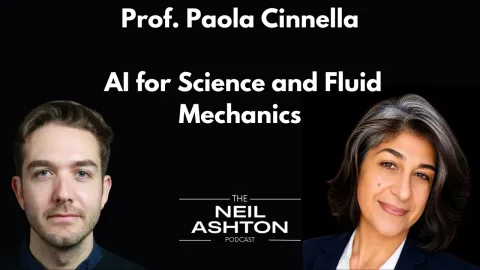
Prof. Paola Cinnella on AI for Science and Fluid Mechanics
Watch on YouTube
Prof. Paola Cinnella on AI for Science and Fluid Mechanics
YouTube video
Watch this episode
YouTube is contacted only after you choose to play the video, keeping this page fast and private by default.
Listen to the audio
Episode overview
RANS uncertainty, data-driven turbulence modeling and AI for Science are the focus of this conversation with Professor Paola Cinnella, Professor of Fluid Mechanics at Sorbonne University and Director of SCAI. Neil and Paola discuss high-order methods, dense gases, Bayesian uncertainty, AirfRANS, surrogate modeling, scientific publishing and education in the AI era.
Chapters
- 00:00 Podcast intro
- 00:39 Introducing Prof. Paola Cinnella
- 03:28 Conversation begins
- 03:56 How Paola Found Fluid Mechanics
- 07:09 Moving from Italy to France
- 08:37 High-Order Schemes and Compressible Flows
- 09:30 Building an Academic Career
- 12:06 Dense Gases and Uncertainty Quantification
- 15:16 Expansion Shockwaves and Real-Gas Effects
- 19:17 Returning to Paris and Academic Mobility
- 24:52 Academia, Passion and Persistence
- 27:51 Bayesian Methods and Turbulence Uncertainty
- 30:47 Learning Statistics Across Disciplines
- 33:07 LearnFluidS, AirfRANS and CFD Datasets
- 36:33 Skepticism and Physics in ML Turbulence Modeling
- 40:41 Could ML Lead to a Universal Turbulence Model?
- 42:59 Turbulence Models, Surrogate Models and RANS
- 45:03 Why LES Alone Cannot Solve Optimization
- 47:15 Multi-Fidelity Modeling
- 49:08 What Computers & Fluids Looks for in ML-for-CFD Papers
- 54:05 CFD Metrics vs. Machine-Learning Metrics
- 57:13 Overselling, Publication Pressure and Quality
- 01:02:22 SCAI and AI for Science
- 01:06:07 Cross-Disciplinary AI for Science
- 01:09:26 Education in the AI Era
- 01:12:44 Critical Thinking and AI Outputs
- 01:18:15 AI as a Companion, Not a Replacement
- 01:21:42 AlphaFold and the Future of Discovery
- 01:23:43 Training Centaur Scientists
- 01:25:11 Closing Thoughts
References and links
- Quantification of model uncertainty in RANS simulations: A review — Heng Xiao, Paola Cinnella doi.org
- Discovery of Algebraic Reynolds-Stress Models Using Sparse Symbolic Regression — Martin Schmelzer, Richard P. Dwight, Paola Cinnella doi.org
- Bayesian estimates of parameter variability in the k-epsilon turbulence model — W.N. Edeling, P. Cinnella, R.P. Dwight, H. Bijl doi.org
- AirfRANS: High Fidelity Computational Fluid Dynamics Dataset for Approximating Reynolds-Averaged Navier-Stokes Solutions arxiv.org
- Data-driven turbulence modeling — Paola Cinnella arxiv.org
- Direct numerical simulations of supersonic turbulent channel flows of dense gases — Luca Sciacovelli, Paola Cinnella, Xavier Gloerfelt doi.org
- Paola Cinnella named Director of SCAI scai.sorbonne-universite.fr
- SCAI scai.sorbonne-universite.fr
- Paola Cinnella — HAL publications cv.hal.science
- Paola Cinnella — Google Scholar scholar.google.com
- ERCOFTAC SIG 54 — Machine Learning for Fluid Dynamics ercoftac.org
Transcript
This transcript was created from the corrected YouTube captions, with names and technical terminology reviewed. Download the corrected SRT file.
Hi, and welcome to the Neil Ashton Podcast. In each episode, we explained some of the fascinating ways that science and engineering are changing the world around us. We talked to leading engineers from elite level sports like cycling and Formula One to some of the world's top academics to understand how fluid dynamics, machine learning, supercomputing are bringing in a new era of discovery. We also hear some of their life stories, their career advice, the lessons they've learned on the way that I hope will be helpful to you too. So sit back and enjoy this episode. Hi, and welcome back to the Neil Ashton Podcast. So today I'm delighted to be
joined by Professor Paola Cinnella. She's a professor of fluid mechanics at Sorbonne University in Paris, and she's also the new director of the Sorbonne Cluster for Artificial Intelligence, also in Paris. And what I've found particularly interesting about her career is that she's not come through AI, through the usual, you know, computer science route. She is very much mechanical engineering and fluid dynamics specialist. We talk about where she started in Italy, the transition to France, moving back, the idea of, you know, academia having to move between different countries to, to secure the tenure positions, how how challenging it, it, it can be, especially
for, you know, for family and, and personal life. But she really, well, I liked it. Her passion for, for fluids, you know, she talked about working on these exotic dense gases and real gas effects and, and how some of those LED her towards the uncertainty quantification and Bayesian methods. And working with statisticians helped her then realize that she could do the same around machine learning and really wanting to collaborate with different disciplines and, and different groups. And, and in some ways, she's represents a very important bridge between what we might call, you know, classical CFD, you know, numerical methods, turbulence modelling and this
new world of, of, of AI for science. And, and she's played actually a, a major role in the wider CFD community. You know, she's an editorial and chief of Computers & Fluids associate editor for International Journal of Heat and Fluid Flow. And she also helps to coordinate the ERCOFTAC special interest group on Machine Learning in Fluid Dynamics, which has led to a really successful conference series. This ML fluids that I have been fortunate to to have helped her a little bit as well. And, but really we, she is an educator and she is an academic and, and we had a really interesting discussion as well on what it means in this new era
of AI, what, what's the valuable thing that we should be teaching new students at undergraduate and postgraduate level? And really what is the potential for methods? And one of the things we talk about is, you know, the differences between surrogate modelling and turbulence modelling and how could they be interconnected? When is the value of those? And and we finish off talking a little bit on the AI for science and how there is this opportunity for cross collaboration across discipline. So she is somebody that I am inspired by and always enjoy working with. And I hope you enjoy learning more about her and her work in this conversation.
So sit back and enjoy this conversation with Paola. So yeah, thanks. Thanks for coming on this, really appreciate it. I've loved working with you on various projects over the years, but this is a good opportunity to hear more about, you know, you and, and what you do. And I guess maybe it's a starting question. You know, you started in mechanical engineering in, in classical fluid mechanics, I guess, and then you move through now into, you know, machine learning and, and AI. But how did all that happen? You know, rewind where? Where did this love for fluid mechanics start? Well, when I started, so I had to choose the university.
I wanted to do fundamental physics. I, I wanted to go to, to fundamental physics, astrophysics or something or to mathematics. And well, my mother said, no, this is not a good job because the only opportunity for you is to become a researcher that's not well paid. So be an engineer. So good for engineering. And then I started to do mechanical engineering actually. And after one year, I discovered that they didn't like, and I started to look for things which were closer to physics and to mathematics. And well, a friend of mine said, you know, I'm doing fluid mechanics. There's quite a lot of mathematics in that, and also some physics.
So, right. And that's how I went to fluid mechanics and I didn't like it. Actually, my my professor in Italy is Michele Napolitano. He was, he worked with NASA. He was, he had a PhD with Stanley Rubin, who was actually the one of the first editors in chief of Computers & Fluids. And he gave us a book by Shapiro. It's fast profiles. I think it's a book. You know, Shapiro is a, is a professor. He was professor at MIT I think. And he said he he gave us the book the first day of the classroom and he said if you don't like this book, you can change, go to another take another course to just abandoned the fluid mechanics option.
And I read it and I loved it so. And that's how I meant for the mechanics. So that's interesting. And then did you always want to go and do a PhD or were you sort of debating of going into industry or something? Yes, because you know my family, everybody. So my family is a family of professors. Well, they are professors more in the secondary school, but they all did high studies, let's say university and so on. So I wanted to be a professor and I wanted to be a researcher most first of all, in the 1st place, I wanted to be a researcher And, and So what I knew that was necessary to have a PhD for being a researcher. And so well, since the beginning
I was looking for a PhD. And at that time it was very hard to have a PhD in Italy because there was no traditional PhD, I would say 30 years ago. And the people went abroad for the PhD actually, because in Italy it was not very valued. It was at the very beginning. I was maybe the 11th cycle of PhD, which means that the, the PhD degree in Italy was created 11 years before I start, you know, so it was relatively recent and, and there were very few fellowships for a PhD, so it was very difficult to have them. And that's how at some point I, I decided to move to France. So, yeah. And and then, well, I loved France and remained here.
Yeah, OK. And your topic was on more numerical schemes, more like compressible to how did you get to that, you know, decision I I guess on the. Topic Actually the very beginning. At the very beginning I was doing schemes for incompressible flow. It was I started with the lid driven cavity and the velocity vorticity formulation of the Navier–Stokes equation. So that was my master's thesis, but then when I was looking for a PhD for a PhD in France, actually the beginning should have been just a second master degree. And after I decided to remain for the PhD in France. But anyway, so my, my supervisor in Italy knew Professor Alain Lerat,
who was one of the founders of the ICCFD conference too. And he said, well, I know this guy in France is doing good job with, but it's compressible. So it's another thing. And then if you don't, you're not scared about compressible flows, you can go to him and he's very good. She's doing, she's doing numerical schemes and so on. And so that's how I decided, oh, Paris is not bad. Actually it was because of Paris more than because of the compressible schemes, because my options were to go to the von Kármán Institute, to go to the US or to go to Paris. And what I said about Paris, I have to go to Paris. And so I arrived here and Alain Lerat proposed to me to work
on high order schemes which were a quite recent topic at that time. You know, at that time high order was second order schemes actually because everybody was doing 1st order. So 2nd order scheme were already high order. And he said to me, but we are going to move to 3rd order. OK, yeah. And that's, you do unsteady flows because at the, you know, at that time people were mostly doing steady Euler or steady Navier–Stokes. And so, well, I started a PhD for high order scheme to capture steady phenomena, even if it was only RANS at the time. And, and, and yes, it was a high order finite-volume schemes. And then I spent quite a lot of
my career on on high order scheme because of that. And, and was it therefore a natural progression to continue going down the route to sort of post doc and, and, and you know, faculty position with was it just an evolution or, or was it a, a challenge to, to, to progress down that route? It was a challenge because as you know, there are not many positions in academia. They're very challenging. Also, when I, when I was in France, I spent quite one year, the second master degree and then three years of PhD in France. And at some point I wanted to go back to Italy. And in Italy there were zero
positions basically. So I passed the competitions in France because in France, you know, the positions are open, you have to to get a qualification, which is a national qualification. So this depends on how many papers if you have taught courses not and so on. And you it's basically sort of minimum certification, which says, OK, you are fit to be a professor. OK, not, not a professor, but an assistant professor. And then we once you have got got, once you got the, the, the qualification, you have to apply at the universities which have positions open and you have to compete with other guys. So I eventually got a position here in Paris, but I wanted to
go back to Italy. So I renounced the position, even it was rank at first. And I decided to go back to Italy. And there I started with a post doc because there were no permanent positions open. And after some time after my post doc, I moved to a close by university because, well, my home university is Bari. It's in the South of Italy, it's Apulia. And I went to Lecce, which is even even more south you know, it's the very tip of the heel. And, and there I got the eventually a faculty position and I worked there for eight years as an assistant professor. And I was the only assistant professor in fluid dynamics of the whole university.
I was the only one. And, and what was what was your main focus back was back then, you know, when did this move to the the RANS modelling and certainty quantification and things like that? Was that during that period or was that? Actually when I arrived in Lecce, I was, as I said, I was the only fluid mechanician and I wasn't part of a group, a larger group in energetics. And I started to think about what could I do which is related to energetics. And I discovered almost by by by chance dense gases. And so dense gases are compressible. So it's it's gases.
So it's compressible. Compressible flows of organic fluids, which are governed by complex equations of state could be super critical CO2, but it's it's light gas. But you can have denser gases or more heavier gases like refrigerants or hydrocarbons. And these gases are used in processes, industrial processes, or also in some thermodynamic cycles like, well, of course the refrigeration cycles, but also direct cycles, which means, for instance, organic Rankine cycles, which are like the Rankine cycle, which works with these strange gases instead of water. And the problem with these gases is that since it is industrial,
industrial fluids they are very ill characterized. Actually you don't know exactly about the properties about equational state you should use there are few data. The material properties are given in only technical sheets with a lot of uncertainties. And that's how I came to uncertainty quantification, because at some point I discovered polynomial chaos stuff and so on. And I said, oh, this is perfect because I have a fluid where actually don't know exactly how it behaves. So I would like to characterize the impact on the CFD solution of the, the, the, the bad knowledge of the fluid properties, not only the thermodynamics, but also the
transport properties are not very well known. And so, yeah, that's how I moved to uncertainty quantification. But at the beginning was not RANS, it was even Euler, you know, but you don't know exactly the thermodynamic, you cannot characterize completely the thermodynamic behavior of your gas because you, you, you don't know which equation of state you should use. And the parameters of the equation of state are, you know, not very accurate. That's interesting. So it's more driven from that. Yeah, I guess did that help you working in a more complex area in a way? Did it give you more understanding of the fundamentals of fluid mechanics?
I guess when people just study single phase simple incompressible, maybe they don't appreciate the. Complexity, yeah. Actually I I adore those gases because, well at least theoretically they could exhibit very exotic behaviors. In particular they are expected to exhibit under some thermodynamic conditions. If if you take a heavy enough gas, it is expected to exhibit expansion shock waves. And actually there is a community around that which is called the non ideal compressible fluid dynamics community, which has spent several years trying to expect to to have an experimental proof of the existence of these expansion shock waves in single
phase compressible flows. So the first one to postulate that is Hans Bethe. So the the physician, the physicist Hans Bethe, Nobel Prize who showed that for van der Waals gases with some values of the of the polytropic exponent, you can get a region where the second principle of thermodynamics forbids the the classical shock waves. So the the the compression shock waves. So instead you have a compression fan and conversely, you can have expansion shock waves and instead of expansion fan. So everything is reversed. And then several researchers work on that. Thompson, Michael Cramer at at Virginia Tech and so on.
And people were fascinated by these gases because everybody wanted to prove experimentally that that was possible. And eventually there was a group in Russia at some point we did an experiment with FC-70, which is a, you know, fluorocarbon, those which are very, very bad for the ozone layer. So they did an experiment with this and they said, oh, here, here you have the expansion shockwaves. But then the people started to challenge the experiment and said no, this is impossible, Probably it was two-phase and so on. And then in depth there was a group. So the group of Piero Colonna, there is a big group in TU Delft who tried to reproduce an
experiment with different gases. Also you have Alberto Guardone, in Milan. He, he got an ERC actually on that. And what it's very, very difficult because this shock expansion shock waves exist in a very tiny thermodynamic region and all the uncertainties associated with the shock tube with the membrane breaking and so on can perturb the actual development of the shockwave. And so we are never sure it's really a pure expansion shockwave. So, well, and the interest of that thing besides the, let's say the, the, the, the scientific curiosity was that some people were expecting that you could exploit this behaviour to get better energy conversion
cycle with the reduced losses and so on. It has been abandoned right now a little bit because actually while there is a very small industry supporting that because it's very specific machines and it's very small companies working on that with few funds for to invest in research. But it was a great period. So it was actually, and also it has the impact, even if you don't find the expansion shock waves, at some point, you don't care because there are plenty of systems with real gas effects, not expansion shockwave, but still real gas effects. And that you need to characterize to have better conversion cycles or better heat
pumps or, you know, all these stuff. And so we're still working. So we are right now a project ongoing with the, with, with the German team. We are doing the, the simulations and the machine learning and they are doing the experiments and it's a very nice team. And yeah, we, yeah. Very cool. And you, you mentioned at the beginning that, you know, you were in Italy, you went to Paris, you went back to Italy. What then was the what? What led to you, you know, going back to Paris again? Yeah, well, again, I mean, it's not easy to stay in academia in Italy because the, you know, the funding system, well, the academic system in Italy is chronically underfunded, but
severely underfunded. That's why you find Italians everywhere. Actually, I've noticed maybe that there are lots of Italians everywhere. So, so the, the academic position are very few. I had one actually. But then you are alone. It's very difficult to get funding. The possibility of having a career are very, So you, you have to be very patient, you know. And also, my husband wasn't Italian and he never could find a satisfactory job in Italy. So at some point he said, well, let's go back to Paris. And there I applied because I wanted to move to a professorship. I was assistant professor, I wanted to move a professor and I
got a position in Paris. And that's how we we moved back to Paris because he also had a job here in Paris. Ah, OK, I understand. So you well, as you say, Paris is not such a bad place to to to be. Easy for two person It's easier to find both a job in Paris than find both a job in the in southern Italy. Yeah, but that does seem to be, I guess, an overriding thing of academia that it's almost this necessity to move, right. It's it's kind of a weird profession. Even in the US or the UK, very few people will have their entire career at one place, particularly earlier on. They will have to have you found that it's almost, it's a fairly
unfair thing in a way that you have to move your family and do things just to progress. Yeah, yeah, that that that's true. And that's because, well, for instance, in France, there is even a rule in some, in some disciplines, like in mathematics, that if you have been an assistant professor in a department, you cannot be a professor in the same department. You have to move another one. And these small cities where you have just one university, it's basically this means that you have to move. So this pushes a lot of people to abandon the idea of moving to a professorship and they remain assistant professors for forever.
Also because the French system allows it. It's not like the tenure track in the US. If you don't, if you are not promoted to associate, then you have to leave academia. You can remain as associate professor with a permanent position forever. So if you can't move with your family, basically you cannot progress in your career. And and so it's a choice. Some people are happy with the, with an assistant professorship for their life, they do teaching and so on. But if you, if you want to move, so if you want to progress with the career, yes. The, the, I don't know, the academic, the academic world is built like that. Why don't know exactly it's also part of science to move.
We should look in the past at the the former scientists where they were moving quite a lot. You know, even in the Renaissance, you know, you, you, you had this, I don't know Galileo or or Leonardo da Vinci, they were moving around. And that's because you need to to spread knowledge to find better environment. So I think it's nice the difficulties when you also have a family life and you have to, so you have two person to, to, to move. In some cases it's easy because 1 is a flexible job or, or things at home. But otherwise it can be, yeah, quite challenging. And I think it's something that the new generation don't appreciate that much because,
you know, I, I think I am what's, what's my generation, I think generation X and we are, you know, I, I know that my children say your generation X is the generation of suffering. You know you were you were raised to suffer, but it's no longer the case. But it, but it is a serious point though, that I've, I almost feel like sometimes academia has maybe not to be careful, but I always, I'm just amazed that the dedication it requires to get through it and to to become Someone Like You, you know, a top professor. Like it feels, it's, I feel like probably many people aren't able
to get to that .1 Obviously they're not intellectual enough. They're not, you know, capable enough. But but also you have to have a quiet determination. Yeah, to, to get there, which is probably partly a good thing because it, you know, it's, it's like a, you know, survival of the fittest, I guess. But as you've said to some people where they just really would love to stay where they're living because they have friends and family and they can't, it's, it's a shame. Well, what I used to say to my PhD students is that the academic career is kind of similar to a career in music or in theatre or in high level level sport. OK, if you are a musician, if
you're a pianist or if you are an opera singer, you have to move around and it's a very competitive field. And you do that not because you want no quiet life, a quiet life, but because you are passioned and you want to be on the stage and see, you know, people around you clapping hands. And, you know, it's a sort of, you know, I think that well, there is a sort of narcissistic side, maybe like people remaining in academia, but also, you know, it's it's an intellectual work. And I guess that what if you, you should you, you do that because because of passion, first of all, it's not, it's not an ordinary job actually. And you want to push the, the,
the, the, the, the, the, the, the frontiers of knowledge. You want your, your work to have an impact and you know, you want to do something to move things forward. And, and that's a, that's a passion. So it's maybe you don't, you don't make it, but you still try because you know, it's, it's like a football player. Not not all football players are Lionel Messi or, I don't know, David Beckham. That's a very good. I've not heard it described that way about a musician or sports players. It's kind of true that they also move around a lot. And I, I get that's the, that's the, the old thing though of universities, isn't it, that you
almost have to wait for the person above you to, you know, retire or die to get their position. So people end up also moving around because there's sort of not enough where I guess in a big corporate world, people are more able to, maybe that's changing, But you know, in a, in like an Airbus or something, I'm, I'm sure there's jobs for life almost just in one company where academia. So I, I, I say that because I think it, people should appreciate just how hard it is to get to being a professor, that it, it's not just an intellectual thing. It's like a determination and passion thing, as you say, to, to, to do it. And so all, you know, talking
about, you know, wanting to be at the forefront. I mean, you, you were quite early on looking at learning and data-driven turbulence models and and machine learning. You know, when did you start to get into that? When did you get a sense that these methods were an alternative or an enhancement on the more traditional numerical methods sort of line of research? Well, actually I. Stepped into Bayesian methods when I was doing uncertainty quantification for dense gases. And at some point I was discussing with some colleagues of mine from from the University of Trieste, and they had a sort of startup, I don't know if you know this startup called ESTECO.
They produce software called modeFRONTIER. Oh yes. Yes, yes, of course, yeah. And so, yeah, they were actually promoting this software in universities and, and they sold also academic licenses and so on. And so I started to discuss with them about my problems with uncertainty quantification in dense gases. And they said, OK, but you could try to solve an inverse problem and so on. And, and, and so that I, so I started to look into the literature and I started to be interested into these Bayesian methods and, and I said, OK, this could work for dense gases, but we, well, the thermodynamics is not the only source of
uncertainty because you also have the uncertainties associated with the turbulence models. And these are very old problems. So there are so many turbulence models, you don't know which one you have to choose, you don't know which parameters you should put into them and so on. So let's try to quantify this statistically instead of just using expert knowledge, which is what any anybody does actually, because every, every company actually has sort of, you know, established know-how saying OK, for this problem, you should use the k-ω SST for this problem, you should use the Spalart–Allmaras for this problem, you should use that one.
And sometimes you also know that they retune the parameters. For instance, I know that people in internal combustion engine used to recalibrate k-ε for for having better results for, for, for, for, Yeah, for internal combustion engines. And but all this was was tuned by hands basically. And I said, OK, if there are, you know, mathematical, clean mathematical techniques to do that, let's try to use them. And so since I was already doing direct uncertainty quantification, I started to, you know, try to do the the inverse uncertainty quantification. And at some point, well, it was a bit hard for me because you know, in mechanical engineering we are not very well trained in,
in probability and statistics. So eventually. I, I studied that myself because it was interesting to that actually I also thought a little bit, but it was not enough to, you know, understand all the details. And so at some point I was invited by statistics department in Chile and they invited me for two months and I was there with statisticians and mathematicians of probabilities. So and during the first month it was impossible to understand each other because, you know, I was calling things with names that they interpreted in another way and so on. And, but at some point we started to understand each other and that was great because some papers which were, you know,
just hieroglyphs to me, hieroglyphs started to be clear. And, and that's where, you know, all the, the Bayesian stuff was, was set and, and, and I could start to recalibrate the turbulence models and and so on. So that. So yeah, the fact of being in an interdisciplinary environment and talk with mathematicians was extremely useful to me, not only with engineers, even if I love engineers, but you know, sometimes like, no, that. That's, that's a very good point. And I guess even to today, that's a challenge on the machine learning side, isn't it, that maybe it's starting to change in a course today. But I guess most people who are doing the research, therefore
who studied, you know, 5 to 10 years ago or more didn't have any of that background in computer science or in statistics or, or sort of methods that maybe people who did more maths, stronger maths may, may, may do it, but engineering courses probably wouldn't. I mean, how have you seen that affect the machine learning side? I know you've been quite passionate about connecting. I know you you kicked off, for example, with the Extrality and AirfRANS data sets. And, you know, did you try and take some of that inspiration of your time getting familiar with statistics and try and do the same on the machine learning side?
Yeah, yeah, definitely. Actually, I had the chance when, when I, when I moved to Sorbonne to be in a very interdisciplinary environment. And at some point I, I, well, I stepped into the team. We have a very strong machine learning team here in the computer science department, and I discovered almost by chance that they were doing machine learning for physics. So I contacted them and said, OK, I'm a fluid mechanicist, I'm trying to move to machine learning. I know that you're doing machine learning and you're trying to move to fluid mechanics. Can we do something together? And so we applied together to an internal funding instrument of the university and we got
funded. So we had this LearnFluidS team. So it was a little bit of money to have a post doc and a few interns and little things, but this allowed to connect each other. And then they said, Hey, we have this guy who is going to do machine learning methods for CFD. So we want to, but we have no databases. In machine learning. We, we have MNIST. We have, you know, many famous databases, but there are no good databases in CFD. We want to build 1, but actually we don't know exactly how to do the meshes because they were trying to use, you know, OpenFOAM, and we're using, you know, snappyHexMesh.
Yeah. And of course the meshes are. Not very good close to the wall. And that's the point. So I said no, but you can also use the structured meshes and so on. And then, and then also we started to discuss a little bit about the criteria we had to use to evaluate the results. Not only the MSE we have discussed, but you know, and that's how well eventually they produce this AirfRANS. Of course, the well, the marriage is essentially the, the, the students. It's something interesting that this student had the background in physics the beginning, so and he moved to machine learning too, but he had a background in not in CFD but in physics.
And so, yeah, so with this mixture of disciplines, we came up with this, with this database. And also they could test a lot of baselines that the way they do it in machine learning or they take 1 based and two baselines and they test all the baselines. And now we are trying to do more actually also for unsteady flows. So hopefully we will have a new database coming out which is on LES. So this times is not steady RANS, it's more LES and it's actually it snapshots because you know to to have time resolved predictions, yes. And. And the idea is the same. So they, they well enlighten me on machine learning architectures because they know
better. They know, they know better. Also the, the, the sometimes the, you know, the, the, the, the pitfalls and the you can have in training these things because sometimes, you know, the training is not an easy. But on the other side, I say, OK, maybe you should look at this and that you should use this physical criteria and so on. And it's very, very instructive, I think, for both sides. So I'm very happy with this collaboration. And yeah, that's that's how we. I mean, how much have you struggled, though to get acceptance in that the from when you started to now? Have you how have you seen things progress?
You know, the the argument of how well is the model just a fancy interpolation versus actually learning the physics? You know, how much is that is a a good thing that this is hard questions and how much of it is almost holding things back a little bit? Well, the. Hardest thing, Well, I started with the turbulence for this right? And it was hard beginning because, you know, well, turbulence models have a lot of knowledge. They are really incredible. They have this physics sense, which is, I don't know, but they are also very, you know, fond of their methodology. They, you know, the fact that you have do you have to do the
things like in a certain way? And also the parameters has been, have been the model parameters been tuned making a lot of compromises and so on. So they don't like that you start playing with the parameters, playing with the terms and so on and so on. And for sure at the beginning the community of people who were who was playing with machine learning or, or calibration also calibrations of of turbulence model was not a community of turbulence modellers was a community of people coming like me from numerical schemes actually or from numerics in general. And so we didn't have the right codes for turbulence modelling,
which is, you know, there is a lot of knowledge accumulated for for decades. And so many people were doing things that were not acceptable actually from a strict turbulence modeling point of view. So they were not using the right features as the input of the turbulent model. For instance, some people were using velocities at the beginning, which, you know, it's it's not Galilean invariant and so on. And and however, well, still this model looked interesting. So everybody was intrigued with the with the with the possibility of having it in this model. Because in the end, if you look at even if the to the traditional turbulence models, they remain data-driven.
They yeah, data-driven with a human, you know, tuning the parameters. But they are data-driven actually because you are you are calibrating on, on some data sets which are the canonical flows. But OK, so at some point, well you had Chris Rumsey, which you know who, you know who decides to organize a meeting at it was in Virginia, it was at the was the name, the light, the lighthouse, right, the lighthouse. So there was this mythical meeting in 2022 where he said, OK, we are going to put around the table classical turbulence modeler and these guys, these, you know, these power venues with their machine learning stuff.
And and it was really instructive because you had incredible guys there. So it was a in honor of the 60th birthday of Philippe Spalart, who is a great guy by the way. And you had, you know, Philippe, you had Paul Durbin, you had all these guys, you know, you know, plenty of things on turbulence modelling and they were explaining things. And on the other hand, we were trying to defend the idea of using machine learning. So we were a little bit, you know, like how, how do you say you attack? Attack. But it was instructive because I think thanks to that, we progressed a lot because we, we started with the idea, OK, it's nice.
We just fine tune a model for a very narrow set of flows. We get better results. We are happy with that. And now we are moving more and more toward unifying models. And maybe, maybe, maybe I, I maybe show ambition, but never know. Maybe in 10 years more we could have a foundation model that's a dream and turbulence model which could, you know, actually realize the the the dream of turbulence model of a universal turbulence model. I'm not sure we will get there, but you know it is. Interesting though, because in some ways turbulence modelling was going out of fashion. And I know that it used to be
the joke, didn't it? I think that for a European project, if you said you're going to work on turbulence modelling, it was almost like guaranteed to be rejected because it was seen as a solved problem or you know what's new? And but there were the the irony is is the industry still uses mainly RANS and are stuck using methods from the 80s or or early 90s seems like with machine learning. Then there was this spike of of of potential again. But I don't know about you, but I almost felt that. Maybe some of the? Use of machine learning for turbulence modeling was a little bit early and the expectation was so big that when it didn't meet that expectation, it sort
of then dropped down again. And, and I, I, but I agree with you that in some ways with the idea that we want to build also foundation models from a surrogate modelling side, having to do everything with LES or whatever, it's just so computationally expensive. Ironically, if you could use machine learning to come up with the ultimate turbulence model, you would actually make it much more affordable to, to, to actually run the simulations to achieve. So I feel like now there is maybe a little bit more economic or relevant again of the turbulence modelling because it would save so much on the date generation side. But yeah, it it does seem to be,
I don't know if you've noticed, but I saw in CFD anyway that initially everybody was focused on machine learning for turbulence models, where now it seems to be far more about machine learning for surrogate models. And that seems to be much more focused on and you don't hear as much on maybe the turbulence modelling in such a strong way. Would would, would you tend to agree with that, that the community sort of shifted a little bit? Some communities, yes, I think in the, in the well in, in complex engineering applications like well car industry or even in solid mechanics for instance, they are shifting in that direction.
I think that in aerospace they are still interesting to turbulence models, especially for complex application like hypersonics or transition models, all that. That's because, well, even if you can, well what you would like to have in in for instance in aerospace where we have what you would like to have is a high fidelity model, so like LES quality and to perform your optimization with that. Why? Because we know that RANS has flaws, because we want to explore extreme, extreme operating conditions, because we are moving away from known paths like we are changing the fuels, we are changing the architectures and so on. So you cannot just design, I
don't know, a new propeller or a new wing based on epsilon modifications of something you know and for which you know that the turbulence model is going to be wrong, but you know more or less how it's going to fail and how you should correct it. OK. And the problem is that even if right now with the, the, the, the porting to GPUs and so on, high fidelity simulation are becoming more affordable, still that's one simulation. If you want to perform an optimization, you need thousands of LES. And even if you can run a complex wall-modelled LES on on a GPU, what you know, chatting, you know, well, you know this, but still it's 1. So if you want to perform, I
don't know, 2000 simulations, you need 2000 GPUs, which is very costly. I don't know how many companies can, you know, afford 2000 GPUs, But there are and also, if you have, you know, few GPUs, well, you have to wait for many, many days and the design cycles to be shorter for for economical reasons and also for environmental reasons. I mean, OK, so for that you cannot rely on LES alone. So what you can try to do is to distill the knowledge of this high fidelity method into lower order models. So the how can you do it? That's the way I tried to do it. One possibility is to distill this into augmented RANS models. And then once you have augmented your RANS model, you use that
one to perform the optimization cycle, which is much more affordable, provided that your model generalizes well enough, at least on your design space. Because if the model fails as you move a little bit far from the baseline, well, that's of course that's useless. The other point you can do is to surrogate models. OK, but the problem with surrogate model is that you will never have enough LES to train a surrogate model on it on LES. So you are trying to do that right? You are trying to produce high fidelity databases but they are still relatively limited and I don't know how many of them will be possible to produce
especially for very complex very high Reynolds number flows. And if we have so many data at some point, what's the point of having surrogates if we can run thousands and 10s of thousands of LES, what's the point of having a surrogate? So I don't know. So maybe what's what we are trying to do is to have multi fidelity models. So where actually you train the model using data of different origins provided that you have a clear hierarchy and you can actually try to to train using plenty of low fidelity data like RANS. So that's where having a RANS, which is not too bad remains useful. And then you try to learn the gap between the RANS and the
high fidelity and then you use your surrogate. And this is something which is not yet so used in the surrogate modelling community because they either use plenty of RANS data or well, whoever some databases, high fidelity database like the one you you have contributed to produce. But still in a database you have what, 300 cases for a family of cases, But it's not enough to, you know, to have something which can be reused for anything. So this means that every time you change, you need to run 300 and yes, or, or one model that yes or whatever. And that's costly. And yeah, So no, I, I. That's kind of why I think there is a connection between the two
for sure that the the the underlying CFD is still the key and making that more affordable. Yeah, you're right. There are start-ups like like Volcano and others who are trying to come up with very computationally efficient codes. But that is kind of the whole point of turbulence modelling in some ways is to, is to try to come up with a way of modelling it in a, in a, in a, in a clever way. So, yeah, if it, if it can be done, then that would be then that would be good. I, I did want to ask you on the, I mean, you're an editor in chief of Computers & Fluids. You're extremely active in the, you know, academic world when it
comes to publishing. You know, how how are things changing with the rise of like ML based papers? You know, what standards should they be having? You know, you would previously we'd always say, I want to see a mesh requirement study. I want to see proof of convergence. I want to see, you know what, what standards are you wanting and seeing? And and yeah, I'd be interested to hear your thoughts as a journal editor. Yeah, what we are. Doing right now in Computers & Fluids is to ask to motivate very well why you do need machine learning and why this is improving over, I would say, standard approaches. To give an example, many people do OK, we were talking about
surrogates and they say, OK, I want to design a new airfoil. So new airfoil and for that I generated a database of 10,000 RANS simulations and then I trained the surrogate and then here goes my my, my, my optimal profile optimized using the surrogate. But if you have the computational power to run 10,000 RANS, you can do brute force optimization. You don't need actually the surrogates, right. So what we are trying to ask is to show clearly that you are learning something more than. So your method is, is bringing something more either in term of total computational time, including the time required to
generate the database and in terms of improved design or showing that you, you know, you are making up for some failure of the classical model because otherwise showing OK, I train surrogate, it works well. Here's the optimum. It's, you know, it's, it's not I, I believe it, it's, it's, it's better. But you know, you are not telling the community what's new with respect to things we, we already are able to do. For instance, in some cases we have tested some baselines on airfoils, you can generate an airfoil solution of full-field RANS in 5 minutes. You know using FreeFEM or any any code. OK to train some surrogates you need 20 or 25 or 30 hours of of
GPU time. So in 20 hours I have largely finished my optimization with my old RANS code. So the point is to show that either you go to more complex models and you can do that fastly. So you have, you know, each RANS simulation would take, I don't know, 100 hours and thanks to the surrogates, I'm speeding up and I can have it in, I don't know, 20 hours or 24 hours or it's not new. So what we are asking is that OK, not only show that your model has been trained well and it performs better, but also try to compare to classical methods, show what's wrong with the classical method, what's what what your new machine learning method is bringing.
And also show eventually where your machine learning method is going to fail because that's also important, not only showing, you know, positive results, but also negative results. And that's something the community doesn't like to do too much because it's easier to publish when you have good results. You know that's. That's a very good point actually. I, I don't, I think if you look at like NeurIPS or those papers conferences, they mandate like a limitations section where you have to put down all the bits where you didn't do it. And unless I'm mistaken, that that precedent of very clearly pointing out where the limitation is not something that's traditionally done right
in not in such a clear before the conclusions limitations. And yeah, I've often felt that there needs to be more transparency also from just the CFD side where things are bad, you know, show me examples of machine learning, for example, where the where if I pick a certain split or, or I pick a thing, I get really bad results. It's actually quite important. Or else the conclusion is that these models are amazing and standard CFD's gone rather than pointing out they're positives and and where they you failed. The classic one I guess is in distribution and out of distribution where like yeah. Exactly. And the other point is to
evaluate the models is as also discussion. We, we have had as aware compare the model on CFD criteria, not only on machine learning criteria, because OK, mean squared errors are the standard in machine learning. They are useful, whatever, but they can be also, you know, misleading, because in particular in external aerodynamics, where most of the flow is uniform, basically you are training a neural network to capture a constant function, and the regions where something's going on which are close to the wall are very tiny. So if you are wrong in that region comparatively to the whole with all the points you have, maybe it's not enough to have a, a clear signal on the
MSE. But you see it if you plot velocity profiles, if you plot pressure distribution in general, they are very bumpy. If you plot skin friction, skin friction is terrible because in that case you are not only reconstructing the flow field, the the the velocity field, you are taking the derivatives. And it's well known that approximating the derivative of a function is more difficult than approximating the function itself, right? And so in the machine learning community is not used to this criteria, which are the standard criteria in CFD. So again, I I think that if you pretend to, if you, if you say that you are going to replace standard CFD approaches with
machine learning, then you have to show that machine learning is able to provide the same thing that the CFD group is able to provide and funny. Enough. I was having this discussion on a, on a, on a paper we're putting out where it's also the case, isn't it, that in machine learning, because you have, let's say, 300 or 100 or 50 test cases, you'll average over them. And as your number where that has the same risk of some are really bad, some are really good. And then you have lots in the middle. Or is it you have lots, you know, how, how bad is bad, how good is good? And, and this isn't fully explained just by a single
number. So this, as you say, almost doing a deeper analysis and showing I, I guess that what someone described to me is they to, to the early point of like hype because of the way the results are presented today, where an R-squared value or even L2 gives such low errors, it looks like they're perfect. But then when they try and practice and they don't see as good, it almost creates A disappointment, which if the paper had shown it, they probably would not be disappointed because it would just be meeting the expectation where yes. So I would agree with you, part of that is down to the way that the results have been presented. Yeah.
There is quite a lot of overselling, but that's because of the economical model also to continue, you know, and, and the, and the publication system, which is a bit too, you know, especially in, in some countries, that's not the case in France, but in some countries, there's this huge pressure for publication for being the 1st for, you know, this is the store. And I think this, this, this rush to publication publishing more and more in higher impact in journals and so on, in the end is increasing in the, the signal to noise ratio at, at such a point that people don't even read the papers. They just read reviews of paper
which are automatically generated by AIs. So there is something fundamentally wrong in this because, you know, which should remain at a reasonable level where humans are talking to humans because, you know, we're trying to produce human knowledge in the end. Because what's the point if all the AI is told to each other, hey, what are we going to do as you? I'm going to look at the beach. What the beach is not really not bad, but stay on the beach all the year. You have to find something else to do. So, yeah, no, I think that we should maybe slow down a little bit and do what well people used to do some years ago, which
means publish less, but publish more thoughtful papers and wait a little bit before publishing. And when you publish, publish something which is more complete, you have looked to all the consequences and you know, thought to all the possible yes. Do you know what you mean? This is the, the good and the bad thing of things like arXiv where there's almost a sense of let's get it out there. We want people to see it. It's a preprint. The preprint supposed to be taken as well. You know, this hasn't been reviewed yet. But unfortunately people just take it as the main thing. And because things are moving so fast, the, the fact that it hasn't been reviewed is
sometimes almost ignored, you know, by, by, by people in a way. So it's, I agree with you there, the pace necessitates sometimes to put it out, but at the same time that feeling in your back at the head of going, well, I could really do with another month or two to really deeply investigate this. Is. Balanced against the desire just to get something out, it's. It's a tricky 1 and. On the other. Hand the editorial The standard editorial system is being flooded by papers. So it's becoming more and more difficult to keep quality in the review process. You know when when you are flooded by 10s of papers every
day, OK. And you have to process them and you have to send them to reviewers. You have to find reviewers who are also flooded by other journals because there are many journals, OK, many, many journals and more journals are, are being created and so on. So at some point it's just, you know, just an escalation and it's very difficult to control the quality of the papers and what in, in fluid mechanics, things are becoming difficult, but they are still under control to some extent because it's a small community. But you have seen the examples of these big conferences like NeurIPS where they have 10s of thousands of papers, where most of the papers are written by AI
and reviewed by AI. And so what's, what's the meaning of the review process in that case? You don't review it at all. You just put it for free on the website and who wants to read it? So I think that the, the, the rush to having more and more and more papers, which is also due to the, you know, to the publishers is in some sense killing system. Because if the review level falls below a given pressure, at some point, there is no point in going through a standard review process because there is no added values in going through that review. So you just produce your your paper, you put it somewhere and the people look at it if they
want and that's it. And if you are in the hype, you are in, let's say, a famous team, very visible and so on, people will have followers who will read your paper because it's you. So we are shifting from scientists to influencers. And that's a bit, you know, scary for me. Yeah. Yeah, no, no the. So how does this, you know, translate and what it what's what are your trying to achieve with with, you know, the new position at Sorbonne AI centre? Could you maybe tell a little bit more about your place and and kind of your vision to how to do, I guess, AI for science and AI for engineering and and and maybe take some of those rigorous things that you've
taken from the fluid mechanics world in into this side? That'd be. I love your shiny new office So I wanted to hear more. Yeah. Well, actually, well, in Sorbonne we have this centre, SCAI Sorbonne. The beginning, the name was Sorbonne Centre for Artificial Intelligence, which was created seven years ago at the beginning of the AI hype, because we had the strong teams in computer science and also in applied mathematics working on that. So basically at the beginning, SCAI has been created by applied mathematicians and and computer scientists alongside with some people from humanities and from other sciences, for instance of computational biology, this kind
of thing. And well, it has helped a lot in in making. So in making AI, it's a one visible. They have generated a lot of activities we have. So at at some point we have been labeled by the French government as clusters. So now the C in SCAI stands for cluster. And these clusters are sort of centres of excellence in France. There are nine of them which are supposed to foster research in AI training and transfer to to companies. And well, every cluster has its own specificities. But when? Well, based on my own experience and based on the very large scientific community at
Sorbonne, I said, well, right now everybody is looking at AI for science because science is actually going to be deeply modified. The way of doing science is going to be deeply modified by the introduction of these AI approaches, which is not the machine learning approaches for, you know, improving predictions or speeding up predictions, but also reasoning tools and, you know, models for, you know, for, for automating labs, automating labs, AI agents and, and all that. And I said, well, the, the difficulty with that is that when you apply this to science, you have several problems. First of all, you are not dealing with random data. It's not images, it's not video.
It's something which has a deep physical meaning, which he's known only to experts from the discipline. So you can train a surrogate or whatever, or a foundation model using, I don't know, chemistry data. But if you don't have a chemist by you to explain, if what's coming out of the model is you know, makes sense from a chemical point of view or is just an hallucination, you don't know. So that's where it's extremely important to connect people from computer science and the disciplines and also people from mathematics because they can help with the mathematical foundations. What I dream about of is the equivalence, you know, Lax
equivalence theorem for machine learning. That would be the grail, you know, something that ensures that you, if you put more data in your model, at some point you are going to converge to something. But you know, that would be great. But so the idea would be to have all these people discussing together. And then I realized that some problems you can have in one discipline, for instance, in high energy physics, you have big data. This data are structured, they encode causalities because the particle I'm capturing here at this moment comes from a jet which has originated there and the particle have undergone some decay process and so on. And this, they call this
actually jets of particles. And they say, oh, this is the same you can have in a turbulent jet because the jet is originating from, you know, as lice or something as law. And then you have causalities of turbulent, of laminar structures which eventually become turbulent and then they are modified, they are transported. So we have the same problems and we have to encode these causalities because trying to learn all the physics, all the chemistry, all the biology from scratch, using brute force training on data, it's not efficient because we know the physics. If we know the physics, let's use it. But the problem is then how do you really encode that physics?
First of all, you need to know it. So it's not the computer science guy who is going to know which are the constraints which are the most suitable for high energy jets, right? So we need the communities to work together and also some problems which have been solved about causalities. I don't know in high energy in the energy physics community can be useful for fluid mechanics and cover city. For instance, I have talked with people from plasma physics. So in some cases they have Navier–Stokes plus the magnetic fields. They have problems of closures because they cannot resolve all the scales they need to coarse- grained models.
So they have closure problems, and maybe something of what we are doing with turbulence modeling can be reused in that field. I'm collaborating with volcanologists because in volcanoes you need to characterize the rheology of magmas and you cannot measure it and you have simplified models which are not accurate enough. So you can use the techniques we use for turbulence modelling to improve the rheology of magmas. So that's where it becomes exciting to share knowledge across the, the different scientific communities instead of having every guy in its isolated department reinvent everything from scratch because we are reinventing the wheel otherwise, you know, and that's
how we are trying to, you know, I'm trying to, to, to, to animate this community. And we have a seminar now called the AI for Science. And hopefully we are trying to apply to funding opportunities, even if they are not funding, just the fact that we are around the table and we are thinking about what we could do together. It's already something which helps building the community. And then what people start to collaborate and I think it's beneficial to everybody. That's, that's my hope at least. No, it sounds. Fantastic. And I totally agree there's lots of I like the ideas that these multidisciplinary centres, particularly in the age of AI. I think it makes complete sense.
And as you say as well helping be a bridge to I guess the industry and startups and and and things like that. That makes makes complete sense. I guess maybe to, as we come to the end, all of these new things, all of these topics that have come up since, since I guess you did your original studies, you know, how does this affect the education system? You know, what should young fluid mechanics researchers be be picking today as their PhD topics or the undergraduate what what will prepare them for the next 10 to 20 years of of the world we live in? Yeah, I. Think we are in a very critical period for education because
well you and me have been educated in a few without AI. So we have been taught how to to solve problems without the help of AI to how to like to interpret critically the results and how to look for information and, you know, how to, to check if what we are doing is good or not and so on. The problem is that the new generation is AI native. So I, I was hearing, yeah, yeah. Because yesterday at the radio were saying that many teenagers now who are going to vote for the first time are asking AIs what should they vote? Because trust AI is more than politicians or more than the
classical media. OK. And they're doing a little bit the same with the with the school, with school teachers and with university professor who are not prepared to that because, you know, the students have smarter than we are and they know how to, you know, to use AI to solve their fluid mechanics problems, to solve their thermodynamics problems. And you have still teachers who six months ago, we're not even imagining that the problem had been solved by an AI. So right now, many, many colleagues are scared about the fact that students are cheating with AI. But the for me, the problem is not only cheating. The fact is that some students
are basically, you know, delegating the task of thinking to AI. That's more much more dangerous. So what I think is that we have to rethink the whole system and many tasks which were, you know, I teach you how to solve a second order linear ordinary differential equations and you just have the technique to solve that. That's no longer useful because you know, ChatGPT knows to do that very well. The problem, we should teach the students how to analyze the results and how to understand if the result is correct, if it's an hallucination, how to formulate the questions also. Because if you don't know how to ask AI correctly, what to do, AI is going to do something you
know you don't control. And if you are not cultivated enough to understand the answer, you are just going to accept whatever comes out without, without, you know, without criticizing what what's coming out. So I think that we have to move the shift. So instead of teaching techniques and, you know, techniques or, or just notions, we should teach critical thinking. And that's harder because it, it, it, it implies a, a considerable modification of our teaching programs and new teaching approaches. It's not easy to do, especially in large universities as we have, I, we have courses with, you know, 500 students.
It's not easy to, you know, to have to, to change all the teaching procedure. But it's something we need to do because without critical thinking, basically humans are going to lose competence. And yeah, and, and, and, and, and in case, in case AI is not working, what do we do? And I had a very nice metaphor from a person from the European committee who said, well, when you, when you are, when are you are a pilot of an aircraft, you are 9, I say 8000 or 99900. Ninety, 100% of the time you are going to use the automatic pilot. But in case of accident, the pilot needs to know how to drive
the plane down to safety, right? And that's exactly that. So we, we need to be critical because we don't know where the AI is going to hallucinate even we are. Also, we need to, to understand if, for instance, sometimes AI is able to bring us notions from other disciplines which are not our discipline. But if we have methodology, we know how to analyze if what the, the, the, the LLM is saying is reasonable or not. We know how to verify facts and so on. And we have culture, general culture and language capacity to understand then we can control and we can be enriched as professionals, as scientists, as humans and whatever instead of being just, you know, replaced
like in Matrix. That's my, my nightmare. You know, Matrix humans are just there to be pumped energy. Yeah. No. It does. It does seem that it's not universally accepted. How best to do this from an education point of view? I've heard some go the other way and be almost well for an undergraduate, we will do lots of in person examinations and basically no homework anymore because you this is no way of knowing the homework. And, and as you say, there's the other side, which is maybe a little bit more ex, you know, do a presentation to explain how you got there. I, I kind of lean a little bit
more to the first one at the right stage of your career. I guess this is more like even a secondary school, let's say, you know, before university, you know, the certain things where I just feel you have to know it because as you say, what if there is a moment where you don't, you're on a, you know, you don't have access to the AI tools. I feel there's like a transition point when you can expect. Like if you're doing a P. HD. Or certainly a. Postdoc. I actually think AI is a fantastic help and will make you more productive, make you be able to do more things, help you achieve what you want to do faster and better, and
ultimately get a, you know what would have taken you a month to write some coding, which wasn't your main task, it was just you had to do it to get there. AI will accelerate it. But if you're at the undergraduate level or or still at school or something, I feel that's probably where AI should only be used to help you learn something, but not it shouldn't be used like a calculator almost or or or you will. Just not. Understand the fundamental theory, it can be used. As a mate you know because you can no say tell the AI ask me questions and give the answer and then the AI can analyze the tutor. Yes, and it. Makes, you know, learning more
interactive. In my research, sometimes I feel alone and I don't have a colleague to discuss about the point. So I take an AI and say, what do you think about this idea? And so we start the conversation and that's useful. And then, you know, the AI is bringing some ideas. So, yeah, yeah. Or. Explaining new topic. I often do that when I'm trying to and you can ask it. And the great thing I find is that it has these different levels where you could say, OK, sometimes I'll ask like, can you show me that in a code like how would you actually code this up? Which would be hard for a tutor to do instantly like a person to
be that flexible to move from reasoning. To code and back and so on. Because you are, yeah, easily lost in, you know, coding details and so on That that yeah, that's that's actually great. But the problem is to explain to the young generations that that's the way probably to use the AI more like a companion then like an entity that is going to do the work in my stead while I'm, I don't know, playing video games or something. That's that's not the point. And, and they need so the problem is to explain them what are the risks and why they are missing something if they use AI only for that.
So I can understand that sometimes you need to accelerate, you know, you have to give a report or you are a little bit in a hurry. But if you do that systematically, then basically you are missing your education because it's not you who is going to be educated, but the AI and and I and I think. In some ways it'll end up creating a bit of a two-tier system where in some ways people will become it's quite capable of doing some jobs where it requires them just to be, you know, a functional user of these tools. But it will stop you from maybe being the the inventor or the innovator. And there it there feels like you could, to be fair, you could
probably still do quite good at a job if you because these AI tools are so good. But I feel there must be some points where that lack of deep understanding will come and bite you. And so, yeah, it's it's a challenge. Yeah. We're not in very. Specialistic fields as as as so we are in very specialistic fields. So I don't think that the AI has been trained enough. So that's where you know, you bring the new ideas, maybe the AI strengthens you, accelerates you with the coding or allows you to make connections more quickly and so on. But it's still new. We're bringing the ideas. And if you're you know although that.
I do suspect will also be, you know, succeeded by AI because the, you know, the, the AI scientist or the AI engineer. I have to say, I, I, I still suspect actually that it will be able to come up with as many ideas as as we, we will be able to do. Maybe not the, you know, Einstein new completely breakthrough thing, but it's it's certainly going to be an interesting test. Of given. That the whole, like your centre is a good example of it. I, I do get the sense that AI for science or AI for engineering is now becoming the frontier. It wasn't five years ago. It was sort of seen as a niche area.
I, I get the sense now that the, the world of sort of physical AI and AI for engineering and AI for science is becoming a hot topic. And whenever it's a hot topic and there's lots of investment and money put into it, it, you know, yeah. There is, yeah, some overselling, yeah. But but yes, I guess, I guess that's the frontier. And I, well, I want to believe that. Well, even if the guys are becoming more and more powerful and potentially they could even win a Nobel Prize at some point if you think about AlphaFold for instance. It's well. What's new is the fact that in a few years they could discover thousands and hundreds of thousands of proteins which are
much more than the 2000 and something proteins they had discovered during the past 50 years. So every protein structure was PhD thesis and now you can generate plenty of them, you know, just with with with these AI. So what was new was the fact of being able to accelerate so much. But still without the knowledge of the proteins from the past, it wouldn't have been possible to have that. And the same for climate. If now climate models are so good, that's because for 10s of years people have developed better and better climate model, the classical ones, and they have done data simulation and then they have done all the
reanalysis from the beginning. And with that they have generated the huge databases which can be used for by the models. And also, well, everything is like that. That's because we have huge amounts of human knowledge accumulated over years, which can be injected in these models. But what once all the knowledge will be generated by by these things? Probably, I don't know, Maybe at some point they will become so intelligent with these emergent phenomena, they will be able to create something new that happens in very complex systems. But I, I, I I I'm. But I, I hope humans has still a role to play. Oh yes. And that. Well, and that instead of being
replaced by these AIs, well, one of the person who participates, a Jesse Thaler, he's a, he's a physicist from MIT and he participated to our AI for science launch day. And he came out with his metaphor of the Centaur scientists. And I found that as a beautiful metaphor because as you know, if you are two men and not enough horse, you are too slow. If you are two horse and not enough man, you cannot reason. But if you have 1/2 man half horse, you can go as fast as a horse while having all, you know, the creativity and and width of a human. And so, well, I, I adopted this idea and say that, well, our role would be to generate to, to, to train the next generation
of Centaur scientists and Centaur professionals and not just horse. I like that. You know, and that's, that's probably a great way to end this in the, in the sense of I agree with you that it's, it's about the coupling of, of human and AI. It's about being progressive and optimistic about AI, but not forgetting the, the sort of human role role in it. And, and I would argue that today the human specialist is needed even more because, you know, to, to help develop these AI models and make them accurate and point them in the right direction. But maybe we need to talk again in two years time and, and see where things have gone.
It'd be interesting to to listen back and see as it shot off like this is, is it the same? Is it less? That will be an interesting, but I really enjoyed this discussion with you and I personally always love working with you on on various committees and things. And yeah, been a pleasure to have to spend this time with you. OK. Thank you for the interview. It was very, very nice to discuss about all this. Great. Thank you.