The Neil Ashton Podcast
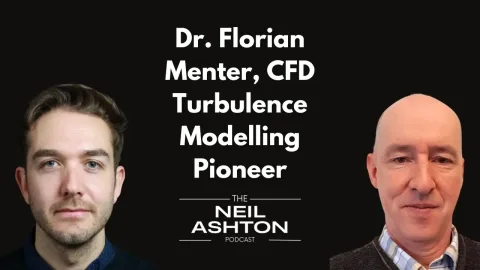
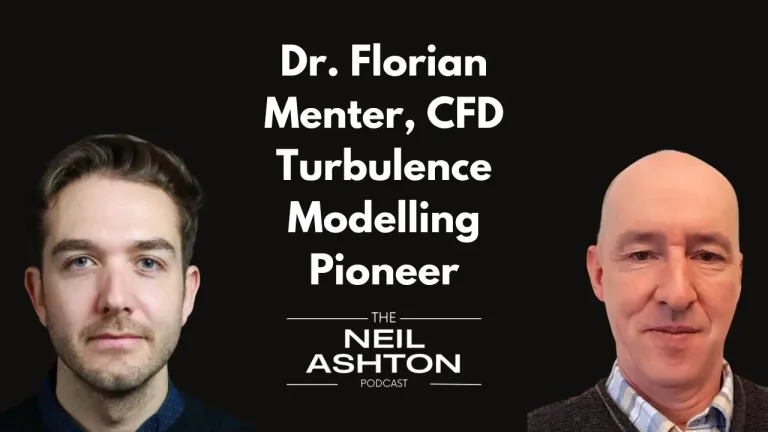
Dr. Florian Menter — Turbulence Modelling Pioneer
Watch on YouTube
Dr. Florian Menter — Turbulence Modelling Pioneer
YouTube video
Watch this episode
YouTube is contacted only after you choose to play the video, keeping this page fast and private by default.
Listen to the audio
Episode overview
Florian Menter discusses his journey in the field of computational fluid dynamics (CFD) and the development of the K-Omega SST model. He shares his experiences working at NASA Ames and the collaborative environment in the CFD community. Florian also talks about his decision to return to Germany and his role in the early days of what would be become ANSYS.
Florian Menter discusses the birth and development of the SST turbulence model, the challenges of transition modeling, and the future of RANS models. He also explores the potential of machine learning in CFD and shares advice for young researchers. The conversation highlights the importance of pursuing valuable ideas, keeping things simple, and envisioning the outcome of one's work.
Transcript
This transcript was created from the corrected YouTube captions, with names and technical terminology reviewed. Download the corrected SRT file.
hi and welcome to the Neil Ashton podcast. In each episode, we explained some of the fascinating ways that science and engineering are changing the world around us. We talk to leading engineers from elite level sports like cycling and Formula One to some of the world's top academics. To understand how fluid dynamics, machine learning and supercomputing are bringing in a new era of discovery, we also hear some of their life stories, their career advice and lessons they've learned on the way that I hope will be helpful to you too. So sit back and enjoy this episode. So this episode focuses on computational fluid dynamics. CFD.
I say that upfront because some of the episodes from this podcast are going to be at a higher level of focusing more on a vertical like cycling or Formula One, whereas this is very much focused on on CFD. So I just warn, if you are somebody from the CFD community, I'm hoping you'll find this interesting and engaging. But if you don't even know what CFD stands for, I just want to call out that, um, this episode may not be for you, but nevertheless, maybe give it a try today. In this episode, I've been speaking to Dr Florian Menter, one of the people, and there's not very many of them that have a surname that precedes them.
I would say of the tens of thousands, maybe hundreds of thousands of people within the CFD community globally. I would say most people know who he is because he developed one of the key turbulence models, the k–ω SST model that really has been responsible for so many engineering things. Cars, planes, pretty much everything you use on a day to day may have been developed, using his model as a fundamental part of the CFD set up. See, you know, the model, the turbulence model, just very briefly to say that for maybe people on the borderline of being in the CFD community or not, is really important because turbulence is such a complex thing.
Um, we have to come up with models most of the time and and certainly in the past few decades and and arguably still today. Although it's slightly changing now due to a higher Fidelity methods, people needed to be able to approximate turbulence in a in a steady state way through some sort of mathematical model to be able to predict industrial flows like over a car, and he and he is one of those people who developed a model that has been so widely used. So the episode is really trying to understand some of the motivations how he came up with the model in the first place, but more about him as a as a person and his life story and his journey into CFD.
We talk about how he started at the von Kármán Institute, then moved to DLR I. I found particularly interesting the the area around his move to to NASA Ames for people who are not aware at that time when he was at NASA Ames Research Centre was also when Philippe Spalart, arguably another person with a surname that is, uh, very famous and a model that is widely used. So we talked a little bit about that, and, uh, I thought was quite interesting. Was his choice to move back to Germany to move away from the US and I. I sensed somebody who is deeply, um, motivated by life and not just work. He's somebody who arguably, um,
you don't see going around and giving keynotes everywhere and put, you know, flashing his name. He's not in the social media world. He's some. In some ways, stay stays quite quiet, considering everything he's done. And I think through this episode you get a bit of a sense of that. I think he he said at one point. You know, he he wanted to go back home. He liked that area, and I can certainly, you know, understand that that sort of thought process, you know, he's spent many decades at Ansys and has gone beyond, of course, just the k–ω SST model did real innovations in transition modelling and also scale resolving model, um,
scale resolving methods and and I'm sure, is a key figure inside Ansys in terms of what they do. So we talk about all those we talk a little bit about machine learning at the end, but I think it's an interesting one in just how somebody who's been so key to our community how they did what they did and and a little bit more about them. So, yeah, I hope you enjoy this, um, episode and what we talked about um I have to apologise a little bit. The audio quality probably isn't as good as I'd like it to be. Hands up. I'm still learning this whole podcast thing. We just got this decent microphone, so I hope you'll bear that maybe the audio quality on both sides is not as good
as it could be. But nevertheless, uh, I hope you enjoy this this episode. Yeah. Thanks very much for doing this, though. I appreciate you taking your time. Your busy time to do this, you know, loads of people. Actually, when I said to a few people that I was thinking of doing this podcast, you were one of the people, um, that they said I should speak to. And I guess, um, this isn't just trying to be, you know, nice to you. Artificially. There's not that many people in the CFD world that their surname is, like, instantaneously recognisable. It's kind of something that people think about when they're starting their career.
But not many people actually get the the surname, uh, thing and, um yeah, I. I guess Maybe that's why I wanted to start, which is I know you've done a lot since and we'll get on to that. But arguably, what a lot of people know you for is, you know, the k–ω SST model. But I'm more interested to know, like, the journey to get there. You know, when When did that start? Was this something already in your sort of PhD days? Was this something? Once you went to NASA, where did that sort of idea come from? Well, actually, I I came to CFD. Of course, everything happens in in in in life by coincidence, right? So I was studying technical mechanics, Really?
And the emphasis was on structural mechanics. And the way I got into CFD is there was on the blackboard. There was an announcement from the von Kármán Institute and you could get a small, you know, fellowship or something when you go there for half and write you some. Some thesis. So I wrote my diploma thesis there, so that's, you know, purely by that coincidence on the blackboard, I got into CFD. And I had a diploma thesis on on numerics there, And, uh, after that—I was in Clausthal- Zellerfeld, a very small university. My professor was working actually mainly at the DLR in Göttingen. So he asked me if I would want to join, uh, DLR. So I spent about five years at DLR.
But I didn't do any. Really. Didn't do any turbulence modelling. It was mostly, uh, code development, parabolized Navier– Stokes equations, actually, at the time, Uh, my boss was Uli Meier. It was an experimental group, and they had done a lot of measurements. You probably know this prolate spheroid test case, right? So still still well known. And he he wanted to have somebody to compute that case. And there was some tension between the experimental and the and the computational department. And and then he decided, you know, he opens his own computational department, which was me, essentially. And and so I ended up in in CFD.
But in an experimental department, and I, you know, I had to essentially write my own code because I didn't get any access to the other code there or I didn't try hard enough. Maybe so. That's how I got into CFD. And there were some, you know, interactions with international groups because everybody was computing the prolate spheroid at the time. And there was a working group with fairly high level people there to C Cebeci. You might know the name. He was head of aerodynamics at McDonnell Douglas, and some people from from NASA Ames like Tom Coakley and others. And And I was there because my boss always took me along because he said, you know,
they talk about CFD. I don't understand about anything about it. So I take you along, you know, and then you can tell me what they want. And, uh so that's how you know, I got a bit more into this, uh, CFD community there Still not doing any turbulence modelling. And the interesting thing about that working group was that developed eventually a kind of a controversy. And it was a high level meeting. And high level meetings typically don't like controversy. But I was there, and I you know, there was something wrong with what was argued there, and I think everybody else felt the same way, But nobody said anything and I was, you know, young and stupid.
So I said, You know, I don't think that that's correct what he's saying. It was essentially between Tuncer Cebeci and myself. Of course, he was the head of the whole group there. And, uh, anyway so, yeah, we we managed to get around that and, uh, write it into the final report. But after that I I had the idea to go to, uh, wanted to spend a bit of time in the US. And, uh, my boss, Uli Meier, he had some context to Iowa. But then, you know, I looked at the map and I said, No, I want to go to California, you know? So II I sent I sent my resume to to the Center for Turbulence Research CTR Stanford aim high, you know,
and, uh and I got turned down because they didn't have any open positions at the time. But, uh, they did send on my resume because apparently it was not so uninteresting. So they passed it on to NASA Ames and it ended up on Joe Steger’s desk, and he said, Well, you know, I know the guy. That was the guy who picked a fight with Tuncer Cebeci, you know, in this in this workshop there, this working group and so you know, that's how I eventually ended up at NASA Ames and, uh, luck wanted it that I ended up again. Not in the CFD department where I actually wanted to be, but I ended up in a essentially experimental group again. It was Joe Marvin's group.
They did a lot of experiments on high speed flows, and it was the supersonic transport times which apparently comes and goes, you know, as we know, And so I ended up. But there were some people who had some CFD turbulence, modelling background. Obviously, it was Tom Coakley was one of the old hands there, And and, uh, Dennis Johnson, you might know from the Johnson King model at the time. And so there was There was enough know how on turbulence modelling to get into that subject area. But I really didn't know anything about it. And that was 1990 when I started. So, um, was that So where was that at Ames? Was this
This wasn't the NA What is now the NAS building was this was this near one of the wind tunnels because I, I can't remember the building. I think it was 248 or something. It was one of the smaller buildings next to the wind tunnel there and not a very memorable building altogether. And it was kind of mixed offices. And I think there was even some experimental facilities there. So, uh, yeah, it was just one of the standard buildings having been there for a long time, I guess not. Not the modern building across the street where all the, you know, the computer guys were sitting. And But anyway, it was still very interesting because
for turbulence model, it's maybe not that bad to be in a mixed group with experimentalists because of obviously, they understand a lot about the physics of these things, and and they had a good understanding of turbulence modelling. So they had their own codes. Mostly, you know, everybody had their own little code there and then implemented different models. And I had a lot of discussions with Tom Coakley and with Dennis Johnson, who is a good friend of mine by now. And, uh, so I learned quite a little bit about turbulence modelling. And of course, you know, you start somewhere, you buy a book, and I bought Wilcox's book.
Obviously not because I think it was certainly one of the better books from a practical standpoint and not so many books were there anyway. So II I read through that book and I found it rather interesting, you know? And of course, it was a bit controversial. Also the book. It was this, you know, the struggle between k– ω and k–ε groups and so forth. And But I did see I mean, I. I picked up something there, and that was the the merits of k–ω model and and that being, you know, it can integrate it to the wall without a lot of additional blending and damping and whatever functions. And, uh, that was always the downfall, essentially, of the
k–ε model: there there were so many different versions and they had all the highly nonlinear functions and they were all essentially unstable at the end of the day for complex flows. So So I learned that from from that book and then I mean, the challenge at the time was also becoming fairly clear. It was, you know, it's 30 some years ago, 35 years ago. It was just about the time the computing power on the Cray Y-MP was about sufficient to do 3D simulations. Really? So a few 100,000 cells on a more or less regular basis and in the aerodynamics is they had all used algebraic models. So they had the Cebeci–Smith model or Baldwin–Lomax
model. Or then you know, the Johnson King model because it was mostly two dimensional simulation. So they had for the sections, and you could find the boundary-layer edge, you know, and they could then go and march along and and and use these models. But in a 3D flow, you could hardly find the boundary-layer edge anymore in a 3D separation. It's pretty difficult and ambiguous, So it was clear that there had to be a change in the paradigm from an algebraic model to a transport-equation model. And of course, there was a number of transport equation models out there, most noticeably k–ε. But that was industrially mostly used with wall functions,
which they also didn't like, and certainly not very suitable for aeronautical simulation. So So you had these different elements and and and the third element was, of course, you have to be able to predict separation onset of separation, onset of stall because that's the safety envelope of the aircraft. And and so so the k–ε model was really not an option because we all know it's going way too high in the angle of attack, way too large in maximum lift and so forth. So I mean, what I did, I think I connected the dots which were there, right? So there was a demand for something and there was different elements out there.
And, uh, the k–ω model also had its kind of weaknesses at the boundary-layer edge. And it also didn't separate all that well. And so what you do essentially, you try to combine these elements into one unit that you can then put into a code and, you know, get it to run there. It's it sounds a bit easier than it was. I mean, first, you have to play around and get it robust and get it stable and also have these blending functions which clearly are necessary. Then, to distinguish between the boundary layer and the free-shear flow to get those reliable to switch really at the place where you wanted to switch and not randomly,
depending on whatever free stream conditions we have. But essentially these three elements then, so you could say it was the near the wall. It's kind of, uh, Wilcox, right? K ω. Then in the middle of the boundary layer it was Johnson–King. So I took some of the elements of the Johnson King model, really, which Dennis had explained to me in large detail. And then near the edge of the boundary layer, we blended in a bit of k–ε to avoid the k–ω free-stream problem. And that was the SST model. And, you know, I didn't think too much about it. You could calibrate it, obviously. And I mean, what I had learned then is you cannot calibrate a model
for, for for boundary-layer separation and for free-shear flows. You have to have some distinction. You have to have some wall-distance information there. And the same is true actually for Spalart–Allmaras, right? It also has this wall-distance-dependent term, so it can be calibrated differently for the boundary layer than for the mixing layer. And and and then we put it in the code. And I wrote the NASA technical memorandum, and, uh, I remember I talked to one of my older colleagues there, Uh, Michael Horstman. He was a high speed guy, but he looked at it and he said, Hey, that's fantastic. You know, that model is gonna make you famous.
And I thought he's kidding me, you know? I mean, this is you know, I was two years into turbulence modelling, and, you know, I had just put together some stuff which I had picked up on the road, so to speak. And, uh, but essentially, he was right. I mean, of course, the model spread like wildfire into all different codes and not not terribly difficult to implement and fill the need and the gap at the time. And then that's how it then went from there. Really? So what was the, um what was it like, though? At Ames, you know, because from my you know, brief time there in speaking with people, everyone talks about that era
as one of the golden eras of turbulence modelling within within Ames and the link with Stanford and the so. So what was it? Was there any kind of noticeable people that you worked with or experiences there? Did you find it was that sort of collaborative environment. Did you Did you feel that or did at the time, it just seem normal. And something later you look back. I mean, I did not have too many connections outside that department where I was in. Yeah, So my my colleagues there, of course, we went to lectures in Stanford. If there was some, you know, we drove over there. It's not so far, obviously. And, uh, there was officially there was actual interaction between CTR and NASA.
There was some sort of a project joint collaboration there, but overall, I, I know there were other people at the time there, So Spalart was in the, you know, in the orbit there. I don't think we ever met at that time. And, uh and of course, there was the people from the computational group. And of course, we had our meetings and our interactions and seminars, and I also got the code from there. So I got from Stuart Rogers. I got the INS to D code, and he explained to me how to put turbulence models in there and so forth. So there was that kind of Cooper operation, but there wasn't much outside my my group in terms of, uh,
kind of active turbulence model discussions. Uh, but I, I think that for me, the main aspect was first of all, they left me alone. You know, they didn't tell me what to do. It was pretty in that respect. It was extremely liberal. I mean, I you know, if I didn't do anything, they wouldn't mind either. You know, So every year you had kind of a little chat with your head of your department, Joe Morin, and he said, Well, great, you know, you're doing a great job and that was it. Yeah. And, uh and so you could really play around and fool around there and nobody would bother you. And I think that was very helpful to me, because
otherwise you kind of, you know, forced to think about other things. And, uh, so II I enjoyed actually that kind of atmosphere. And there was another element which I could compare DLR and NSA, which are more or less, you know, similar organisations. And if you would say something at DLR, I exaggerate a little bit at DLR. They would say that never gonna work. But now they would say, Hey, that’s a great idea. Yeah, and and so they have always a bit more of a kind of a positive feedback loop and which, which allows you then as a kind of a younger researcher, to go out, you know, and do your thing there without being discouraged
immediately from from the start, which makes things a bit harder. But do you remember what it was? Because I can imagine. So you were basically a couple of years. If I translate it to like somebody now, so you'd done your sort of education, so to speak. You were basically in your first post. Well, not post op. But first job outside of PhD work, and you then came up with a model. Do you remember going to the AIAA? Did people take you seriously? Were people sort of doubting? I'm trying to translate it to now if someone literally was to come and say I've made a model two years after they're like graduating. Do Do you remember what? What reception you got presenting those?
Well, I mean, clearly, NASA helps, right? If you have NASA standing on the paper and and, of course, if we went. We always went to Reno. There was every year in winter, there was the AIAA conference in Reno. And, of course, then you were already in a group of people from NASA because almost everybody went. It's not a long distance either. So, uh, you were already kind of part of the family there. And in that respect, you know, you never know what people think. Obviously, you know, I had some meetings with Wilcox, and of course, he you know, I don't know whether they ever met Wilcox when he was still alive. I mean, he was also pretty special character.
I liked him, but he was, you know, was a bit different than other people. And clearly he didn't, you know, he didn't think much of it, but, uh, yeah, I mean, at the end of the day, uh, I think it's it's only the results and the test cases, the calibration of the model. And then, of course, being at NASA, of course. Then you have the opportunity that people pick up that model rather quickly because by direct communication, they ask, you know, can I can you show me the modelling and put it in the code. So of course, it goes much more quickly into code than if you are at the university of whatever, you know, and then you publish something and it takes much longer until
somebody notices it and somebody puts it in their code. And then in that respect, NASA was was clearly a kind of, uh, you know, accelerating factor in that in that whole game. But I, I mean, I did have that kind of direct or indirect feedback that some of the you know, the the the the professionals. Let me put it in turbulence modelling. Uh, they they looked a little bit, you know, surprised at this, uh, insurrection there and about, you know, looking at the the citation counts. Over the years, you know, people had worked their entire life on turbulence modelling. And this guy comes along, you know, and has probably 10 times or even more citations on a single paper.
And I said so, I. I think not everybody took that with, you know, uh, delight. Let me put it that way. But, you know, that's the way it is. So it it spread. Was it kind of an organic thing. Did you start getting email? Well, yeah, emails or messages from people wanting to implement it. You know, like like now I suppose on translate is now, if someone comes up with a new model, it feels like one of the challenges is just convincing other people to implement it and test it. You know, it's I mean, how did you find that II? I think it was It was easier, because now there is already models out there, right? And everybody has their their history on these models.
They have done all their test cases on these models. So there is a strong reluctance to take up another model if there is not enormous benefit from it, which typically isn't the case. At that time, of course, nobody had a model which was really working for this application. So that's also the same with this Spalart– Allmaras model. I mean, that was also at that time. I think 92 was the first version of the publication 94. So, and and it served a kind of a similar purpose. And so at that time, I didn't feel it was very difficult. Actually, I was surprised how quickly. People implemented it into the codes. And I didn't have to do a hard push on that, either. Being there,
that's amazing. Yeah, but so what about that's often the question people ask is So you were coming up, you know? 1990 9294 And then, Yeah, the Spalart– Allmaras model—very similar time in the same place. So did you Did you interact? Did you see the present? Did you get a sense? Was there like, a competition? You know, you could easily think of it in, like a modern day movie scenario where two people are trying to get models out. I mean, what was the reality of the situation that you remember? Well, I mean, turbulence models are competitive, and I learned that also from Wilcox; he was very competitive. I liked it. Yeah, So he was comp
competitive, actually. And, uh, and, uh, the the link that I had to this one equation models was actually I mean, the first one equation model that was kind of circulating as an idea also came from two very unlikely candidates. So it was the Baldwin–Barth model at the time, and they were both numerics guys. So they had not much of a background in turbulence modelling. But they asked a reasonable question. They asked, Well, you know, if I, uh, if I have only a eddy viscosity, I would need two equations to solve before you get an eddy viscosity. So they, uh, came up with a transport equation for the eddy viscosity. And
the problem with the eddy-viscosity equation is you need a sink term, and that sink term doesn't come naturally. So if you transform k–ω or k–ε into an eddy viscosity equation, you don't have an algebraic sink term. You have cross diffusion terms and all sorts of things, which is not which are not so numerically, uh, you know, easy to handle. So they had a cross-diffusion term as a sink term, which was gradient eddy viscosity, gradient eddy viscosity, and and that term, uh, turned out to be catastrophic near the boundary-layer edge because it had about the same destructive behaviour near the wall where you wanted it,
as it had at the boundary-layer edge, where it was also going with a large gradient. And then, if you refine the mesh, the shear layers would collapse, and it would have a strange S shaped profiles and things like that. But But the idea was out there, and I actually at the time wrote a small, also technical memorandum about one equation model. So the question was, how would you translate more, uh, more mathematically two equation model into a one equation model? And of course, you need an additional assumption to get rid of the second transport equation. Additional assumption is essentially that omega. The turbulent turnaround time of the eddies, or frequency of the eddies,
is proportional to the strain rate. And in shear layers and log layers, that's exact, so that if you look at S over omega in these layers of 0.3 years, so and so if you make that assumption, you can actually eliminate the second equation. Get an exact transformation of k–ε to k–ω, and it has the von Kármán length scale in there, uh, by transformation. So you get the first derivative divided by the second derivative, Uh, and, of course, the von Kármán length scale is, yeah, a bit difficult to implement second derivatives in finite volume codes, Uh, is a bit fragile. Uh, if you have non-perfect meshes, it can be a bit, uh,
bumpy. Uh, but, uh, it shows that you you can actually transform these things. And, uh, and at the same time, I think Spalart also picked up that idea. And there's basically a third concept. So the first source term is the eddy-viscosity gradient squared. The second is eddy viscosity squared, divided by von Kármán length-scale squared. And the third sink term is eddy viscosity squared by wall distance squared. And Spalart I picked the third option there, uh, which is the least problematic in terms of numerics. And that's why that model was also fairly easy to implement and is, you know, numerically relatively easy to handle.
So then it also, you know, that's the source of this whole development. At the time it was Baldwin and Barth. And so Barrett Baldwin, also for some reason, had ended up in our department. He was fairly old there, but I had some conversation, was a really interesting nice guy, actually. And, uh, very interesting character. Uh, but that was the source, and that was later turned out. Uh, I mean, that was the time when the Iron Curtain was coming down. Right now we're putting it up again at great cost. But at that time, we were putting it down or somebody somebody was pulling it down, not us. And, uh and it turned out that in Russia there was also, uh, Professor
Sekundov’s group. They had also one equation model, which was actually fairly similar to Spalart’s model. And I think he even had contact that over over time, then with this group, and and had some more fruitful interaction with them. But nobody knew about that. Obviously at the time. Appeared later then, yeah, so But was it then in terms of at NASA, though, was there Did you feel like a bit of a You know, if I think now I don't know, there's some programme meeting or there's some thing and they're they're wanting to the space shuttle or whatever was Was there ever that sense of you being in a room and then showing Well,
well, here's the line with the SST model, and here's the line with the SA. Did that ever sort of happen. Oh, yeah, Sure. I mean, you you, of course. You sit. Then over the decades in in in, you know, hundreds of thousands of meetings and and and And you look at these curves, right? And, of course, if the curve is completely wrong, you don't feel so good about it. Uh, that's clear. Of course. Over time, it kind of, uh, you know, it dampens out a little bit the anxiety, but, uh, there there's clearly that that element as said, I mean, modellers are competitive. I think anybody is competitive because what we want to see succeed
and that element is certainly there. Um, So you were So you were aims. So what? What made you leave aims, then? Because, I mean well, first of all, what was the time, like in Palo Alto in Mountain View? Did you kind of? Because that was in some ways also the Silicon Valley, you know, at the time as well as other businesses growing, wasn't it? It was quite a hot time for that area. What was it like being there in those four or five years? Well, it was pretty. Uh I mean, of course we were outsiders to that whole business that was developing at the time there. But it was pretty amazing to see how these companies were growing. You know that
this, uh dot com and software companies and so forth and and And they were building complexes of offices in, you know, in a year there was a huge office there and thousands of people I could I could not imagine how you actually managed such a company and such a growth, and yeah, And then, of course they would. They would be gone a few years later because somebody else had, you know, had a better idea, and and I had nothing to do with it. I just watched it with a certain amazement, you know, compared to Germany, where everything stands at the same place for hundreds of years. And but But that was as much as I had to do with it.
I mean, of course, everybody at the time had his personal experiences with with the laptops, right? And with the desktops, uh, the the which were coming up, and every two years you bought a new one, and it was twice as fast and so forth, but with this whole industry I I had very little to do except watch in, you know, amazement there. And And I mean, it was of course, California is a very nice place, as we all know and very diverse in terms of what you can go out and eat and do and young guys and, uh, sometimes go to San Francisco. I like the countryside, Really. I mean, I I'm more a country boy than a city boy and so going to the
Sierra Nevada and going to the ocean and, you know, the redwood forest and that kind of thing. So I like that. And of course I'm and and And that's maybe one of the more essential parts of my being. Uh, I come from Bavaria and southern Bavaria that is very close to the mountains here, and, uh, we have specific characteristics, so people always come back. Mm. So if I If I look at my my friends and my family, I think the average radius people have moved is less than five kilometres Really? Truly. I mean, if somebody moves more than 10 kilometres, something wrong with them, and, uh and so I was a bit the exception for, you know, being gone for 15 years or so.
But you never lose that kind of idea in the back of your mind that eventually you're going to go back and and and, of course, you socialise also with people. So in California, I met some, uh, there was a restaurant Bavarian restaurant. So, you know, eventually ended up in that place and had my my rice beer there. And, uh, yeah, there was a kind of a group of people from from that area. So, you know, it's it's it's like it is with you kind of immigrant. So you look for for people of your own background and origin. So you were there for five years, and then what? So what was the thing that made you leave? I mean, was there a temptation to stay at
NASA to you know, um, at that time, what? What was the so driving factor? Well, I, I never had the idea to stay in the US forever. So from the beginning, I had actually I had thought to stay much shorter, maybe two years, maybe Max, three years. There was a bit of a recession at the time in Germany, at least, and it was kind of hard to get a, you know, a good job from the distance on top of that. So I stayed a bit longer. Of course, I was also not an American citizen. So you're basically a contractor, And, uh, the contracting was also kind of shaky there, you know, it goes from this company to that company. Kind of be pushed around a bit and so forth.
And so it didn't look like, really a very attractive career path. Maybe, you know, as as staying there as contractor for forever. So and I I felt also eventually, you know, I had done my thing there, and there was time to, you know, to move on. I guess. So what was the decision? Because, I guess Did you ever think about academia like, actually going in in a more like pure, you know, professor role, essentially going down the academic track. Was that something you ever considered? Yeah, I did have that in the back of my mind too, but I didn't actively pursue that at that point. A little bit later, I did try. But at that point
I essentially tried to get back to Germany and find a job and and there was actually coincidence there. I mean, sometimes there's really unbelievable things happening in life. So I was in my office and I had a Chinese friend, George Wong from Taiwan, colleague, and he came to my office and he had a letter. He had some correspondence with somebody from Germany and he showed me the letter and said, Do you know the guy? It said Georg Scheuerer. I said, Well, I know the name. He did some turbulence work with Rodi, but I didn't know the guy, and uh and then I read, OK, there is a CFD company, and it’s right next to my hometown.
I wanted to go in the first place, you know how how big are the chances that, you know, somewhere on the planet there is a CFD company which you can reach almost there in 15–20 minutes. And so I said, George, I'm gonna work there, you know, that's my place. You know, that's destiny here. And, uh so I I moved to Germany and, of course, I. I contacted, uh, Georg and sent my resume and everything, but it was a very small company at the time, so he had maybe five or six people and clearly he didn't have an opening. And, uh, you know, it's not so easy for a small company to come up with funding for an additional person.
And there was no project, nothing. So but I kept on bugging him, obviously, because I had made up my mind and, uh, eventually I got a bit lucky. So we met, I think, for lunch or so and he said, Well, we have our our users meeting, and so we all the customers would come. It wasn't big. It was maybe 50 people or something like that. I said, I'm going to give a presentation there, OK, he said, Oh, yeah, that's great. You know, somebody from NASA gives a presentation. I use a meeting. Let's do that. So I gave a presentation, and then apparently some of his customers approached him and said, Why don't you hire the guy you know?
And, uh so E. Eventually I ended up in that small company, which was called Advanced Scientific Computing. Uh, the code was task flow, uh, turbo machinery code essentially, and it was originated from the university in Waterloo, Canada, near Toronto. And, uh, I said it was a fairly small company. The the main office was in, in, in, in Canada. And of course, you can't have everything. So I didn't really get, of course in a small company to get a research job, So I had to build up a group. So my boss wanted to have a development group because he felt it's much better to interact with customers. You know, if somebody can look at the code.
But the Canadian company didn't want to hire anybody in Germany because we were too expensive. In Canada. They they get tax refunds and all sorts of things, so they didn't want to do that. So my job was really to to have acquire external projects, European projects, German research projects, customer projects. So external funding. I didn't have to make a profit, but I essentially had to pay for everybody. I would hire through that through that venue, and so I really didn't do any programming or anything like that. So, of course, the bias of the project was then going more and more into turbulence, modelling naturally, and I had them People work on turbulence modelling,
and I could interact with them. And they developed the theory and they put it in the code. And then we worked on that. So that's how that developed. And I did that actually, fairly long. Maybe 10 years or so, Uh, in that function, I think we had at the end, of course, once the people had their project experience, we could channel them back into the main development, because then the cost factor was no longer relevant. So we built up maybe something like 1012 people over time in that office as a development and still exist as a development office today. So what was then? Because I I'm interested to know the history then. So this
this happened for About what? Tenish years? So what? Where did you go to next? How what was this? I mean, we know where you are now. So where was I know? There’s a bit of a history with Ansys and acquisitions and different companies. So how did you end up being in the, um, family, so to speak? Well, I had made up my mind. I'm not going to leave here anymore, so I just stayed there companies coming, you know, And I sit there and stay, and everything else was just acquisitions. So we were bought up, then, by the Atomic Energy Authority in England. They developed the CFX-4 code for nuclear-safety applications. And it was the time of privatisation,
right? So the British government had decided to float the AEA research lab into the into the market, and that was pretty much a disaster. You know, they had everything and anything, and they no clue what to do with it. And, uh, so we were always on the brink of financial collapse and didn't make a lot of money because there was no investment because they didn't understand the business and so forth. So it was It was not a good place to be. And then, fortunately, we were eventually bought by Ansys, which, of course, was a hardcore software company. And they understood the business. And they, uh they made a difference for us. And and, uh so we were quite happy.
And, of course, then came the Big Bang and Ansys bought Fluent, which, of course, was our main enemy. Right. It was the was the big battleship. And it was the small Corvette. And, uh, and so that that was certainly a culture shock for, I think, for everybody fluent included, you know? And it took obviously quite a bit of time to to to straighten things out. But over time, you know, these things settle down. And I think we have a very good integrated unit after maybe some five years or so. Yeah. OK, so then so would that be fair to say that, then? So you did, obviously. You know, the SST model comes out 94. Then I guess you're slightly more on the
project Based, Uh, well, I mean, from what you're saying, it was mainly about a personal reason, right? You wanted to go back home essentially, you wanted to be. And I can sort of emphasise that like I live in Oxfordshire. And people always say, Why did you work for Oxford University? And I genuinely said, It's nothing to do with. I just wanted to live here. I didn't want to go anywhere else, and I don't want to move. So it's that or nothing. Um, so I guess the same for you. You could have gone many other places, but actually, it was about you wanting to stay. Exactly. So that was mostly a private decision. And, of course,
with a portion of luck. Because, of course, I wouldn't have wanted to work for an outfit that I wouldn't want to work for something that wouldn't be interesting, so to speak. But that turned out to be quite interesting. And so why leave? You know, there was nothing wrong with it. And over time, things developed quite quite well. So that's so you were doing a lot of turbo machinery. Um, work or or some turbo machinery. So what was the it sounded like then? For a bit? You weren't maybe on hardcore research as much on the turbulence-modelling side. And then I guess you know, you've done the SST. That was already a very well known model. I guess you know, it was growing.
It was being implemented in code. So what, then? Fast forward, I guess. What was the next big thing? Because I guess two, at least from my eyes, what I've seen is one the transition modelling, which I think is, you know, had a huge impact. Um and then obviously more the scale resolving side. So on the transition modelling side. Where where did that come from? You know, did you purposely think this is an interesting problem I want to get into What? What was the drive to, you know, focus in that area? Yeah. I mean, the transition modelling was the big black hole in CFD, right? I mean, we had everything and anything,
a model for everything and anything in the code Multiphase, combustion, radiation, whatever. And of course, there were specific transition models for aeronautics—the e^N method. But they were not code compatible, really, with an industrial code. And and and And And I learned later that Spalding had given a talk and had had said in 19 seventies, Well, eventually we're gonna also have transition models. Right? And that was 19 seventies. And I remember we had a European project. It wasn't really a project was we had some funding to meet and there was a meeting every half a year, and it was mostly institutions which were working on transition.
And somehow I was also because I had they built up several connections into the different community. I was there, but I didn't have a project, so we would meet every half a year and everybody would present what they're doing on transition. And after three years, there was nothing that was just the same as before, as always, in transition modelling. And then I had this. It’s a small idea. You have to relate something local quantity to these integral quantities that we know how they correlate with transition. And, uh so So the Vorticity Reynolds number was obviously the the key element in in in recognising that vorticity
Reynolds number is proportional to the maximum of the of that number in the boundary is proportional to the momentum thickness Reynolds number. And and then I realised you could do something. It was actually one of these meetings, so I walked around, you know, I was thinking, Oh, wow, that could actually work, you know? And I remember I was sitting there. It was something I think, protocol in this upon. And I was drinking these small bottles of wine, you know, scribbling wrong and drinking. And eventually I was so drunk I could hardly find my hotel. That sounds like a T modelling conference. So I was carried away on that. But
then I had a student, Sławomir Kubacki from Poland, to work, you know, for half a year. And we made a very simple version of that model and had a ETMM conference paper on that. And, uh but then, of course, I had no funding. And the problem is, with the job I had, you could get funding, but not for the things you wanted to do because you had to respond to some. Whatever calls so And the company also didn't have enough interest to to to pay for it at the time. So what I did, actually, I wrote a letter to all turbo machinery companies on the planet. Not all of them, but the big ones. GE and Pratt & Whitney and Rolls-Royce and so forth.
And customers are not. I just sent an email, a letter, and it took a while, and it was a bit back and forth and eventually GE decided, You know that that that of course, SST help name recognition help, obviously, and they decided, Well, let's let's give it a shot. And then they funded it for, I think, three years and we hired Robin Langtry, who was a Canadian. He had already worked on similar ideas in Canada, So he had a good flying start and and that was then the γ–Reθ model. Eventually, which resulted from his PhD thesis that he wrote on on that topic. And of course, these models then multiplied and multiplied, so there’s a whole
of different models. But the idea is essentially always the same, right? You have an indicator function and a triggering function, and then eventually you trip it into going into going turbulent. But that was that was a much more challenging problem, obviously compared to SST, because in SST, you know, I had already elements there which could needed combining. But in that case, there wasn't all that much of elements out there how to do that. And, uh and of course, it's extremely fragile physical process, which makes it also fragile numerically so you can have all sorts of problems, and and and so we went back, you know, starting with this γ–Reθ
model. And then we had the gamma one-equation model. And now we have this algebraic model, and every time you have a bit of an idea go back. And every time you regret it, because the effort is much higher than you think is every time you touch it, you know it. It starts to accumulate time. Uh, but overall, I mean, it's it's pretty, pretty fascinating that now we have an algebraic model, and it can essentially do bypass transition, natural transition, separation, induced transition and cross flow transition by now, uh, just an algebraic equation. It costs nothing to to numerically do that really And, uh, and and that all on on on local quantities.
So it's beyond actually what the hope had been at the time. And, of course, accuracy is RANS. I mean, it’s not the last 5% and sometimes it's it's worse, but at least it gives you the first order effect. And we have a lot of customers, which use it in very different applications from wind turbines. And there’s a huge range of applications: turbo- machinery, wind turbines, Formula One cars, you know, it's it's it's drones, I'm certain have the same type of problems, so it’s filled kind of a niche there. I remember that being, uh, a pretty key moment. I remember working in you know, people were waiting to have that implemented in the code, or or, you know,
or that to be. I think there was a little bit of a controversy. Well, not controversy that I don't think you were able to fully publish it. This is always a like Was this always a, You know, a challenge for you. In a way. I think it's always a sensitive point of like, At what point do you fully make something open? At what point is it commercial like? Yeah, of course. That’s a—that’s a field of, uh that we we live in, right. We we we are a company like any other company and and also that that the project was funded by A by a company. So, uh, you know, they were not that we would go out and publish it the next day,
So we made a kind of a compromise. I think it was a fair compromise. We published the basic idea, right? So So we said, OK, that's the idea behind the model. And then we didn't publish the correlations that we were using, so it was clear people would pick it up and recalibrate it and re invent these calibration. These correlations there and it's clear these things they have, they give you maybe a five year, if you like, a little bit more time scale, and then eventually somebody's going to reconstruct it, and I think everybody accepts that. But of course, on the other hand, company pays a salary, so you have to also provide some, you know,
some benefit and some commercial advantage to that company. And we try to do our best to balance things there. Of course, from the outside, academics are sometimes a bit frustrated, same as SST clearly, and the gecko model now. But yeah, eventually it's gonna get there, that somebody else is getting close enough, you know? And then he said, Well, you know, the advantage is really not that big, so you can push it out. So where do you? I mean, one of the key questions I was interested is, um, you I actually wrote this down, which I thought was interesting, I think it says in your paper, uh, there’s a discrepancy between the large
number of publications about two equation models and the slow pace of improvement in accuracy that has been achieved, and it kind of goes to the broader question of how much? How much will there be a point when RANS models are not used? You know it is. There seems to be in this weird thing where you know, the seventies, the eighties, arguably the nineties were that kind of key era. And then I know there have been plenty of models published since. But if I go round to most companies, they still are using them on from the nineties. Um, and it's now the 20 twenties. So it's it's quite a few years. So and with the advances
in scale, resolving thing like, where do you see? Yeah, that that kind of transition. Is it purely a computational thing? Are they going to die out? And people will just, you know, scale. Resolving will be so cheap that people would just go to them. III. I just remember that when I started in in Germany and after some time, you know, maybe five years later we tried to hire somebody. Maybe, you know, just around 2000, maybe 25 years ago. So I had a PhD and he sent me. So we had an interview and I asked you about R. He said, I know nothing about R. We do LES, and RANS will be replaced anyway by LES in the next years.
And, you know, that was 25 years ago. And, uh, nothing not much happened in between, Really? And I don't think RANS is going to go away. I mean, if it's never gonna go away, because if you look at the design system, you always start from cheap to expensive, right? I mean, people in the machine they have inviscid flow codes, they have 1D codes where they have the channel, and then they have inviscid flow codes. And then they have this and that. So they they will always have some place where they do a quick RANS simulation going from there and then eventually, If if LES becomes more accurate and reasonably affordable, of course, then the emphasis will shift.
But the models will never go away unless we go to quantum computing, you know, and then changes everything, but But otherwise the RANS models will be around. Why would anybody who designs a water turbine and gets almost perfect results? Why would they change, But do you? But do you see that? The, um, the reason I say that is because there's some codes and things coming out where they don’t even have RANS implemented? Um, you know, and so I’m wondering: is that almost a mistake? That there’s a a sort of sense of because I say very interesting what you say If the correlation is good, if you're just doing flat plates or channels or you're doing something where, like,
it's propellers, you know, propellers are a very good example. They're actually perfect with with most of the time. But, um, what has been your so obviously one of the other big ones was SAS, and now looking at wall-modelled LES. Where do you see that, though? Is it becoming far more common? Are you seeing far more people use it. I mean, it used to be research, you know that everyone came up with these methods like wall-resolved LES or hybrid RANS. But when you actually went to a company who was designing a real thing, they were still using RANS. Have you seen that transition of people actually in production using,
you know, have you observed that shift. There's no question about it. Uh, there’s a lot of applications. It started probably with combustion being one of the main LES or hybrid application areas, because RANS in this—I mean, RANS works fine if you have a very nicely guided flow. But if the flow has degrees of freedom, then it becomes dangerous because it can lock itself into topology and not get out of it, right? I mean, we saw these pizza shaped separations on the high-lift airfoils, and then that’s that. So uh, uh, in that respect, if you have these topological options scale resolving is obviously necessary, and free-shear flows often have that.
So, uh, free-shear flows are also much cheaper to compute with LES. If you go to the if you go to the kind of mixed flows like aerodynamics and automotive as we are all familiar with, I mean I, I our experiences And of course, we we see things become feasible with GPU power. Now I mean wall-bounded LES in any form—wall-function, wall-modelled, anything— It was completely unrealistic with CPUs. But now with GPUs OK, we have a factor. Almost factor 10 in cost reduction and so that that gets you into the range of where that becomes feasible. If I look, for example, at the automotive DrivAer simulations, if I look at the boundary layer between the SST and wall-function LES,
I think the boundary layer is better captured with the RANS model. Still, because what we found doing diffuser simple diffuser flows. You need a lot of points. You can You can do a pretty good job, actually, on a fairly coarse mesh, surprisingly, with LES with wall modelled LES of wall function, LES. But then, to get that last bit of accuracy, you need massive refinement, which is very costly. And and that step we are certainly not there in terms of resolution. So you have you have LES in the boundary layer, sometimes not more accurate than the k– ε model in terms of separation prediction and the like. I think the main benefit that we seem to see there in these automotive simulations,
for example, is that wall-function LES forces you to have a more uniform, fine mesh. So if you go from wall-bounded flows into a separation, You don't have this area of undefined flow where you have the grey area. Whatever you want to call this transition zone between RANS and LES and often that transition zone is also pretty coarsely discretized because you don’t know where it is, and with RANS, you don’t need to have a very fine mesh. So having that that forcing you to have that refinement in different areas seems to me the main benefit. But if I look, for example, at the separation from the A pillar, but you need to get right to get, for example, the noise on the side window
impacting there from the from the mirror and from the a pillar. Uh, if you do that with LES, typically vortex is at the wrong place because it separates too late, and then it's too far downstream. And if you do it with SAS, with the SST model, Then you tend to get that much more accurately, So I don't think we are there, where you can really claim that the wall LES in itself is more accurate than RANS with the meshes we can afford these days. But, uh, we're gonna probably get there eventually. Yeah, I thought for that the, um the whole wall-modelled LES versus hybrid RANS versus RANS is an interesting one because
in some ways it seems to be not a completely fair comparison because most people when they do hybrid RANS, um, they're probably using a low Y Plus, you know, in a more academic setting whereas a wall-modelled LES, by definition, you're you don't have many points to the wall. So probably a fairer comparison would be a wall function hybrid RANS. LES. Um And I guess this is I mean, just for people. You you've you've coined, not coined the term. But you you've popularised the term maybe wall function LES. So how do you, in a simple way, would you explain the difference between a wall modelled LES and a wall function LES?
Well, it’s really only the grid that you use. In wall-function LES, you basically have your first grid point somewhere in the log layer—cell centre, whatever you’re using—you have that in the log layer. And then you bridge everything without the grid. You can have a separate— Some people have separate meshes into separate simulations. But on the CFD mesh itself, you have no resolution between the log layer and the wall, and in wall-modelled LES, we have resolution—we can put in y+ ≈ 1 meshes—but we don't have the computing power to resolve all three dimensions. So we only refine in one, and then you have to put in this RANS
kind of algebraic RANS model there to bridge to bridge the gap. And so it is essentially the mesh that they are using that defines between wall function and wall modelled in our terminology. Now, the problem with wall-modelled LES: you can put a kind of Prandtl model there. It's very simple. And, uh but the question is, then how do we handle transition? Because then the RANS model starts to interfere with the laminar boundary layer, and you have to turn it off, you know, So that's something. We are currently experimenting with our friends in Russia. So we had this, as you know, this strong connection with the Strelets
group, the NTS, which was actually also triangular relationship because Spalart had a contract with them, and we had a we had, you know, kind of circulating information there. And, uh, of course, with this Russian situation now, these contracts are gone, but we still communicate, and they they still work on certain aspects of it. And, uh, but, yeah, that's that’s where that stands. And they started, actually, this wall-modelled LES. Professor Shur actually had the first of these algebraic models where he used a Prandtl mixing-length model near the wall. Yeah, so do you. Um what, You know, everything we've spoken about has been,
well, not everything but largely low speed flows. And one of the things I always find interesting is, if you look now into the sort of hypersonics world, the big question is always Well, we're trying to use models that were designed for low speed flows for high speed flows. And you know, how much do you see that as being an important area of research or even just heat transfer? You know, it seems like a lot of focus is on, um, single phase simple stuff where the real, like complex and I guess real physics is often a lot harder, isn't it? Yeah. II, I must say ahead of time. I'm not an expert in high speed flows because we didn't have
a lot of customers historically. But now we have We have some. We have done quite a lot of work on high speed numerics. So we have a pretty good numerics offering there. And but on the modelling side, we we haven't done much else than anybody else. And of course, there were these compressibility corrections of Sarkar and others, which were mainly for free-shear flows and not for boundary layers. So it actually has a has a negative effect. If you put them into into boundary layer flows II, I follow it with some interest and I discuss with colleagues who are working with customers in that area. I don't see anything, which is
kind of convincing me that that's better than doing nothing for boundaries. Uh, on transition. It might be a little bit different because we have additional transition effects, obviously. So I think that we have to do something that would be clearly higher priority because there is a clearly visible, different effect that we have to model. But on the on the fully turbulent boundary layer, I have not seen, but I might not be aware of all and everything that's out there. There’s a lot of stuff now. Of course, there’s a lot of funding there, and it used to be also an area where he had a severe lack of data. So he had very limited data,
and it was very hard to reproduce them because sometimes you didn't know where the transition was and what other conditions you could match—wall roughness and so forth. But now, with DNS, at certain Reynolds numbers—not that high— so it's accessible partly to DNS. So we're gonna have more, more data, and we'll see how the models without corrections work and whether there is a systematic, the systematic recognition that we need to do something. I I'm I'm currently not at that level of knowledge that I would I would see that it might come. So the other one that is on everyone's minds is machine learning. You know, it's one of these topics that divides the the industry.
You know, some people are extremely negative on it. Others are extremely positive on it. Where do you sit in that? Uh, in that realm? Well, I mean, from a CFD company standpoint, Of course, machine learning is a is a huge thing, right? It's it's it's, it's it's massive because it has a lot of implications on a lot of things. It's not just modelling. It's how you guide how you guide the user, how you automate your processes. How I mean if you read, if you read the geometry into A into a meshing geometry tool, shouldn’t that recognise that that’s a car and that’s an aeroplane, you know, and not be totally stupid about
it. And then and then set all sorts of things already in the right place. Uh, III. I think that's clearly there's clearly a lot of potential in in in that in that area. And, of course, then if it gets down to the physics and numerics and so forth, Uh, of course, we haven't seen a lot of, uh, dynamic progress there, uh, on turbulence modelling. I think it's nothing that I would see that has really emerged as being vastly superior, maybe a bit of work on wall functions, which is interesting, but I don't think wall functions are all that all that dominating in these flows more an add on. But on the RANS side, there’s a lot of—I mean, sometimes it’s shocking what people do there,
because what you have. I mean, you put in input and you get an output and they use input, which no turbulence model would ever use, because it's not invariant or because it's it's Reynolds number dependent. So I watched the presentation not so long ago with the guy you know had 30 minutes talkers or 20 minutes, and he showed all sorts of complicated stuff. But then he he examined what his machine learning tool was focusing in on, and it was essentially μ_t/μ in a case which essentially was Reynolds number independent. And, of course, that is the essence of Reynolds number dependency. So he could you know it. It pick different cases and apparently had different levels
of μ_t/μ by coincidence. And and that's what the model learned, which was actually worse than nothing. And, uh, and so people have go to this machine learning tools very often with no understanding of of the basic physics and, of course, then the machine learning doesn't help you anything. But And the other thing is, of course, data. How many data we had? There was this project where they tried to generate data, uh, to use them to train RANS models, Reynolds-stress models, Essentially. So the goal was to have all the terms in the Reynolds-stress equations averaged out of DNS. And then at every grid point you have all the pressure,
strain and whatever terms. But even with a lot of computing power and relatively simple flows, they could never get to that level of refinement that the balances between the different terms would add up to zero. So the error in that game was too large. And then, of course, you still have the scale equation, the epsilon, the the omega equation, which is not a solid basis. There is not an exact equation to build upon. So if suppose that equation causes 30% of all errors, then even this huge effort you still have 30% of all error, right? They have not an order of magnitude improvement, but, you know, 70% improvement,
and, uh, and that's probably not worthwhile the effort. So I don't say there might not be an improvement here and there, but, uh, it's currently not. It's currently not visible, but what about the bigger picture? So, ignoring turbulence modelling per se, You know, there's growing now interest in, um I don't know how you'd call it, um, surrogate modelling, essentially, you know, reinventing, you know, reduced order modelling the idea of mapping an input to an output. You know, don’t try and develop a turbulence model—just going straight from a geometry to an output or maybe a lack of physics, but, uh, something pragmatically at work. I mean,
do you? There’s a role. That is very interesting, because if you, I mean, we should not forget. A lot of engineers do the same thing over and over and over and over again, right? So if you if you a blade designer, you design blades and you do that and the department does it for, you know, 50 100 years, and so, of course, why would you have to repeat every single computation time and over and over again? So of course, you can learn something from the previous ones, and I think that’s a much more fruitful usage of machine learning because it also fits much better into that framework of interpolation, Right? It’s kind of a functional interpolator.
And if you have enough space and you can generate data because you only want to learn your RANS solution, you don't want to learn the absolute truth. You can calibrate against RANS, which you can produce very lot of data in a very limited cost and time frame. So that's clearly something of of, of benefit and and interest. So where do you see if you were to fast forward in 20 years time? So Oh, no. 20 No. 35. So basically from when you did your F like the SST model to now go that time again, what do you think the CFD will look like? The interesting thing about CFD is that it now it seems actually
more uncertain what future it has than it had maybe 10 years ago. 10 years ago, to me, at least, it looked much more kind of stable. But But now we have these elements, As you say, there is machine learning and who knows what the impact of machine learning. Maybe somebody comes up with some something very smart. You know, maybe you can replace the linear solver with machine learning, whatever. There could be all sorts of things happening, so we don't know that, uh, on a CFD level. It could be that maybe we learn so much about the solutions that CFD will play a smaller and smaller role because it’s a functional interpolator.
You need only a very limited number of CFD solutions. Who knows? And of course, the big factor in the back is is is quantum computing. I mean, in 35 years, you know, it's of course, it's, uh it's now it looks unrealistic, but who knows? Maybe we have quantum computing and, uh, and, uh, you know, fusion reactors driving them, who knows? And, of course, then the game is DNS or fine-grid LES and and all these these things there. So I think you cannot, with any reasonable accuracy, predict in our time a period of 35 years in Not in, not in
technology, not in politics, not in social dimensions. I mean, everything is kind of yeah, getting unr it in a way and who knows what what machine learning what an impact it has on on all of us. It could be it could be good. It could be catastrophic. And and the CFD is probably the smallest thing to worry about in 35 years. Yeah, Yeah, I did get too. Yeah, gloomy on it, but yeah, I. I do know what you mean. Well, one final thing I wanted to ask you actually was, you know, there’s a lot of people, um, you know who look up to you and what you've done and I guess, want to replicate or or or or have a career successful.
But what would be your advice to maybe people who are, I don't know, in their PhD S right now or or or in their first job? Is there anything that you've learned along the way, or or an attitude or a thing that, you know, you think has made a difference? I think there’s a few things, actually, Uh, one thing I I always remember was I had a professor at the university. He was a mathematics professor, Professor Juan Fick, and he was a very accurate, very slim from my perspective, older man. And he was very accurately writing at the blackboard. He had no notes. Nothing in was was a perfect mathematician. And he never had any personal relations with his students either.
Uh, but one day he wrote something on the blackboard which, apparently he liked that idea. You know, he was somehow that was something he found. That was a great idea at the time. And so he turned around to us. He looked at us and he said, Should you ever have an idea, you have to pursue it because it will not have many of them. And then he turned around and he kept on writing. And, uh, I mean, this cognitive that you say, Well, should you ever have an idea, it might be You have none that that was the implication there. And of course, as a young guy, you think I have so many ideas, you know, why would you even think about that?
But in reality, it's not. It's not that you have only, uh, what you could really consider is an idea which makes a difference which moves something from a to B, right? There's not so many of these, and really, you cannot give up on an idea that in your mind has a value. You have to fight for these ideas because sometimes there is. You know, I had no funding for transition modelling, and we have to write a letter to all the companies to machine companies just to get the funding. But you cannot. First of all, that’s the first thing: you cannot give up on an idea if you think it’s a valuable idea. The second thing is,
be aware of complexity. There are a lot of people who go immediately. If there is a problem into the path of complexity and in engineering, that's always almost always a recipe for failure because you have to explore first the simple passages. And then and then you can go into the more complex because complexity always breeds complexity. So it’s a complexity of maths that breeds, complexity of implementation breeds complexity of convergence, breeds all sorts of other problems. So so you have to try to keep it simple, and and that's actually difficult at universities because people are not valued for doing something simple.
You are valued for doing something complex. The most valued papers are the ones nobody understands, right? I mean that in a way, that's how it works. And, uh and so, but still, you know, from a from a pragmatic standpoint, uh, that's the the kind of the second, the second thing that you, uh I think which is important. And, uh, what else? The other thing. And I think that's maybe the most important one is you have to picture because every everything you do is takes a lot of effort and a lot of brain power and a lot of work and so forth. You have to picture before I get into it. What happens if I'm successful, right? What's the outcome? If I do that, all that work
and it achieves what I want to achieve, what is the outcome? Does it make any difference or not? And is that difference that it makes big enough to make that investment in time and effort? Or should I, you know, look at something which has a bigger multiplication factor, something that has a bigger potential to get yourself a technology or whatever you're interested in a step forward. So that's something. Also, it's very easy to get dragged into something just because it's there. Yeah, and and then you're stuck with it and then it's hard to get out of it. But it might not be the best usage of your time. Mm, yeah,
yeah. No, no, I think that's very wise. I think the first one is, uh is very true. I mean, yeah, no, not many people do. I guess it does seem like there's that golden period as well. Sometimes people, maybe when they don't have the stresses of life and like mortgages and all the rest There's probably like a time period, which I guess you were at in those. Obviously, you've gone on into more things. But in that sort of SST time, I guess you were more. You could just focus on it. Where, I guess later on, you have more complexities of life to sort of get in the way invariably, but still, I mean, ideas are ideas and they come and go and you can't control that.
And sometimes they come at, you know, most unpleasant or unsuitable times, but then you still have to kind of listen. It's kind of interesting. What I found is, if you are confronted with a problem your brain decides on its own, At least that's my experience. Whether it can solve that problem. And if it decides that at least it has a fighting chance, it it it keeps on working whether you want it or not. And and but some other problems, which I think, well, that would be very interesting. My brain says, You know, I don't think you have the competence here to to solve that. And and and it just it just doesn't connect to it.
Yeah. Yeah, Well, thank you so much for taking the time. II. I learned a lot already on sort of the interesting bits of the history behind the model. And like like, I didn't even know the transition. Like how you got that funded. Or there are certain bits that now gonna make more sense to me. Like why certain things happen And, uh, yeah, thank you for taking the time. And it was lovely to chat. And I hope we get to speak again more in the in the future, in various workshops or things. Yeah, thanks. Thanks, Neil, for having me. And good luck with your endeavour. There on on your cheers. Thank you. Bye.