The Neil Ashton Podcast
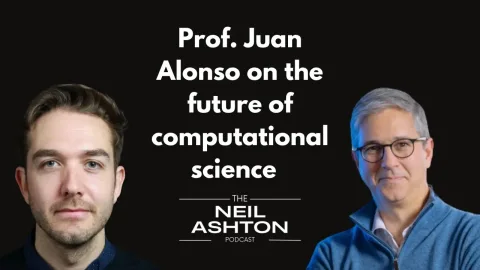
Prof. Juan Alonso — The future of computational science
Watch on YouTube
Prof. Juan Alonso — The future of computational science
YouTube video
Watch this episode
YouTube is contacted only after you choose to play the video, keeping this page fast and private by default.
Listen to the audio
Episode overview
In this episode I speak to Prof Juan J. Alonso on his vision of the future of computational science as well as his journey from academia to entrepreneurship - founding Luminary Cloud. He reflects on the revolutions in computational science and the different ways of developing software throughout his career.
Alonso emphasizes the importance of academia in creating and perpetuating knowledge, as well as the value of innovation and new ideas. He also discusses the changes in the CFD world, the emergence of new technologies like GPU computing and cloud computing, and the potential for advancements in computational simulations for analysis and design. We also touch on the transition of the aerospace industry towards commercial software and the potential for cloud computing to revolutionize CFD.
The conversation concludes with a discussion on the progress made towards achieving the goals outlined in the 2030 CFD vision report and the role of machine learning and AI in simulation-driven workflows. In this final part of the conversation, Juan discusses the potential applications of ML and AI in engineering. He identifies four main areas where these technologies can be beneficial, but emphasizes that these applications will always be based on high-fidelity simulations.
He concludes by envisioning the future of computational-driven science and the continued innovation in the field.
Chapters
- 06:00 Introduction and Background
- 09:11 Early Interest in Aerospace Engineering
- 12:13 From Academia to Industry
- 15:11 Decision to Stay in Academia
- 17:11 Balancing Fundamental Science and Applied Research
- 22:14 Early Aims and Focus on High Performance Computing
- 29:18 Emergence of GPU Computing and Cloud Computing
- 32:23 Conditions for Innovation and Entrepreneurship
- 35:01 The Importance of the Bay Area
- 35:37 Challenges and Requirements in Developing Solvers
- 41:00 The Role of the Bay Area in Attracting Computational Science Talent
- 44:16 The Difficulty and Respect for Building High-Quality Commercial Software
- 47:03 The Transition of the Aerospace Industry towards Commercial Software
- 49:30 The Potential of Cloud Computing in Revolutionizing CFD
- 53:59 Progress towards the Goals of the 2030 CFD Vision Report
- 01:00:53 The Role of Machine Learning and AI in Simulation-Driven Workflows
- 01:04:01 Applications of ML and AI in Engineering
- 01:05:36 Optimization and Design Optimization with ML and AI
- 01:06:04 Outer Loops and Uncertainty Quantification
- 01:07:04 Digital Twin Frameworks and Constant Retraining
- 01:12:36 The Value of Open-Source Codes in Academia
- 01:16:19 Challenges of Integrating Commercial Tools with Research
- 01:25:20 The Future of Computational-Driven Science
- 01:29:01 Continued Innovation and Replacement of Physical Experimentation
References and links
Transcript
This transcript was created from the corrected YouTube captions, with names and technical terminology reviewed. Download the corrected SRT file.
Hi, and welcome to the Neil Ashton podcast. In each episode, we explain some of the fascinating ways that science and engineering are changing the world around us. We talk to leading engineers from elite level sports like cycling and Formula 1 to some of the world's top academics to understand how fluid dynamics, machine learning, supercomputing are bringing in a new era of discovery. We also hear some of their life stories, their career advice, and lessons they've learned on the way that I hope will be helpful to you, too. So, sit back and enjoy this episode. Welcome back to the Neil Ashton podcast. This episode is with Professor Juan
Alonso, somebody who has really been a pioneer in the area of aeronautics and computational fluid dynamics. I thought this was a good person to speak to because, as I've discussed in a couple of previous episodes, I'm always fascinated by the by the link between academia and industry and the roles that that both play and the sort of merits of both and and Juan is someone who really epitomizes both. He's a professor at Stanford University, but um recently also founded a innovative new startup called Luminary Cloud. And we talk in the episode today firstly about his his career, how he got into engineering. I I'm I always love to
know what motivated people, what drove them. I think it's so interesting to hear different experiences. So, we talk a little bit about how, you know, his early days, about becoming a professor, about, you know, leading a research group. Some of his early observations, um you know, he mentioned something like, "Oh, at the beginning I was didn't really I hadn't matured my thinking. I was still doing a little bit of what my supervisor had done. And I think that's true if you're an assistant professor straight out of your PhD, maybe you haven't fully, you know, got your own vision for everything. But even though he said that, if you
look, he he was one of the first people to be doing a lot around high performance computing, looking at merging methods. Obviously, one of his big focus was on aircraft design. We didn't talk about too much. He he also spent some time in NASA headquarters. Although, as in any of these episodes, I feel we could have gone on for hours more cuz these people have done so much in their careers to date that it's hard to cover everything. But we we really get into some core topics around where where CFD going? What's the future of CFD? And one of the things we talk around is the CFD Vision 2030 report. This was a report that Juan was one of
the authors on, which was commissioned by NASA to set out by 2030, where do we see CFD going? And essentially, it talked about some grand challenges that need to be completed. So, we talked to we talked about his opinion on that, whether we already have completed some of them. And and so, I asked him, what would be the 2050 vision? We talked about machine learning, his opinion on you know, the hype around machine learning and where it's suitable and where it's not suitable. Uh and we talk about the interesting debate around when is open-source the right what can open-source codes achieve? And where do you need to have commercial codes?
And I think he's uniquely placed to answer that question because of his work to help found SU2, one of the you know, largest open-source code that is used for CFD in particularly in the aerospace. And then now with Luminary Cloud, which is most definitely one of the disruptors in the CFD market, their philosophy of, you know, cloud first, their automated, super fast GPU solver is something that is, as we discussed, long been spoken about in academia, but only recently have their methods matured to be suitable for for commercial um code. And so he talks about that the motivation behind behind Luminary Cloud, what what made him think
about that, the rise of cloud computing and HPC, the commoditization of compute. So we go through we go through all of it and I I found him a fantastic person to speak to. I always enjoy um seeing I don't see him that often because he's in Stanford, I'm in the UK, but whenever I do see him I I really value his judgments and his ideas and I hope that you also take something out of of of this conversation. So So I really hope you enjoy this episode uh too and if you do, make sure you, you know, subscribe and follow to to wherever you're listening to this podcast or or looking at it on YouTube or Spotify and Apple. Uh but yeah, sit back and enjoy this
conversation with Professor Juan Alonso. First of all, thank you for doing this. I um I know it's hard to find time to speak to people. I'm sure with everything you've got now. I can only imagine how you're sort of juggling um things cuz I would argue that as a professor at Stanford, now a, you know, a founder of a pretty innovative, forward-thinking, potentially cutting-edge, groundbreaking, you know, software company, most people would say that's a pretty good life. How do I get to that? So did you always want to go into engineering and sort of aerospace engineering or is this one of these
things you just fell into it? Well, I've always been interested in space and aircraft. So, my father worked for the Spanish airline company Iberia. Oh, yeah. And I I tell people until the sweet age of eight I wanted to be an astronaut and then I realized A, I wear glasses and B, I live in a country Spain that didn't have a space program. So, So, very quickly I decided astronaut was not the thing for me and I've always had a an interest in technology but also aesthetics. So, I thought of becoming an architect uh in Spain much like in the UK I think you have to select the major before you go into college. But I thought I didn't have enough
artistic talent to be a good architect and I loved airplanes and I loved the shape and function of them and the engineering of it. Yeah. kind of fell into it but I had an interest before I got there. That you know that's so interesting you said that cuz I often joke with some of my friends that I wanted to you know being from the UK to be an astronaut and yeah, one of them was definitely the Oh, hold on. Well, the UK technically has a space program but I'm not sure I would I won't get into that sort of issue but Um but for me it was more the um I'm not very good with roller coasters. So, I kind of realized that actually
you you have the most of them are fighter pilots, aren't they? So, I thought you have to kind of be used to um I love taking the G's. Oh, do you? Oh, there you go. Especially the ones that go upside down. Well, okay. So, you you are definitely closer. Maybe you should you could still do it. Do you think? Private tourism maybe? Maybe. Maybe. Someday. I hope so. Somebody offered me the chance to go into more, I'll take the the right anytime. Yeah, if you'd have asked me that probably 15 years ago, like when I was a teenager, I absolutely said yes. I think now coming from an engineering side and going, "Hmm, how often are those
tested?" I'm I'm not sure. Um but okay, so you you got in more through the love of aircraft and space. So, is that what drove you to then go down from an engineering at university? Was that always what pushed you, you know, ignoring architecture, but you wanted to go down the engineering route? Yeah, I I I was analytically good, mathematically good. I I think I had a knack for physical intuition of things, physics. And I wanted to solve problems. So, I I think I thought at the time, and I I think it's panned out that an engineering career was a good career. I was kind of interested in airplanes and spacecraft, so I thought aerospace
engineering would be good. And then my my career early on was a little bit funny. I I did my freshman year of college in Spain, in Madrid, where I'm from. And then I had the opportunity to come to the States as a sophomore, so a second-year student in the East in the States, and and I I ended up at MIT for my second year with a plan of trying it out for 1 year. And if I liked it, I would stay. If not, I would go back to Spain and finish my career there. And that was 1988, and I have been here ever since. So, so it was a great experience as an undergraduate. I got to learn a lot of things. I got to try a lot of things.
Um both in building things and testing things, but also I started doing computations. Took a class from Mike Giles, who was at MIT at the time when I was an undergraduate. My first CFD class I think the year or two before he went back to Oxford. So this is must have been 1990 1991. Yeah. And I was sort of hooked on on the valley of computation and it's potential as it develops into the tools that you know we have today to really solve groundbreaking aerospace engineering problems and by extension engineering problems in other disciplines. So So Yes, there's always there's a problem solver in me and I thought the engineering profession was a good match
to my skills. It always amazed me how small world I that Mike Giles I can't confess to know Mike that well but I would seem to be around people who know I was actually just having coffee this morning with um with somebody in Oxford and he he he was like working with him during the PhD years and uh Yeah, it's kind of funny how it works isn't it that you everyone seems to like have some connection to these people. It's a small world. He was a remarkable teacher and you know I I credit him for putting me on to CFD as as something that I would do as a professional later on. So But then did you So that was at MIT. What cuz
I suppose one of the things I'm always interested in is as you finish your undergrad you obviously have an option to go into industry or academia. Was that ever a decision which way you were going to go? Oh absolutely. So you know everybody thinks when they see somebody who's had a 30 year 40 year career that they planned it all out. But no I I I was set on going back to Spain when I finished my studies in the US. And at the time when I started college Spain's engineering programs were six years six year programs. This was before the like the I think it's called the Bologna treaty or something where they the European Union and homogenized all of
the engineering and educational programs. So So I knew I had to do at least a masters in order to be able to go back to Spain and just work as a practicing aerospace engineer. Yeah. So I went to grad school with that idea. Um I'd done a lot of engineering things, but I'd done little research, a little bit during the summers. I did not know that I wanted to be a researcher. In fact, my idea going into grad school is I was going to get a masters and potentially what I wanted to do was to go design airplanes in industry. Mhm. But the masters exposed me to research. You know, I worked with Antony Jameson at Princeton
who also, you know, like Mike Giles was an inspiring Yeah. pioneer of CFD and numerical analysis. And I stayed on for the PhD and I was still thinking I was going to go back to industry and actually design airplanes. And And then the opportunity to come to Stanford as a faculty member came up and I thought, well, I can do that for a couple years. If I If I don't like it, I can still go and design airplanes. If not, it'll be very difficult to go the other way around. So So, you know, in in your career, like I imagine in yours, you take these make these decisions here and there and they they lead you to where you are now, but
it was never calculated or planned out. Was there any of that of the um Cuz I I actually found after my PhD almost the opposite. I was kind of sick of academia in a way, you know, like it it felt like I wanted a change. Did you ever get down there? Or was there something also about moving to Stanford? Was there Was there or the location, living in Was there anything else that sort of did it for you? For me it's not as much as location. I It's beautiful weather here, I would tell you. And And it's one of the best weather sort of patterns in the world. Um to me, the thing that made me stay in academia, even though I have a bent
towards solving real problems, which I mentioned before, is sort of the the being at the edge of the precipice type feeling in research when you actually don't know whether you're going to be able to find a solution for a problem and you're trying to do it in better ways than anybody's done it before. That was very motivating to me. I Yeah. Yeah. I think the ability to also work on the problems that I thought were important throughout my career, the ability to work with amazing young people who are far more talented than I am and then with whom, you know, together you end up doing some or or creating some key contributions, you
know, to the field, that was very attractive to me. Um Mhm. I knew in an industry I could contribute in different ways, but I think my personality was better suited for academics and and and and to sort of go a little bit more into the unknown rather than into things that are or tend to be a little bit more incremental. Yeah. But So You know, if I may, in in my career, I've always tried to get my students to do something new in research but applied to something that is quasi realistic without doing the job of industry, of course, right? Uh Yeah. So it there there's been a constant tug-of-war between doing advanced new ivory tower type things and
sort of having them be applied to something else and I I found that Stanford allowed me the opportunity to thrive in that sort of tension between the two worlds and and I I've enjoyed it ever since. I couldn't I think of myself Yeah, I must admit I I kind of I look up to you as as somebody who has done that very well. I think as someone Thank you. myself who feels a little bit caught between the two worlds that I I think what you're doing is actually very important because on one hand there is real value in fundamental science and fundamental, you know, theorems and and all the rest, but sometimes I see the sort of cynical side
of it just, you know, for publication's sakes and I sometimes find myself going, "Yeah, but why? How is that going to make a difference?" sort of thing and Right. But if you go too applied, it's almost there's not the academic rigor and it feels like what you're doing different than industry is doing. So, it's it's a difficult spot I feel you're in the middle, isn't it? Yeah, so I I do think that you know, academia comes up with fundamental new ideas and sometimes they pan out, sometimes they don't. But any advanced society that already covers their needs for like food and shelter, etc., etc., goes next to trying to deal
with knowledge and that's the creation and the propagation and I would say the perpetuation of the knowledge that has been acquired. So, so at the very least academia has value in creating the knowledge and perpetuating the knowledge by training people. I think there's much more value created in academia than just that. Yeah. But but for me in particular, it's all my academic ideas over 20, 30 years, perhaps we'll speak about this today. Mhm. Uh you know, have led to what I'm doing today in in sort of the entrepreneurial world, right? I would not have thought that that would happen, but without the academic experiences, the interactions
with students and amazing colleagues that, you know, started creating languages so you could program in a GPU, for example, 20 plus years ago, you know, the the the company we created now would not have happened. So, so I I do think you have to navigate that balance and I think there are academics of all kinds. Um but I I think societies that don't have the ability to do academic thinking, innovation, creation of new ideas, and knowledge for the sake of knowledge, they end up dying. Yeah. Yeah. So, what was your you know, as I'm interested to see how you kind of how you've got to where you've got now and some of the
route, I guess. So, when you were doing you were starting at Stanford, what was your core sort of um aims or sort of 30-year goal, you know, what were what was your group trying to do? Cuz I feel like looking at some of your early papers, there were still things around high-performance computing very early on, arguably, in the sort of Sure. high-performance computing trend that we're in now. Well, so you assume there was a 30-year plan. I at the time I was very young still. So, I I came to Stanford straight out of my PhD and I had not had the opportunity to establish my own independence of thought in terms of research program.
So, I I've been heavily influenced by my my PhD advisor. But, I also love the notion of of modeling the real world uh with mathematics and physics and then implementing it usefully in a uh in a digital computer in order to be able to to have simulators that were more effective than than the experiments and that was very early on. Um I was also smitten by the fact that I could see very early on that if you have the analysis capability, you could do optimization on top of the analysis to have tremendous potential. So, my early career was very much focused on getting the analysis in place and that was in numerical methods, high-performance
computing, flow physics, etc. etc. But, also doing optimization on top of that. So, you know, I inherited thoughts of adjoint methods and you know, optimization whether single objective, multi-objective, etc. etc. And that that meant that the research had to grow to encompass a pretty broad ecosystem of various different elements. And I pursued some of those elements throughout my career. You know, some more successfully than others, I would say. But uh but but the plan was always to design. I mentioned I thought of being an aircraft designer. For for me um computational methods have always been a means to an end.
And they still are. It's just that sometimes you have to invent, generate, or improve the tools in order for them to be a good means to an end. And and as you know, since you've been around for quite a bit of time as well, um these tools were not ready to be used in what I call the outer loops, right? You could do a single simulation. You could spend weeks and months trying to get that single simulation, but automatically running a hundred, a thousand, ten thousand simulations to do whatever outer loop, let's say optimization, but there are many others. That was not anything that could be done at the time. So, I mean,
we were trying supersonic airplanes with uh Euler methods. You know, we were trying genetic algorithms. We were trying all kinds of interesting things to see what would work or what methods would work in which applications. And that was my early career. And the idea was I wanted to get everything ready so I could do optimization. Based design as I can understand and and simulation-based optimization. So, that that that was what motivated me in the early days. And there was a lot of America houses and a lot of parallel computing. Yeah. How do you think it's changed then? So, if you look back when in when was it night well, no, early 2000s.
Yeah. Um if you were to go to an aircraft manufacturer, look at their design process then, and fast forward it to now, what would you see as being the sort of big differences? Um I don't want this to sound critical of the aerospace industry cuz this safety critical industry that requires very careful attention paid to to large steps, large changes in design processes, and manufacturing process control systems, whatever the heck. Um I think the use of computation from when I got out of grad school, so in '97, until now, it's gotten more automated and it's gotten faster, but it's not gotten substantially
different. There are a few companies around the world who try to do some of the outer loops, sometimes more successfully than others, seldom in production, I would say, most often than not in their R&D centers, sort of informing studies and various other things. So So surprisingly, we've come up with a number of technologies to accelerate the simulations, and we come up, I would say, with a number of technologies when you're doing the same thing over and over again to automate, script, link things together, which is one big part of engineering, don't take me wrong, but I I don't think we fundamentally talked about changing
the way in which we either design systems or use the computational tools to design those systems. And I think in academia we we have more freedom to think about these things, and I tried to devote a lot of my academic experience to how do you reimagine the way you do design, and and more recently in in Luminary, the the small startup that we created about 4 and 1/2 years ago or so, it's it's it's been about saying, "Okay, we know what we need to do, but we got to put it together, right?" And it's it's it's interesting. I I don't know what you think about this, and I don't mean to interview you in your own podcast,
but but it's been very clear to me from the beginning that what engineers need is that inner loop, you know, going from geometry to output of simulation to be very fast, guaranteed level of accuracy, whatever is requested, very robust, meaning it always runs without worrying about this mesh or that mesh or this parameter, and very scalably, so you can sometimes run five or 10 at a time and sometimes 100 at a time, right? And that's end to end. So so it's become very clear over the years that if you had that capability, if you could put a geometry and you get an answer fast, accurately, reliably, you know, and scalably, you'd be able to
then put all these outer loops, optimization, uncertainty quantification, parameter studies, you know, AI, ML, so on and so forth. The essence is that inner loop. The way we do the outer loops is is relatively well known at the moment, and and we just need to make it work and make it work fast. So So I would say I've I've devoted a lot of my career and more recently, you know, Luminary, my time and effort to make sure that we get those inner loops nailed down, so all the outer loops become possible. I don't know if that makes sense to you, but No, no, no. I think um I I I think the bit that I'm interested in it does seem as if the CFD, I mean,
fast forwarding a little bit to now, Yeah. the CFD world, it did feel in a way was almost a little bit static. And I know some people would say, "No, that's not true." But it felt it was a period, let's say before COVID, where if I was to look at the codes that were coming out and everything, it was mainly CPU-based, mainly still RANS- based, unstructured grids, and people were tweaking things, but if if you looked from the early 2000s until like the 2020s, people were using models still published in the 1990s. There wasn't that much. And it well, maybe that were happening were in academia, but they weren't in like
industry production. Where if you fast forward to now, I'm seeing companies like yours, and to be fair, a broader sort of like emergence of these new companies. What What do you think is driving that? Like what made you do it? What made it possible for you to do it in, you know, now in the past 4 years versus 50 years ago? Like what what what's made the conditions right for it to happen? I I So, I would agree with you. You know, up to about 5 6 7 years ago, except in academia, where we were all trying all kinds of crazy interesting things, Mhm. nothing much had happened other than more cores, same code, more MPI ranks, you know,
a few automations here and there, mesh generation for unstructured methods, you know, becoming a more mature discipline, although, you still in in need of lots of sort of interesting improvements, I would say. And and and very stagnated field. Um To me, and I if I switch now to my non-academic and and more entrepreneurial Luminary career, um in the 2019 time frame, when I was talking to the person who'll become my co-founder here at Luminary, it become very clear that a number of the key technologies that were needed to realize the vision were now mature enough that you could actually have a chance of getting it done in a
short amount of time. I put short in between quotes, right? So, um we started looking at sort of GPU computing at Stanford. You know, these are colleagues in CS that were participating these ASCII programs for full jet engine simulations. In in the early 2000s, this is prior to CUDA, etc. etc. In fact, it was a student of Pat Hanrahan's I met I I remember Ian Buck, who's now at NVIDIA, who had done something called BrookGPU where the texture memory of the existing GPUs of the time was used as memory for computations. And and Ian then got hired at NVIDIA and and became the main architect of CUDA, right? And of course,
at the same time NVIDIA started changing the hardware of the GPUs in order to enable computing. So, so back in the early 2000s, we were already doing these things. In fact, I remember with another colleague from Stanford, who's also at NVIDIA now, Massimiliano Fatica, in 2004, we published two papers in the AIAA Aerospace Sciences Meeting, one called Stream Flow and the other one was Stream FEM. The The GPU computing name back then was coined by Bill Dally, who's now a chief scientist at NVIDIA, at the time a professor in CS as well, and electrical engineering, I think. Um the trea- the term was coined stream computing, right? So, or stream
supercomputing, so. So, back then, those ideas were germinating and now they were ready in let's say the 2018-2019 timeframe. Cloud was unheard of in the early 2000s. You know this better than I do. But you may remember grid computing, right? Or very different supercomputing. So, the the idea of the cloud was germinating back then as well, but you know, the costs, the high availability, the security, and various other, you know, virtualization layers that came from many of those early research projects, you know, were also panning out. The infrastructure wasn't place, so you could actually run a calculation at data
center in the middle of the US and sort of visualize it in real time from a browser, you know, in the Bay Area. So, all of these things were coming together and it was clear that it was possible to do something different. Um Yeah, it it became very clear that that was the solution. That eventually most of the high-performance computing in the world will go away from on-prem clusters and and just go into the cloud. And and I know you work for one such cloud service provider, so I I know you're going to agree with me, but the competition between the major cloud service providers over the next 10 years is going to be fierce, which means
prices will come down, capabilities will go up, and additional differentiators will will be attempted by various different places. So, so there'll be a continuous drive for innovation. So, to to me it became very clear. I've been doing some things in the cloud earlier on in my research program and saw how good it was. So, it became very clear that a combination of GPU computing native from zero, you know, the beginning, and cloud computing native from the beginning was the way to have that sort of step function in terms of improvement of how computational simulations could be used for analysis and design, right? So, So,
that's a long-winded answer to your question, but but that's precisely what was happening. It was very clear there was a confluence of things happening that will make this possible. And go ahead. No, I was going to say and it's not like we had a, you know, crystal ball and everything was perfectly crystal clear, you know. There was con- There were concerns about companies putting their IP in the cloud, you know, data security issues, performance issues, you know, the the level of differentiation that one could achieve versus existing software providers, uh and and whether we could be successful, and frankly, how long it would take to redevelop
everything from scratch. Not just for solver technology, meshing, adaptation, visualization, AI machine learning, right? CAD ingestion, CAD cleanup, um you know, interpretations of results, creation of databases, scaling to large numbers of users, you know, scaling to large numbers of GPU resources in the cloud. Those were all unknowns that one needed to come up with solutions for that were less in the academic realm and more in the, I would say, creativity and innovation realm, right? How important do you think it it is that you are where you are in the world? Like, do you think you could have attracted the investment on the idea if
you weren't in the Bay Area? Is there something about the Bay Area that helps, or Yeah. Yeah. Yeah, I I I mean, I don't have proof that the following statement is true or factual, but I have a strong inclination to say that it would have been almost impossible anywhere in the world. You know, um you know, how how much work goes into just doing a solver. So, now try to do solvers for compressible and incompressible. Try to add porous media. Try to add multi-phase flows, thermal solvers, aeroacoustics, etc., etc., eventually structures. It's a massive amount of effort, and it requires a very large number of people
by academic standards. So, it requires funding because these things don't get done in 6 months, right? We're not I I remind people, we're not putting together an online calendaring application. You know it's going to work, right? You you're trying to do something that's never been done before and you want to make sure it's accurate, it's fast, it is robust, it works all the time, right? Etc. etc. So, so that requires a certain level of investment that would have been hard to find anywhere else but in the Bay Area. Also in Luminary, unlike in my academic research, there are two parts of the company. One are software developer computer
scientists that are highly concentrated in this area of the world and that are essential to the success of the company. The other are people like you and me, sort of trained as computational scientists, visualization experts, AI machine learning, meshing, geometry, etc. etc. Um and those exist all over the world. And in fact, you have to attract them to a place where they want to be. And the Bay Area is a nice place to attract people despite the housing costs. Um but but yes, I think it would have been very difficult to do anywhere else because of the magnitude of the investment, the time that it takes and sustain level that it requires to
actually get there. And I would say because you're going to have to attract talented people from across the world. We have a good pool of software developers, but everybody else has to come from wherever they are. So, they're the best in what they do and and attracting them here versus other places in the world is is a little bit easier, right? Yeah. How much do you I don't know how to phrase this. Do you have more respect now not that you were disrespecting for some of the large ISV companies. Like I always got this sense in academia that sometimes it was easy to criticize large commercial companies and be like, oh, you know, their codes are
not very good. You know, what we've developed in our paper is better. Having to do what you've done, do you suddenly go, hmm, actually now I see it's actually quite hard to build up these big code bases and validate them, etc. Yeah, um Yes and no. So, two things, of course, um Yes, producing a product that can be applied to many different types of applications and that are willing to pay for because it's it's addressing pain that they have in the current processes is very hard. It's much harder than writing an open source software solver and and making sure that, you know, academics with a lot of patience and and some industry
and and government people are able to use it and and they ask questions and it's okay they didn't pay anything for it. So, you know, if it doesn't work as advertised, it's all right. So, gain a tremendous amount of respect for companies that put good, high-quality products together because that means there's a tremendous amount of thinking about the features, how they're exposed to the users, how they're implemented, what type of regression testing you do, you know, what type of user testing you do, how do you make sure that you're doing something for the sake of improving processes. So, so that takes an inordinate amount of time. You know, if
you develop something in academia and you think you're done, you've done about 10% of what it is required to actually put together a viable product. So, So, in that sense, yes, I I I have a tremendous amount of respect for those companies that actually do this properly. Yeah. Um The converse is also true. You know, some of these companies, I mean, they're around for a long, long time. And while their solver technology has improved over the years, they missed opportunities over time to really do much more significant improvements. And you know, as an an academic, I seen the ways of technology that eventually I'm taking advantage of as an entrepreneur.
Um I seen them come by and and I I seen that they've been largely ignored by many of the the larger companies and and for that I think we should fault them. I I think as engineers, you know, and developers, when we have the resources to do what needs to be done and it's not done, that that's just slowing everybody down. And I I think there's a little bit of that in the legacy vendors to be completely honest. One of the things I observed uh I've been trying to to see if it's going to change or why it's the case. If you look at the automotive sector, Mhm. it's largely ISV or things like OpenFOAM or commercial versions of OpenFOAM. Whereas, if you
look at the aerospace sector, it's a lot of homegrown code. Why do you think that is and you think it will always be that case in the aerospace or do you think there's this slow move and I'm not not because I'm not trying to blame you but but because some people are maybe going, "You know what? I want to have I I want to leave that company and go and join an exciting startup and do it." Do you Do you think eventually there will be a move to a more sort of private codes and commercial codes and So, I I witnessed a lot of things through my career that lead me to the following comments that I'll make about your question. So,
um the aerospace industry invested heavily in computational fluid dynamics from the beginning as an alternative to internal testing. To the point that the major aerospace corporations in the '70s, '80s, and '90s, even into the early 2000s, would have, you know, teams of 50, 60 to 100 people working on the development of these methods that were used throughout their corporations. That changed in the early 2000s and the maturity of some of the commercial tools became to be so high that even aerospace companies started reducing the size of the teams that were doing new method development, new code development in favor of sort of
commercial offerings and options, right? Uh Um that happened more quickly, I think, uh particularly the transition to transient flow uh calculations in the automotive industry. They they recognized the advantages of the technology. They they knew they have tools that were almost ready. They some of them invested in improving, you know, existing solvers, OpenFOAM type uh things, right? Uh uh there were a number of smaller companies that were formed around the open-source code, OpenFOAM, in order to do further improvements that are needed by industry. And largely there's there's a lot of penetration, you know, of existing commercial vendors and
open-source-based commercial vendors because they seem, you know, the the advantages. I I I think aerospace industry is going in the same direction. Um there may be some esoteric applications, you know, in stealth aircraft and, you know, various other things that may still be in the realm of what the aerospace companies want to do, but the vast majority of the simulation workflows are ones that commercial software can do. And that commercial companies that are reinventing the way this gets done can do way better and way faster. So, eventually it's going to go in that direction. The the value added by the companies is not going to be in the
development of yet another unstructured polyhedral, you know, finite volume solver, but rather in how you use it in the outer loops. And the inner loops are going to be taken for granted if companies like ours and others start making sure that you can get them accurately fast and scalable as as we were discussing before. So, So, my take is the aerospace industry will go mostly commercial, mostly I would say modern computing type approaches and they'll be building or rebuilding some other processes on top of these units of computation that are going to be effectively taken for granted. Yeah, just seem almost ironically that
it's a a credit to CFD if it does become that way because almost it feels like it had to be developed by your own cuz you were the only people who knew how to do it where almost now not commoditized, but you know, it's becoming able to be created and made automated that you don't need that to be a special team within your company. Well, in the early days of the aerospace industry, Neil, it was a competitive advantage to have a team of experts developing that capability that nobody else had. At this point, the the individual solution capability is is not something that's going to be differentiating across these companies, but how you use
it in tens or hundreds or thousands of times, right? And then how do you embed it into processes and raise other things. So, yes, I I think it's it's a credit to the success of CFD as a discipline that 30, 40, 50 years after it was created, it's now becoming something that people believe, trust, and they can use in that inner loop without giving it much thought. And actually relinquishing it to to companies like ours, for example, and trusting that those companies are doing all the due diligence enough to make sure that the accuracy, performance trade-offs are are well understood. Yeah, almost feels a way a bit like
um HPC and the cloud. And obviously, I am slightly biased. I work for AWS, but I I would say this even if I wasn't working. And I think others have made these comments that it used to be the fact that HPC was a very specialist topic, required specialist hardware, but now even if somebody built their own machine, they're just using nodes and types that are widely used by anybody else. They're not really specific, so why would you need to build your own if you can just get it from a cloud vendor. It's because it's become more normalized, um you don't need to have this special system in-house. I I think you said the keyword before,
you know, high-performance computing has become commoditized. You know, no longer do we have custom-made chips, custom-made operating systems as was the case when I was a grad student, you know, custom-made interconnects if you have that. This is all commoditized. And, you know, the cloud service providers are building these data centers with the best in class of those commoditized components, and then they're putting the software infrastructure infrastructure together so you can actually use them in a dynamic way. So, um it it's hard to believe that individual companies are going to be able to recreate the value that's being added by these
cloud-based companies at much larger scale. And, of course, it's hard to believe that individual companies are going to be able to buy at the scale that's needed in order to burst in capacity. It's It's hard to believe that individual companies are going to be able to have access to the GPUs, the most modern GPUs, as early as the large cloud service providers are having access to them. So, and and it's hard to believe that that companies are going to reproduce all of the software services that come from a cloud infrastructure that that are not there in the on-premises clusters. So, yeah, I I mean, the the only drawback of at some
point or drawbacks were the cost and you know, the perception of security. I mean, the security one is essentially gone away and the costs are coming down over time. So, different companies have different appetites, you know, for understanding how much they spend internally to achieve similar or lower levels of of, you know, reliability, you know, credibility, security, etc., etc. And and different people will jump into the bandwagon at steps. But as you have seen, the engineering profession was lagging behind sort of the financial systems that sort of migrated to the cloud 5, 6, 7 years ago completely and engineering
is going in that direction right now. It's happening. Yeah. Yeah, it's it seems to be a um an interesting transition point where there's still I guess like anybody, you know, if you say, "Hey, use this new turbulence model." No, no, "No, I have to use that one." It's it's everybody gets in a certain mindset of doing it the way they've done it forever. Um So, it it is hard to sometimes convince and even in my 4 years as it is now with cloud, what it was at the beginning to what it is now is already a major difference. The conversations I was having at the beginning, it was being told to sort of get lost and I had to
try, you know, and I'm not a sort of salesperson in that sense. Like, I pride myself in not selling stuff to people, but it it was quite a different People didn't I Well, although, would you not say that you and I in some way working in a more cloud or closer to the cloud companies, working at a cloud company, your company that uses cloud resources, I still wonder if we're a little bit um not fully aware of still how much people don't even know what the cloud is. You know, if you go to some companies, you know, like does that surprise you still that when you're like, "Oh, do you not realize how I know it sounds like I'm selling it
now, but you know how good it is or how much potential there is?" Some people don't even know what it is, yeah. I'm not surprised that people have a lack of understanding of the potential of the cloud for their engineering simulations because there's so many ways of using the cloud and I think it's cluttering their perception of what the cloud does. I mean, I I talked to a number of people over the last 4 years while we were building Luminary who really have very little idea of what we were saying we were doing at Luminary cuz they Again, they had a mixture of ideas. They're like, "You mean, you're hosting my data there and I
never have to have something here or is it a virtual private cloud or am I just using the cloud for when I don't have resources in my company?" So, there's many ways in which people have done it. I I have to tell you, Neil, that the best way to make sure that people understand how we think the cloud should be used for engineering simulations is to show them a demo. Oh, yeah. Right. Yeah. It It's when it clicks for people. I can see that all the time. They have all these questions in their minds of, "What do you mean this, that, that?" When you finally show a demo and you upload a CAD file to the cloud and it takes, you know, 2 seconds
and then you run a transient simulation that generates multiple terabytes and immediately you can actually see and you've never transferred a single file or done anything, that's when people see it and and I I think it's it's companies like ours and others who are beginning to do this that can give people the more clear understanding of what it is and what the potential it has of becoming and and that's when it clicks for people I think normally. Mhm. But yes, there's many different ways as of you know of using the cloud and and I think that's confused a lot of people who who've been around simulation over the years but have not paid close
attention to the cloud. Well, I'm I'm kind of um glad in a way that um it has turned out the way it does because I remember I was giving a talk. I think it was in about May of 2020, something like that. I think it was like a remote thing at um at NASA. They do this seminar series and I gave a talk on like how the cloud you know, will transform CFD and I I remember the I mean admittedly okay, for people who know I was doing at NASA's supercomputing division which probably is not the right place to be pitching. Sure. Sure. Um but anyway, I remember saying some of the stuff and I I genuinely thought it was going to be
the case but um there was not as many other people truly believing in it and it was interesting that in that even before that your company was brewing and it it it showed that it takes time for things to happen but it I kind of at least I'm happy that it it kind of has I wasn't telling people a bunch of lies and has kind of come to be true. You were one of the pioneers of this. I remember you and I we met at I think it was an international CFD conference in Strathclyde. Oh, yeah. A few years few years before that, maybe in 2016-17. And you were beginning to talk about these things and and I was paying attention. And yes, I I think
you know, going to people who own supercomputers and that are very interested in sort of the hero calculations where you're going to be using 1 and 1/2 million, you know, CPUs or something. It It That's the right the wrong crowd, right? Uh But But as you very well know, you know, from the early days in the early '90s of MPI, you know, 4 6 8 16 processors, eventually 200 400, then Blue Gene L with 100,000 cores or racks, and then eventually some of the 1.5 million simulations. We all thought that for supercomputing to keep going, we're going to get into the millions of cores, yeah, yeah, heterogeneous, etc., etc.,
right? Uh and everybody was talking about MPI plus X. We didn't know how the future of software development was going to happen. It turns out that for some of the most demanding supercomputing calculations for engineering, I'm not going to talk about basic science at the moment, but for engineering, we can do really well with 256 A100 GPUs in the cloud. So, so I think it's taking a while for people to understand that vast improvements in supercomputing are not requiring some massive changes, you know. It's cloud, yes, new technology. It is, you know, 500 GPUs, 1,000 GPUs, but not hundreds of thousands or millions of GPUs, right?
So, so I I think we got into a point where where most people are seeing that for engineering calculations, this is the way to go. So, where I I agree with you there. I think that's an interesting I always do this. I always show this in any presentation I do about like the cost and that doing an, you know, a DNS or things like that are are so unbelievably expensive that it's it's good maybe for academic work or things where for national security reasons or whatever, you know, you have to get the answer through CFD and maybe the accuracy. But I I would agree with you that we've made very large inroads into showing high fidelity
methods are maybe not as expensive as people thought they were maybe 10 years ago. You know, that sort of vision of 2030 I would argue is come closer and obviously, you know, that was something you were heavily involved with. Do you think How do you think things are looking? So the CFD Vision 2030 report was a very big pioneering is quoted everywhere. How are things progressing towards achieving those aims? Yeah. So as you mentioned I was one of the co-authors of that study and it was a very fun study to do cuz it involved academics, it involved industry, you know, it involved people who have been in the computer science side of the
effort etc. etc. At the time we were so that was published in 2014 10 years ago. We've been working on it for about 2 years. I think is the total time that it took us a a small contract from NASA to sort of put this vision together of what CFD in the 2030 should actually be. Um at the time that we were writing that report and we published it I don't think anyone of us of 10 or so people in the committee that wrote that paper thought we would get anywhere close to being at the level predicted by 2030. And here we are 6 years before the deadline and I think much of what we were talking about in the solver technology
in the managing large numbers of simulations, in some of the multiphysics elements, and some of the design optimization elements that I'm you know, I that was one of the major writers for, I think we're almost there. Um meshing adaptation, accuracy, scale resolving simulations, those were things that were not deemed to be possible you know, until 2030 or beyond and and I I think I think we're going to definitely meet the goals by 2030 or before. Which by the way is a lesson for the next 20 years, right? The Like I was telling you at Stanford people were looking at how to program in GPUs before there was CUDA or anything else 20 years
ago. So, you know, we're in 2024, 2044, hopefully we're both still around. And it could be radically different than than what people are working on today may actually have a substantial impact when, right? So, so we we we're definitely on track to achieving the goals of the CFD Vision 2030 uh CFD vision before. Uh there's a group that's actually tracking this and and you could argue that you could interpret all the statements made in the original report in one way or another, but but we made tremendous progress mostly thanks to GPU computing and sort of advances in sort of meshing, adaptation, post-processing, and multiphysics, right? I think
I think taking calculations that used to take 4 to 6 hours and doing them in 2 minutes opens up the possibilities for multiphysics which were recognized in the CFD Vision 2030 as one of the key ingredients, you know, for for future uses of CFD in in you know, beyond what's been used today. Mhm. I think one um and I probably should have read the report before saying this, but I'm pretty sure it doesn't have it in there, but correct me if I'm wrong. Is as we move into now the machine learning side of things. Um I'm interested to know your thoughts on this cuz just as GPUs, totally agree, have been a game-changer, rewriting codes um for
GPUs, and you know, all the advantages that gave and and and and and even just as you were saying, integrating the HPC and the software more tightly, um so it's not separate things. But where do you see machine learning coming? Do you think it will be a major change or do you think it's too hyped? Where's your viewpoint on this? Yeah, so this is a long topic and that one that's close and dear to my heart. I've been doing research in this at Stanford since I would say 2010 or so. Um There is no question that it's it's one of our technological revolutions in general.
In science, engineering, and consumer industries, etc., etc. The abundance of data is what motivated this, whether you produce it through more accurate much quicker simulations that you can run in parallel, you know, hundreds of them, etc., etc., or whether you're collecting data from sensors, sensor technology from existing systems feel it in the you know, in the world. Um, I do think it's a revolution, but I am afraid it is massively hyped up when it comes to physics-based simulation impact of AI and ML. And actually, if you will allow me, I'll always say ML and AI. Because I mean, what we're talking about is is
advanced methodologies for regression of existing data, mathematically speaking, right? Um I don't think it's a question of whether it will be useful or not. It will be useful. I think the key question is for what will it be useful? And also, how will it be useful for people who are doing simulation-based work, right? So, I got I got I have to carve out that niche, which is my niche, right? Um, it is my strong opinion at the moment and I've been thinking about this quite a bit that there are four potential uses of ML and AI in simulation-driven workflows. By the way, if I hear anybody put a LinkedIn post or publish something
when they say like, "Ooh, we did this and it's 10,000 times faster than the original solver." I'm going to write a nasty gram because they never talk about how much it took to generate the data, how much it took to train the model. Something recently on I wrote a comment on a few days ago. I didn't say it was 10,000, to be clear. Somebody else did. And I Okay. Well, so what what I'm trying to say is that those things are are hype. No discussion of how many actual simulations were required to train the model, right? No discussion as to what the training costs were. No discussion as to the accuracy of the predictive tool. No discussion as to
whether that methodology is interpolative in nature only or extrapolative in nature, typically not, obviously. And you know, sort of no discussion as to whether, you know, you were actually training for something and actually testing for something else. So So my take is that those things just ring very hollow. Most people do not understand the real problems for which these replacements of high-performance computing sort of type of approaches would actually be used for. And I I hope I'm not insulting you or any of your of your you know, podcast viewers and listeners. Um I I believe strongly that there are uses for it, but I think we have to sort of
get over the hype and and sort of move on to to show things. So So if I can tell you um the four things where I think uh this technology is going to be very useful. Um I I Do you have time? Yeah. Yeah, absolutely. Let me start. Number one, one that makes absolute sense to me in aerospace and outside of aerospace, real-time control of systems. You have a system, a plan that's fixed. You can analyze and hyper-analyze it and create training data, right? The it requires that you query the model many times per second. So, there's a performance requirement that is absolutely necessary. It is a control system and therefore
it's built to reject errors, which means it's okay to actually build a model that has some errors. And in fact, it's okay to build models that have significant errors, so you can reduce the amount of training data, right? The And at the end of the day, like I said, the system's not changing, so so you can actually build it and you can amortize it over, you know, many many many repetitions of that system, whether it's an airplane or a jet engine or a car or something else. That makes perfect sense to me. It's a very viable use. So, that's that to me will be use number one. Uh, use number two, uh, would be some very hard optimization
problems. So, design, design optimization for various different reasons. Maybe it's very high dimensional, right? Maybe there has noise. Maybe it's very multiphysics oriented, etc., etc. I can see how what I would call ML/AI surrogates with certain amount of errors in the context of an optimization framework, like let's say a trust region based type of approach, could actually be helpful, more helpful than doing direct optimization on top of the high fidelity analysis. Except in many situations, you know, if I can get away with adjoint methods and various other sophisticated methodologies, well, let's say 100 or 200 function evaluations, well, and and
get to the optimum with high fidelity without having to check and recheck, why am I going to train a model with several thousand simulations, you know, unless I'm going to be doing it very often. So, so some of these optimization hard optimization problems could benefit from these types of methodologies. That to me is application number two, right there. Um application number three are some of the outer loops that also can tolerate some errors. So, uncertainty quantification, design under uncertainty, some large parameter studies, data assimilation, inverse problems. There are some situations where this makes sense. And then
finally, if you have a system that is not only simulatable and trainable, but you can actually collect a lot of data. So, digital twin type ideas in certain situations. The the ability of having frameworks, possibly cloud-based, where you're constantly retraining based on the availability of data for bespoke models for various different, you know, products that you have out there. That could actually be very useful. So, so I can see a tremendous potential for those four types of applications, but they're all always going to be based on the high-fidelity simulations that you have to create in the first place. And they're going to have to be based on
some more modern, more non-linear techniques. And hopefully, as we move forward over the next 10 years or so, academics, industry, and others will begin looking for ways in which these models can be much more extrapolative than they are today. So, the cost and investment of setting up the model and training it can be amortized over much larger numbers of user uses um than than what is the limited set of uses that one can use today. So, so I'm not cynical. I hope I don't come across as cynical. I I I'm more about sort of trying to understand from a very rigorous mathematical and physical point of view what these methodologies can and cannot
do, Yeah. Um so, that that's my thinking. There's there's There's of generative design that we could go into, that may be enabled by the high fidelity simulations, but but that's even at an earlier stage at the moment. So Yeah, I find Yeah, I definitely find an interesting topic because um Mhm. we you know, we see a lot of interesting companies come out. I agree with you there's a there's a lot of bold, shall we say, marketing claims Yeah. that uh funny in a way. I kind of see on one hand it puts people off, but on the other hand I kind of see that some companies need to do that almost to get the attention. So there's a sort of uh
counterbalance um and and I kind of wonder well, firstly, whether whether that's true. I mean, I think it's crying out for a proper study that does a more fairer comparison because I know that just looking at the inference time alone is is not the full picture. Right. To the same point that I know that some wind tunnel people hate it when you say, "Oh, the cost of CFD is this and the cost of a wind tunnel is this." And they say, "Well, hold on, how long did you take to mesh that?" Now, I know maybe with your code you don't need to spend as long meshing it, but there's always a slight challenge of comparing things
like like. Um but what do you think about the bolder claim around sort of foundational models? So the theory being that if I'm an automotive customer and I always run cars, do you not perceive that with enough high fidelity simulations with enough sort of input-output mappings that you could get to a point where you could train a model that could predict a car? You know, like is it a simply a data problem? If there's enough data, do you think you can ultimately get to that point, or do you see it more from a sort of physics enforcing as in it's okay for low fidelity, but if you really want to get everything right, you still need the
high fidelity? Um definitely Well, that's a wonderful question, and let me say a few things about it. It's uh going to be a factor of the level of accuracy you require. Sorry. Don't worry. Don't use the phone. It doesn't do it for me. I don't know I think You could do it in the outtakes. Uh I think the answer to that is is multi-pronged. So, let me uh let me start by saying that I I do believe that additional amount of data, vast amount of data, are going to be helpful. But, I think
whether you can replace a physics solver by an ML AI sort of capability, it's going to depend very strongly on the level of accuracy that you require. I I'm a little biased. I come from the aerospace industry where, you know, a half a percent difference in the prediction of drag and therefore fuel burn of an aircraft is a huge number. Mhm. I have some hope that if we had data for thousands or hundreds of thousands or millions of airplanes, we'll get there. But, I think that's going to be a very expensive proposition. If you're designing a valve, you know, for an irrigation system, and you can tolerate five or 10% errors,
then I think there's going to be strong potential use even without hundreds of millions of data points, etc., etc., right? Uh Mhm. So, I do think the accuracy level is going to be important. Um I do think the availability of massive amounts of data is going to be important. In aerospace, I mean at the end of the day, Neil, you know this, right? The CFD solver is solving a PDE with a basis. And because we have meshes that are very fine, these bases can represent all kinds of features that are very small in size and therefore, you know, there there's a very good ability to represent the exact solution of that PDE that you're
actually solving. Here, what you're doing is you have a non-linear basis that you're combining in various different ways, but part of the decrease in cost of the simulation requires that the number of basis vectors, let's say, is significantly reduced. So, you're always going to be trading this. You know, we've been doing this from finite element bases to, you know, wavelet transforms and various other things. This is yet another non-linear basis combination of various different tools, which will have potential use in many areas, but I don't see it as a complete replacement of the types of things that we're talking
about. I Also, I have to tell you that the I've lived this over the last 5 years. When you go from executing one calculation in 6 hours to 1 minute, your your trade-off between speed of execution of a surrogate model of some kind and you know, the the actual accuracy that you need changes, right? So, and I I do think that that's going to sort of be sort of coming after us for a long, long time in some applications where the accuracy is very, very, very important. In other applications, I think we'll we'll transition to some of those models more quickly. I think there's a dearth of research that is trying to understand
fundamentals of the physics to then introduce in a machine learning methodology to extrapolate from the data you learn from by using sort of the commonality of the physics that was actually learned. I'm excited about sort of researching those areas that that could have tremendous potential over the next 10 years. So, there are a number of people around the world trying these ideas. Uh I I almost see it as a an ironic way that the very thing that makes machine learning so potentially transformative um which you could which some people may think would challenge the need for research into sort of high fidelity or improved CFD is almost the motivation
for it. And the reason I say that is because if you need so much training data the actual method you use to create the training data becomes a huge cost. So, if you can if your code can run five times faster, means you could potentially generate five times more training examples and make your model much better. Now, whether the cost saving means that why you're even doing that, you know, you might as well just run the normal simulation. That's I guess to be determined. Um it's it's it seems to be almost a motivation for the higher fidelity fast methods. I I'll make a I'll make a prediction and then I'll I'll give you an analogy.
The The prediction is I think the the small companies that are simply sort of taking simulation data from some other provider and doing let's say ML AI any one of the methodologies um making the claims that we're talking about are unlikely to be successful and viable companies because there'll be a number of use cases as we were discussing before that could be useful, but they're going to depend very heavily on on on tight integration with the simulation tools that are producing the data in the first place. And and they're not adding a significant amount of IP in terms of coming up with brand new methods that are not fully
published out there. And with PyTorch, most people who know what they're doing could actually code up in a couple months, right? So So I I think there's going to have to be much more interaction between companies or tools that do the AI and the machine learning and simulation technology in order to be able to sort of address many of these different fields. So you you asked me a question as to where I think this whole thing is going. And again, I I don't want to sound cynical at all. I think I'm very upbeat about it for certain uses. I you know, as I get older, I can pontificate about these kinds of things. So over my lifetime, I've seen NX, PVM and
MPI, you know, for for um message passing sort of things. Then then you could argue you you see single core to multi-core processors to Titanium processors to IBM cell processors to GPU computing, etc. etc. You never know which of those things are really going to pan out and which ones are going to just, you know, die and wither on the vine. So I think AI and ML is a broad uh topic with many different elements. I think some of those are going to be successful and some of them are going to die and wither on the vine because uh you know, high-performance computing simulations are going to be done. They don't need millions of evaluations and
and therefore you're going to be better off just doing it directly and not having to worry about whether you have to reevaluate, retrain, so on and so forth. So So yeah, it's it it's it's early uh stages. And I think I think you can see, as I told you, I'm convinced that there's three, four, five uses where this is going to be very, very powerful. And I think there are others where it's just hype and it'll go away. One of the um I think interesting things that you've done and and I guess there's a little bit of analogy to the ML world, which is this whole argument of open-source versus closed source. What's the way to
advance things? Obviously, one of the things I think you have made a large contribution as well with your you know, colleagues and people who who founded the SU2 movement. Um What do you think are the sort of What can open-source codes achieve? What can't they achieve? Well, you know, what Where do you need to almost have a commercial company that an open-source couldn't do? Or I'm I'm kind of always interested on what's like the way to advance the science in a way. Yeah, so I came to open-source reluctantly, I would say. We had always given our codes that we had developed at Stanford to anybody who wanted them, but
we said, "Here it is, not much documentation, you're on your own, right?" So, when I came back from NASA headquarters in 2009, I had a very talented sort of researcher in my lab, Francisco Palacios, who uh you probably have come across at some point in your before then. And he convinced me that we had to ditch our multi-block solvers and start doing unstructured, and we said, "Okay, let's do it." And then he and some of the students were the ones who said, "Let's put it on the open-source." And I'll get back to your question in a moment, but just for context. And at the time I was very concerned about it. I was like, "Well, it carries
the Stanford name, so we cannot have something that's crappy." Um it's something that people are going to be to a lot of questions, so we have to have documentation and various other things. You know, it's not clear that in a university environment with people who come and go over time, we're going to be able to sustain it over a long period of time. So, it was important to start enlisting other colleagues, collaborators around the world. Um but I had learned a very valuable management lesson at NASA from somebody who was my senior technical advisor there. And that is that you never say no because you say yes if. And we organized
ourselves you know, to make it happen and we put it out in the open-source and we wish for the best. And at the time to be honest, my ambition for SU2 was to make sure my students at Stanford didn't have to redevelop technology every time that was not intrinsic or or exciting or interesting for their own research. That was the motivation. Um soon after we released it, several key universities around the world jumped in and I I I have to say the value of open-source was twofold. One One was about building community of people who had different areas of expertise but were like-minded about developing new capabilities and
sharing it. Um and I would say it was also very important uh to make sure that we generated an a new generation of graduate students who were trained in these five types of tools who then go out to industry and sort of do amazing things. So, so to me SU2 was the most wonderful experience that was completely serendipitous and it continues to this day. Mhm. But open-source at least at the level of SU2, you know more about OpenFOAM than I do although we we've interacted with the OpenFOAM team many times. Um if you think the most important thing is X and the universities have funding for Y Y gets done and X, you know, maybe we make a little
bit of progress if we organize ourselves and we put a foundation together and various things, we tried all those things. So, what ends up happening is that the progress is slower. You know, what you can do in industry, with venture capital funds, with focus, with ex- experienced people who are not coding, you know, the solver for the first time, etc., etc., means that you can do things much more quickly, more professionally, more robustly, uh and you can do end-to-end solutions. It's very hard to do that in open-source, as you know. Um at the same time, it's how you train people to be able to do great things, because they have
access to every line of code of a state-of-the-art algorithm, a state-of-the-art physics model, a state-of-the-art multiphysics coupling, a state-of-the-art automatic differentiation tool. So, I think it in in academia, we have to figure out how to leverage open-source tools to train our students to be the next generation of people who do amazing things like we're doing at Luminary. Mhm. And without those people that understand the details, you don't get to do amazing things. So, so there there's a tremendous value of open-source. At the same time, you know, I'm back in academia now. And I know academia cannot compete
with the level of talent we put together at a company like Luminary, and I imagine other companies that may be trying to do similar things. And um it is a good question that I don't have a good answer to. That's what academia should be doing to add value on how could companies team up with academic teams to allow the use of these established tools that that are, you know, non-research value, but enable the research in order for academia to continue to be relevant. And that's something that I'm I'm struggling with a little bit right now, and need to continue sort of pushing on. I Continuing open-source is one of the
options, right? And then and that I'm very committed to the future of SU2. but but there may be other models that allow us to continue to push the research boundaries in academia with the aid of commercial tools. And how how do we do that? I think it's a good question. I don't know if you have any any thoughts I don't know about that. Yeah, it's it's um it's also the case I mean there's always a healthy um movement, I guess, cuz you as you say you need if all of academia uses commercial tools with no access to the source code, they're never going to be able to learn how to do the coding that is to develop it. Right. Um but if the code if I think
you said it very well, if every student has to start from the beginning, they never really get to focus on the novelty bit. So, there needs to be a foundation and so that it naturally motivates the desire for codes, you know, to become more as a platform, I guess. It's what you build then on top of it. And that's why I guess the PyTorch sort of thing is interesting that there's a framework that CFD doesn't have, does it? I mean, if you look at ML, most people use PyTorch or TensorFlow and build on top of it. We well, I I guess you could argue there's some linear solvers and things like that that people try and build on, but we we
haven't been as coordinated, maybe. Yeah. Um Our abstraction layer has not been created as effectively as AI/ML has done theirs. But of course, it their theirs is a much much bigger market, right? So, so there is there is a very very high value to creating those abstraction layers for execution in any platform um than there is for CFD, right? Not many people around the world write CFD solvers. So, um maybe a final question. So, you you were the author of the 2030 report. So, if you were going to now put down what you think is this s- 2050 Yeah. What would you put as the grand challenges? The stuff that can't be done
now and are the things that still we need to put as our grand challenges? If we assume that the goals of 2030 are achieved in 2030 or before, right? Let's assume, like I mentioned, that inner flow, inner workflow Mhm. is is fast, is accurate, it always works, you know, it's scalable, it can be executed anywhere you want. So, let's say we've forgotten about that. I think the challenge, the the next challenge is the outer flows and how we're going to achieve them. So, the outer flows for me are, you know, always optimization, design optimization, uncertainty quantification, design and their uncertainty, AI/ML, you know, those
things that require repeated evaluation of the actual, you know, physical models, right? So So, I think it's all about that. I think it's about multiphysics. It's about judicious use of ML/AI, right? The um I think those are the challenges, but then there are many, many challenges of how we get there. Right? Then Mhm. um I strongly believe we're going to have GPUs around for another 6 to 10 years. That's the interesting one, isn't it? Hardware, because it feels like it's been machine learning that has made GPUs. It's nothing to do with CFD, is it, really? They didn't We haven't suddenly got more GPUs cuz someone got,
"Oh, I really like fluid dynamics and they're helping wind tunnels." It's It's just come back learning, it was video gaming. It's not It wasn't the machine learning and it wasn't computing, either, right? So Yeah. um We're going to run out of ideas and and how to make these things faster at some point with GPUs, as well, right? The Uh we can still do a few things. So, there's there's a lot of technology that I'm sure you know about um that gives me confidence that that it's a stable model for at least a good number of years, right? Um Um but there's going to be other ways in which we use artificial intelligence. Uh
there's going to be quantum computing coming along. I mean, if we're talking about another 20 years, right? 2030 CFD was written in essentially 2012. So, it was almost a 20-year prediction. So, we're talking about 20 more years. It's not out of the scope that many of these things will But would you not say that the irony which goes back to right at the beginning when I said about what's the difference between design then and now is it takes people 20 years to change the way they work sometimes. That like you know, the technology arguably that you as a company are building in as you said you're doing it now because it
has reached maturity and then maybe over the next 10 years people will start to use it. Yeah. But it takes time. So, maybe the 2050 is just that everybody will be using the stuff available now in production. I don't know, you know. There's a human time constant that is very important because it takes time to build experience, build processes, so on and so forth. Maybe there'll be technology that accelerate that, but that's been a constant over time. Mhm. But there's also something that I would say about the human beings is we never stop innovating. So, I I think we'll be using So, the the state of the art in 2050 will be that
nobody will be thinking about just doing a single simulation. They'll be running a thousand simulations simultaneously in 2 minutes. They'll be real models about it and they'll be querying them and you know, our vision at Luminary was always the the Jarvis uh Iron Man vision. I don't know if you're familiar with that. It's this little AI that Tony Stark has where you're like, "Oh, I want to design a new rocket. Yeah. here's three options you have. So So, my guess is that people in 2050 will be doing ensembles of simulations and extracting information from those in both design, uncertainty, risks, so on and so forth, and that will become
commonplace. These are things that academia has been sort of working on for the last 10 years at least, I would say, and and they're they're going to be transitioned to become commonplace, but there'll be something else beyond that. Right? So, I hope so. It's something to work with. Yeah. That's it. But but I I I have tremendous faith that we'll keep innovating and however slowly for those of us who are involved in this business, you know, we see it day-to-day and it seems slow, but when you look back 10 20 years, you're like, "Wow, we actually got some stuff done, right?" There's been some step changes along the
way. There'll continue to be step changes along the way by the year 2050. So, I'm I'm quite bullish on the uh on the future of computational driven science. I think it's largely going to replace physical experimentation by 2050 for sure in many engineering disciplines, let's say. So, Yeah. Yeah. Well, thank you for doing this. Uh it's been lovely to chat to you, and I really do I am so pleased to see, you know, the Luminary Cloud that it's been launched now, and I must have been a fantastic excitement, stress journey, but I really do wish you all the best and and hope it is a a big success. People check it out and um
hope we get to meet in person again point at some conference and uh have a drink or a coffee. I would love to do that. Um thank you for doing the podcast and inviting me to the podcast. Thanks for the kind words about Luminary. We really do think that there's a nugget there that can help change the way we do engineering, and and it's always going to be fed by new ideas that are going to come out from academia. So, our academic colleagues are are also, you know, amazing people who have made this this current state-of-the-art sort of happen and this is this going to continue along and I think you and I will have many coffees
and good opportunities to think about what the future might bring. Yeah, awesome. Thanks very much. Neil, it's a real pleasure. Thank you for the invitation and, you know, have a nice evening there. Yeah.