The Neil Ashton Podcast
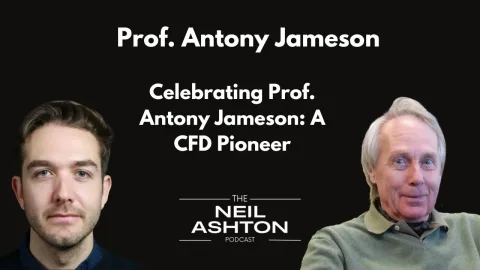
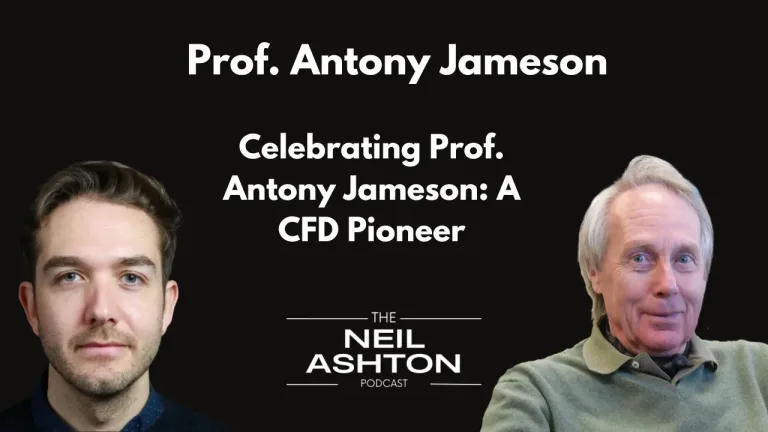
Celebrating Prof. Antony Jameson: A CFD Pioneer
Watch on YouTube
Celebrating Prof. Antony Jameson: A CFD Pioneer
YouTube video
Watch this episode
YouTube is contacted only after you choose to play the video, keeping this page fast and private by default.
Listen to the audio
Episode overview
In this episode of the Neil Ashton podcast, we celebrate the life and contributions of Professor Antony Jameson, a pioneer in Computational Fluid Dynamics (CFD). The conversation explores his early influences, academic journey, and significant contributions to aerodynamics and engineering. Professor Jameson shares insights from his career in both academia and industry, highlighting pivotal moments that shaped his work in CFD and transonic flow.
Prof. Jameson discusses his journey through the complexities of numerical methods for fluid flow, his transition from industry to academia, the development of influential flow codes, and the evolution of computational fluid dynamics (CFD). He reflects on the challenges of teaching, the impact of his work on the aerospace industry, and the commercialization of CFD technologies.
In this conversation, he shares his journey from academia to industry, discussing the challenges and successes he faced in the field of aerodynamics and computational fluid dynamics. He reflects on the importance of innovation, the impact of industry experience on academic research, and offers valuable advice for aspiring professionals in aeronautics. The discussion also touches on the evolution of computational power and the role of machine learning in the field.
Chapters
- 00:00 Introduction to Computational Fluid Dynamics and Professor Jameson
- 05:02 Professor Jameson's Early Life and Influences
- 20:00 Academic Journey and Contributions to Aerodynamics
- 34:50 Career in Industry and Transition to Academia
- 48:52 Pivotal Moments in Computational Fluid Dynamics
- 50:19 Navigating Numerical Methods for Fluid Flow
- 57:02 Transitioning to Academia and Teaching Challenges
- 01:06:25 Developing Flow Codes FLO & SYN and Their Impact
- 01:12:21 The Evolution of Computational Fluid Dynamics
- 01:19:10 Commercialization and the Future of CFD
- 01:30:34 Journey to Success: From Code to Commercialization
- 01:37:02 Innovations in Aerodynamics: Control Theory and Design
- 01:43:06 The Impact of Industry Experience on Academic Research
- 01:51:24 The Evolution of Computational Power in Aerodynamics
- 02:01:29 Advice for Aspiring Aeronautics Professionals Summary of key work: (see
References and links
Transcript
This transcript was created from the corrected YouTube captions, with names and technical terminology reviewed. Download the corrected SRT file.
Hi, and welcome to the Neil Ashton Podcast. In each episode, we explained some of the fascinating ways that science and engineering are changing the world around us. We talked to leading engineers from elite level sports like cycling and Formula One to some of the world's top academics to understand how fluid dynamics, machine learning, supercomputing are bringing in a new era of discovery. We also hear some of their life stories, their career advice, the lessons they've learned on the way that I hope will be helpful to you too. So sit back and enjoy this episode. Hi, and welcome back to the Neil Ashton Podcast. Today, I think it's a pretty special
episode. It's with really one of the icons of CFD, Professor Antony Jameson. It really is somebody who I'd always known about, you know, from the early days of me studying CFD and speaking to various people, it was clear that he was somebody who was a real pioneer. But I have to completely confess that I was I was learning a lot through the conversation I had with him. And as I was going through it, I was blown away by what he has done and what what it has led to it. It's pretty incredible that he was there at the beginning of both the use of computational
fluid dynamics, but also the early days of computing, the early days of aeronautics, the move to transonic, the sort of evolution in aircraft design. And it's amazing. And I purposely have released it today, which is his 90th birthday. And so I consider this an episode to really celebrate the life and career of Professor Antony Jameson. Just very briefly to summarise, he had an incredible backstory going into the British Army, being an officer in the British Army, living around the world in India, Malaya, studying at Cambridge, then moving over to to the US, working with some of
the defense companies and aerospace companies, writing code, then moving to become a professor in New York, then eventually going to Princeton. But really the overall and later then he went to Stanford and he's now at Texas A&M. But what blows my mind is one, his intellect, he's just the way you can hear and speak about things. But also the fact that when you appreciate what he was writing these codes decades before any of the codes that we today take for granted, the commercial codes, the government codes. And you really can see that it, it really, I, I don't think it's too far of a stretch of imagination to say he was one of
the key people responsible for modern-day CFD. There's not many people who can say that it's, it's incredible. And yeah, he, he's known for certain certain things, you know, like adjoint methods, maybe for aircraft design or the, or some of the, the JST scheme shock capturing. But I think that that culture of writing the code, getting in, in the very early days, working with industry closely, he was not a pure academic nor a pure industry. It was clear that he was always moving between and you know, as we discussed a little bit, but probably didn't focus on too much. Just the sheer number of people that he has supervised and mentored who have gone on to do
amazing things as top professors and and engineers throughout the world is a real testament to what he has done. Now this is a completely unedited, this is a more than two hour long conversation and I purposely kept it this way to not take anything away from what his his life story is. There were far more things we could have spoken about, but I wanted to be respectful of of his time. I will put some links in the description. If you're watching this on, on YouTube, it's probably one that maybe will take you a few times to go through because, you know, like I said, it's more than two hours long. But yeah, I, I just have incredible honour of being able
to, to speak to him. And I want to thank him. And hopefully I can say that on behalf of everybody else to thank him for his amazing contribution to the field of computational fluid dynamics, computational aerodynamics and scientific computing. So sit back and enjoy this episode with Professor Antony Jameson. So, so where did it, where did it all all begin? So did you have, were you one of these children who were always into aircraft from a very young age, or was this something that that took age? How did this love of aircraft and and later fluid dynamics begin? Well, so actually, as a small boy— So I can tell you the following story, and of course it's just
my memory, but my father was a British Army officer, so I think he was sent to India in 1938 when I was three years old, and he spent six months in Bombay. But then he was attached to the headquarters of the British Army. Remember, there was an Indian army, but there was also contingents of the British Army in India. So the headquarters was in Delhi. But because Delhi is very hot during the summer, they moved to the summer capital, Shimla, which is in the foothills of the Himalayas at 7,000 feet. So somewhere around when I was
perhaps I've also had a nanny at this point and she took my brother and me. I have a brother who was one year younger than me, but born on the same day as me. On a walk in Delhi. We went past a small airport, which I'm sure doesn't exist anymore, and there was a, a biplane there, a twin engined biplane, something like a twin-engined biplane, something like a Vickers Valentia, if you want, but I don't know exactly what it was. But it was a biplane with sticks and strings all over the place and the engines in the middle of each, between each pair of wings. I looked at that and you know, I had been looking at birds quite
a bit and I thought this is all wrong. You know, birds don't have all these wires and sticks and things. But then it took another look and I was looking at, I saw it had these movable hinge surfaces on the wings and on the tail. And I looked at the tail and saw that if you, I saw the wind bearing over the plane. I can't tell you why, but I saw that if you push the elevator up, that the wind would hit the top of the elevator and push the tail down. And that was my first time I'd ever really had a close view of an aircraft. Well, I can't have been more than about six years old because
soon after that my father was sent to Iraq and my mother spent soon after that my father was sent to Iraq and my mother moved to Shimla on a full-time basis. And we lived in Shimla between 1940 and '43. So my mother taught me to read and write by copying over her handwriting. She started teaching me the tables when I was about 7 and I told her that you don't need to teach me this because I can work it out. It's fairly obvious to me that you can, you know, add seven and seven to get 14 and add seven again, it's 21. I can do that. So at that point, my mother used to read to us.
I haven't yet gone to school. I went to school when I was 7 when my mother got pregnant at this Roman Catholic mission when my mother got pregnant, at this Roman Catholic mission school in Shimla, but I found an Observer's Book of Aircraft with three-view silhouettes of things like Spitfires and Messerschmitt 109s and so on. And I persuaded my mother to buy this book for me and I forced her to read out of this book more or less every day—sort of wingspan, 36 feet and things like that. So that was that. All right. But we did. My father was spread first Iraq and then Iran, and then he was moved back to the front against
Japan, which by that time was in the not in Burma but in the North East of India. So when I was eight we moved to Shillong in northeast India and I went to another of these Roman Catholic mission schools for a year. My dad wanted to have something to do with the invasion of Normandy and he applied to come back to England. So we came back to England in March 1944, coming on a convoy that went through the Mediterranean and then went way out into the Atlantic and finally landed in Liverpool on a horrible cold day and they managed to get into luggage vans or some train we travelled to some.
My father's sister was living in Sherborne at the time when we spent a few weeks there. And then I was dumped in a boarding school, a boarding prep school. And the reason for that particular school was that my father actually had been a Wimbledon tennis player and also one of the world's best squash players. And the owner of the school was somebody else who had been on the British national squash team that toured America in 1934. As far as I can make out, I was actually conceived in America during that squash tour. Anyway, I went to this boarding prep school that would normally be in Brighton, but it was evacuated to the Midlands during the war and well, we had I was
put in the third form. It had 6 forms, so I was nine. I was put in the third form. But what happened was that you could be promoted each term. And each term I came in the top five and got promoted. So by the time I was 10, I was actually sitting in the top form of this school. And I sat there for the next couple of years kind of without much to do because the teachers there, I mean, these are during the war and they were not the only people available to teach, were sort of retirees and so on. I think that somebody, for example, could have taught me calculus at this point, but there was nobody at the school who probably knew calculus and
then wound up in 1947. My father applied for a job in New York for the what was going to be the United Nations Army, which never happened because of the Cold War. The reason he did is that my mother was actually born in America and we had American families. So they went to America and they left my brother and me going to these boarding schools in England. And we spent our school holidays with an aunt, actually. And I wound up getting a scholarship to Winchester in 1948. And so that kind of had a big
And Winchester, of course, was probably about that time considered to be the best academic school in England probably. And at Winchester, I wound up focusing more on physics and chemistry, but I wound up eventually getting a scholarship to Cambridge. Well, we had state scholarships and county scholarships, but I also took this open scholarship exam in Cambridge. I went to Trinity Hall because my father had actually been sent to Cambridge for two years as an Army officer, but asked him what college he was, he said Trinity.
And somebody at the War Office didn't know that Trinity Hall and Trinity were two different colleges. So he went to Trinity Hall. Sorry, decided I might as well go to the same place. But I didn't go straight to Cambridge. See, we had national service in those days, so out of Winchester I went straight into the Army for two years when I was 18. And so now there's something else that's a little bit relevant to this. While I was at Winchester, one of the maths teachers was Doctor Thwaites. Thwaites actually was a quite well known expert in theoretical
aerodynamics and he he went on from Winchester to become the chair of aeronautics at Southampton University. Now I was never in a class taught by him, but he organised some trip to visit Super Marine in South outside Southampton, which is pretty near Winchester. And I told him I was really interested in aircraft. And he told me that I ought to read the book by Glauert, The Elements of Aerofoil and Airscrew Theory, which I don't know whether you're familiar with that book or not. So I managed to to get a copy, I'm not quite sure how. So now when I'm in the Army, I spent several months in basic
training and then I passed this War Office selection board for officer training. So another six months on officer training, then you could apply to go where you want. And I applied to go to, to Malaya was then called now called Malaysia, right? So we went out to Malaysia, Malaya by ship. And I had this book by Glauert. I read it on the ship and I've still got that copy of the book in very tattered form. And you can see that I've put handwritten notes all over the place when I tried to verify the formulas. But this, this book actually
introduces complex variables and conformal mapping. So I actually learnt complex variables from this book and also conformal mapping. I've also learnt 3D lifting line also learnt 3D lifting-line wing theory of Prandtl. So now I spent a year as a Lieutenant in Malaya and I came back and my father by this time was back in England and he knew somebody rather who had a contact with Bristol Aero Engines. So I spent six months from March to September working at Bristol Aero Engines before going to Cambridge.
So I was in a compressor design section, about 50 people and everybody else in there had a university degree. But anyway, the first day or two somebody showed me like it was a day or two, somebody showed me how to use a slide rule. We didn't— This is before electronic computing had really come in and I went to a book. I bought a book on thermodynamics and another one on jet engines and read them in a hurry. As it turned out, I could do the job. I didn't didn't need a university degree. Then the next thing that happened was that we were supposed to do these stage by stage calculations as slide rules looking at data from this
test station, which had something like a 25,000-horsepower electric motors driving this and the test station blew up. Well, something got out of balance and everything just tore apart. So there was no data. So it was a sort of stroke of luck for me, because then they had to think of something else for me to do and I looked at something called radial equilibrium that flows in jet engine compressors. And then finally I actually calculated the—they were testing, or had, the first two-spool jet engine, the Bristol Olympus, that went in the Vulcan and later was adapted to the Concorde.
And they had flight test data and they didn't know what the relative speed of the two high speed, high pressure and low pressure compressors would be. So based on the flight measurements of the RPM, I calculated the combined compressor characteristic for the whole 2 spools. So that's before I got to Cambridge. Before, yeah, yeah, before you went to university. All right. But by the time I got to Cambridge, of course I knew quite a bit of basic aerodynamics, like I also knew quite a bit about thermodynamics. I know at Cambridge I wasn't sure whether to try maths or physics or engineering, but seemed like the path of minimum effort was to do what we called
mechanical sciences. At Cambridge. When you take, if you have a scholarship, you could take what's called a fast course. It meant you take the secondary exams at the end of your first year and basically your degree exam after two years, and then for the third year you do something wants to be a kind of post graduation, sort of like approximately a master's degree. But but at Cambridge I was really, I thought they weren't teaching the maths that we needed, so they didn't teach vector analysis, for example. And so I started buying, they were various quite inexpensive books and I started buying these books on things like vector
analysis and tensor analysis and so on and trying to teach myself anyway, I. Were you always a more than maths person than an engineering? Did you? Did you always have a a keenness for maths? You know, in your earlier years you said then that they didn't teach enough maths. Do you, do you have a very mathematical brain? Do you find maths comes very naturally? Well, yes, I think it does, but I didn't read maths at Cambridge and maybe I should have it actually I have a younger and maybe I should have. Actually, I have a younger brother who was eight years younger than me, and he did read maths at Cambridge. And so anyway, I but yeah, I'm
really interested in, well, for example, I mean for the Greeks, you know, people think about Pythagoras theorem. But the thing that's actually interesting to me is a consequence of Pythagoras theorem is that if you have a triangle with two sides of one, I mean right triangle, then the length of the third side is the square root of two, and now there's no fraction that when you square it can produce 2. So you can prove that however large the fraction is. And the Greeks already knew this and it really wasn't sorted out
until the 19th century when it had a theory for real numbers developed. Another kind of interesting thing is that Euclid, he's known for his geometry, but he actually had a proof that there's no largest prime number. So they knew there was an infinite number of primes already, the Greeks. So this is not the kind of question that people designing aeroplanes really usually interested in. But I am interested in this kind of thing, and there's set theory, which is basically the theory of what's progressively larger infinities. There's countable numbers and then there's the real numbers and so on. There's a theorem that the set
of all subsets is larger than the original set, which means it could get a whole hierarchy of these transfinite numbers. So yeah, this kind of thing continues to interest me, but I was also still interested in aircraft and I was very lucky in the following sense that in England in those days, well under the Labour government, they tried to make opportunities, firstly for people to get into universities. But secondly, if you got first class honours, your degree exams, you automatically got support from the Ministry of
Education to do doctoral studies, so they would pay the full tuition and lodging to any university who was willing to accept you as a graduate student. So of course I was able to take advantage of that, but I didn't really want to to leave Cambridge. really want to leave Cambridge. So I had to try to find somebody inside Cambridge who was doing something that interested me. And I wound up finding Arthur And I wound up finding Arthur Shercliff, who later became well known— a Fellow of the Royal Society and so on. But at the time I knew he was only seven years older than me and had just been made a lecturer.
He was doing magnetohydrodynamics. So that's what I wound up doing in my thesis. But and then about one year into the thesis, I was lucky that I was in kind of invited to apply for what's called a research fellowship at Trinity Hall. So research fellows at Oxford or Cambridge are people who are actually are on the governing bodies of their colleagues. I mean, it's a sort of pseudo faculty kind of position. So I had a three-year fellowship at Trinity Hall. Actually I had a slightly
difficult start because I had been getting my grant from the Ministry of Education every three months and that was paid in advance. And then as a researcher it turned out that I was going to get paid quarterly, but in arrears. So I had like six months and I had to ask the bursar of the college to give me a loan because I, I. So the other thing is that my advisor, Arthur Shercliff—so he went on an exchange to MIT in my third year as a doctoral student.
So at this point a student who was one year ahead of me became my nominal thesis adviser. And I actually did an experimental thesis and tried to generate Alfvén waves in liquid sodium. My thesis by the way you can find on my Stanford homepage. I wound up building a ten-tonne magnet and things like that and we needed 300 amperes of current, 200 volts. And there was a motor generator set from a World War II submarine in the lobby of the engineering department. And I managed to have that moved into the lab and use that to supply the current for this magnet. After all this, I
realised firstly I did not think I should be doing experiments. I felt very uncomfortable trying to interpret sort of pictures and oscilloscope traces. I didn't actually think hydrodynamics is going anywhere in engineering, so I didn't really know what I wanted to do. And then I had some sort of interest in politics. I was quite upset when Macmillan stepped down as Prime Minister and engineered Lord Home becoming Prime Minister and I thought, well, maybe I should
get involved. The Trades Union Congress advertised at the time for people to work in the economics department, and I sent in an application and they decided they would interview me. So I had about 3 weeks to read as much as I could about economics in a hurry. And then I had an interview with Len Murray, who at that time was head of the economics department but later became general secretary. He wound up hiring me as an economist working for the Trade Union Congress, and it was quite interesting actually. They had what they called National Economic Development Councils—NEDCs—which were one-third
government, one-third management from industry and one-third union reps, and were supposed to be discussing how to improve things, different industries. So I was actually preparing the position for the trades unions on the aircraft industry and the electrical industry, but I knew that I wasn't going to be long term a trade union person. I found it, it was interesting and actually I did a kind of study of what happened to rates of inflation versus unemployment and going back to about 1900 and I found that interesting enough the fastest rate of inflation in
England was usually on the downside of each economic cycle. And that's because as far as I can make out costs went up on the downside because there was less utilisation of the factories and so on, and companies had to pass the higher costs straight on in higher prices. I've certainly concluded that this idea that there's a sort of non inflationary rate of unemployment is is wrong and actually morally wrong as well as practically wrong in my opinion. I mean, deliberately having a high rate of unemployment in order to prevent inflation is actually sort of a bit like human sacrifice used to be to some prehistoric god.
You know you sacrifice somebody for the benefit of everybody else right. But anyway, quite by chance there was an advertisement in one of the London evening newspapers saying that Hawker Siddeley Dynamics was looking for engineers and they would have some representatives of the company in a hotel. Happened to me about 5 minutes walk from the Trades Union Congress. So I decided I might as well walk in there around about 5 in the evening at the end of the day and had a very weird interview. So there were two people in the room. One of them said, what do you think
I can do? I said I think I can do aerodynamics. The other guy said well what are you doing now? I said, well, I'm working as an economist. So then there was complete silence for about two minutes. Then one of them said, well, what makes you think you can do aerodynamics? I said, well, I have a PhD in magnetohydrodynamics and I think it would be relatively easy for me to do aerodynamics. So they thought about that for a bit. They finally just said, well, would I be interested in coming to the factory, which is in Warwick basically exactly what used to be the Armstrong Whitworth company during the Second World War made some very bad airplanes.
There was a bomber called the Whitley that sort of flew nose-down. But anyway, I said, well, it would depend on the salary. They said they didn't know what the salary would be. I said, in that case I don't, I don't know whether I'm interested in coming for an interview and I, I didn't certainly hear from them again, but but suddenly about a month later they wrote to me and asked me if I would go up there. So I finally travelled up for about a couple more interviews and the outcome was that they decided to offer me a position as chief mathematician of this Hawker Siddeley Dynamics in Coventry. So actually not reporting to the head of aerodynamics, but on a
level or even above him. So I thought, well, I got to try this. So I wound up at Hawker Siddeley Dynamics. And— And how old were you then? Well, that was 1964, I guess. So I was just coming up to SO. You were 3030. Just approaching that, yeah. Yeah. So actually, incredible. When I got to Hawker Siddeley Dynamics, the first thing that happened was that the guy who had kind of initiated hiring me, head of aerodynamics, a guy called Malcolm James, told me that he decided to leave and was going to work for Douglas Aircraft in California.
So I had expected that I would collaborate with him, and that didn't happen. You see it only overlapped a couple of weeks, but I did, I did quite a lot of antenna calculations for example. And again, if you go on my homepage, you can find some Hawker Siddeley reports, which show the kind of thing they were doing at the time. And well, what I concluded was after I'd been there about a year was that they were never actually going to build another missile. They were making anti aircraft missiles and they had this thing called the Sea Dart. And I didn't think we were ever going to build anything.
So I finally decided, well I've either got to get out of the aircraft industry or I have to come to America, one or the other because British aircraft industry didn't seem to be going to build anything anyway. Every project got cancelled by the government, sometimes even when they got to the point of flying. So finally I had some interview actually, I think, with the Central Electricity Generating Board and for some teaching positions somewhere. I'm so lucky I was turned down by both of them. But, and then I went on this, I can't quite remember, but at that time Boeing, Douglas and so on were recruiting quite heavily
in in England. Well, I knew that they had teams in England. Well, I knew that they had teams in England, and I wasn't interviewed by Boeing or Douglas. And I probably thought I would probably rule out because they wouldn't like my trade union background. But finally Grumman, who I didn't know a great deal about, but they made these sort of fatter fighter planes during the Second World War. They said that they were interviewing in London and they in fact decided to invite me to an interview. So I wound up hitting it off rather well with the guy who
interviewed me, and he said, well, would I like to be in what department? I said, well, the research department at Grumman. He said, well, he didn't represent the research department, but he could recommend me to one of the aerodynamics or thermodynamics this kind of thing. So I finally accepted an offer to work in the aerodynamics department of Grumman on Long Island. That didn't start very smoothly the day I got there. Well, firstly, they had a kind of— outside the main Grumman sort of campus— a plant where people who hadn't got security
clearances were parked. So I went, I reported to this department. There was an Englishman in charge who said he was very sorry, but they didn't have any free desk for me to sit at. I mean, they had about 150 people in there sitting side by side, but there was no free desk. Wow. So then they said, well, the best thing to do is we'll send you to be interviewed by the head of the aero department. I had to be escorted by a cop. So I got to see this head of the aero department. His name was Bill Murphy. And his opening words were that it had been a mistake to hire me, that he didn't have any need for anybody with a PhD,
that he had had somebody with a PhD there the year before who was arrogant and lazy, and that he had no need for me. So this didn't seem like a very good start. But then he handed me off to one of his group leaders, a guy called Rudy Mayer. So they had control systems inside the aerodynamics department because, if you have something like a fighter, then the aerodynamic stability depends a lot on things like dihedral and so on. So it's not just black boxes. So Rudy Mayer—I met him and he turned out to be an extremely nice guy who was actually a veteran of the Korean War.
And he said he thought it would be interesting to look at Horowitz's method of designing control systems, or stability augmentation systems. I'd never heard of Horowitz. So I sort of thought about it a bit. I countered. I said, look, I think it's very interesting to look at the issue of control systems, but why don't you let me go away and do a little bit of research for a few days and I'll come back and make a recommendation. So he he agreed to that. Now I'm not quite sure how I managed to find the literature, but, I mean, Grumman had quite a good library. I suppose they may have allowed me into it. But anyway, when I met Rudy the following week, I suggested that
we try linear optimal-control theory. At that time it was quite new, pioneered by Kalman in particular, who was famous for the Kalman filter, and really went along with that. So I started looking at how you would apply linear optimal control theory to designing control systems for fighter aircraft and suchlike. In actual fact, Grumman was also building this airborne early-warning plane, the E-2A Hawkeye, with the big radome on top of it. And so that had really awkward stability characteristics. So the question was, could you design something that would make
it flyable? And what I actually got into was that you don't necessarily—optimal control requires you to measure everything. I mean, it's fairly obvious because you can't really have an optimal control if you can't predict the trajectory. So if you express the system of the first-order system of differential equations, you need to know the initial conditions for each variable. In other words, if it's a feedback system, you need to measure everything the full state. But actually to make a workable control system, you don't necessarily need that. So you can try to make a what would be in some sense a suboptimal system nowadays, a
what would now be called sparse control, where you restrict the number of permitted feedbacks. And actually for lateral control of an airplane, for example, you don't really want to measure the roll angle because otherwise if you roll 360°, the control system will try to roll the whole way back. It doesn't recognise it. All right, so nowadays, you know, quite a mathematical theory for sparse control, but I wound up actually publishing about 15 journal articles and control theory over the next few years. Some other strokes of luck at this point, because there was
a scientist called John DeYoung, who was an ex-NASA guy, who was developing a theory for predicting very high lift aerodynamics, what we call V/STOL aircraft. It was a thing like the Breguet 941 that had these big propellers and then it has flaps to try to deflect the propeller slipstream to take off in a very short distance. So John DeYoung had got a contract from NASA Ames to develop this theory, and then he was married to a Brazilian woman who wasn't very happy, apparently. He asked for a leave of absence for three months and then he didn't come back. So Grumman got a message from
NASA Ames saying, what's happened to the contract? The PI appears to be now working for Ling-Temco-Vought, which the government didn't know. So now there's a crisis. The head of aerodynamics said, well, we should just give up on the contract. And he was overruled by the vice president of engineering, who said we can't tell NASA that there's nobody else is able to do it here. At this point. It turned out that having someone with a PhD was a little bit of an advantage that they asked me if I was willing to take over the contract. I said, well, I don't really want to, but we need to, as long as I'm also allowed to continue doing some work on this control
system theory. So they agreed to that. But now when I looked at DeYoung's theory, I thought it was actually not quite right. But I came up with fixes and kind of convinced the, I said, well, we have to write a computer code also. And the first reaction was that that'll cost you much. And I went out to NASA and said, no, I can write this in within the cost of this contract. So that meant that at this point I felt that I was being underpaid by Grumman because I knew that people with my level of experience were getting quite a bit more by just by reading the job advertisements that used to come out in the Sunday
newspapers. I wound up having an interview with an outfit called General Research based in Santa Barbara, who were trying to develop an anti-ballistic-missile system. They offered me a job and my first reaction was to say yes. So I gave Grumman notice on a Friday, and on Monday I was called in before the VP of engineering who said that he was retrospectively raising my salary by 30% from the beginning of the year. Would I reconsider? So I said yes, but I don't really want to just do dynamics. I mean, I want to look at a broader picture. And finally, they created a
staff position for me where I reported to the manager of Flight Sciences, a man called Stu Harvey. Stu first asked me if I could try to design a wind tunnel that Grumman might build. I looked at this for a few months. I don't really believe that Grumman was ever going to go anywhere with it. Well, then all of a sudden, and this is in I guess like November 1969, Stu Harvey called me in and said that we've got to do something about supercritical wings. And I said, well, what do you mean by supercritical wing? And he said, well, the wing that works well in transonic flow.
And Whitcomb—at this point Richard Whitcomb at NASA Langley had made a big splash with what he called supercritical airfoils that managed to reduce the shock drag transonic. And Whitcomb was an experimentalist who just sort of used a file to change the shapes and so on. And Stu Harvey says, well, we can't depend on Whitcomb's file. So I said to Stu, well, look, this is actually very interesting. I said there's a aerospace sciences meeting being held in New York in January, and maybe I should. After all, Grumman's 40 miles from New York City.
And I said maybe I should go to this and try to find out what's being done in transonics. And I went to this meeting and Earl Murman presented what became quite a famous paper on calculating a solution to the transonic small disturbance equation. And The thing is I knew very well that transonic flow cannot be treated by linearising anything. So you have linearised subsonic equation called the Prandtl–Glauert equation, or you have linearised supersonic flow. But those what happens in transonic flow is it it's actually an elliptic equation in the subsonic part of the flow field and hyperbolic in the
supersonic part. You can only get that change in type in full nonlinear equations. And there were books, for example, by Oswatitsch and Lipman Bers— attempts at analytic solutions of transonic flow that had basically gone nowhere. So I knew that you had to do this by some kind of numerical calculation, and I also saw that computers are getting just fast enough that you actually probably could do some useful calculations. So that was kind of my chance to try to solve the problem. This was a pivotal moment. Just at the right time, down in
the right it. Seems like you had, but you had a build up. I, I, I assumed that from an early stage of your career that you were working on transonic flow, but you almost had 36 years of build-up to this point to then be given the opportunity to, to focus on this. Yeah, well, the answer is no. I hadn't actually worked in transonics at all, and I knew very little about it, and I didn't know much about numerical methods. I'd never taken a course in numerical methods, but I had learned how to solve partial differential equations as part of my thesis, because when I did this magnetohydrodynamics,
I had to solve this. I solved the equations for these Alfvén waves by separation of variables and expansions in Bessel functions and things like that. So I had some background in PDEs. I'd never taken a course in PDEs either. But now that I realised that you could do something numerically, turned out that nobody—the head of the aero department at Grumman— wasn't willing to put anybody on to this. I finally decided I'd better try to do it myself, so I started trying to write computer programmes for fluid flow and I
didn't. I knew I had to learn more about numerical methods. So I managed to get hold of a book by Richtmyer and Morton called Difference Methods for Initial-Value Problems, and that was very hard for me. It talked about things like Banach spaces and so on. I never heard of, but I fought my way through this book. And then what we needed to do was not to solve the small disturbance equation because they're not small disturbances. When you have a supercritical airfoil or wing. So the best model was to use what's called the full transonic potential-flow equation. I ruled out trying to solve the Euler equations because you
didn't have enough memory on the computer at the time. To do a 3D potential-flow solution, You just got to store 1 variable instead of like 5 variables if you're solving the Euler equations. And so I could see that we could actually write a computer programme that would work. And in the meanwhile also I had discovered that there was a group at the Courant Institute led by Paul Garabedian and I went in to meet them. Paul Garabedian had a student called David Korn. They had developed a method of calculating so-called shock free
airfoils in transonic flow by transformation to the hodograph plane and then a method of solution so-called complex characteristics, due to Garabedian and Korn. But I got to know them and I thought that we could solve the full transonic potential-flow equation, but you would need to use some kind of conformal mapping so as to map the flow outside the airfoil to the flow inside a unit disk. Well, I had the background in conformal mapping way back to the Glauert book. So I wrote codes to solve two-dimensional incompressible inviscid flow by conformal
mapping, because my first code was FLO1. But I envisaged a sequence of codes that would become progressively more complicated, more complicated geometries go to 3D and so on, and eventually go to solving the Euler equation. So in FORTRAN at the time you were not allowed more than six characters in a variable name or a programme name. So I truncated FLOW to FLO to allow for three digits. And after, about, about sometime during 1971 or after, I managed to get a flow solver for transonic potential flow
working. And at this point, Paul Garabedian— I had persuaded Grumman to hire Korn as a consultant. So we had some contacts and they'd also been writing an analysis code. And when they found out that I'd And when they found out that I'd written mine, that appeared to work as well. Paul asked me if I would spend three months at the Courant Institute as a visitor and I thought I said yes. I realised that I'm not going to be able to do this in the long run at Grumman, so I had to consider moving into academia somehow. And so I went there for three
months and then Paul kind of tested me in various ways during that time. And then he said, well, why don't you stay here? And he said, well, I can't just disappear from Grumman and I have to go back and give them notice. But I agreed and he had me as a senior research scientist. That's in 1972. And he told me that there's no faculty positions going to be available at the Courant Institute, but if you make a splash, you might get an offer from somewhere else. So I said, OK, I'll settle for that. So when I got to the Courant Institute, I started working for Paul who he agreed that I would try to write a 3D solver for the
transonic potential flow, but he wanted it to be for a yawed flying wing because he had a contract with R. T. Jones at NASA Ames. R. T. Jones was advocating that a supersonic transport aircraft be just a flying wing which would fly at a skew angle—a so-called yawed flying wing. Of course, that never actually happened, but meanwhile Paul also had a contract with NASA Langley because Whitcomb also understood that if you could calculate transonic flows, it might help him to obtain better supercritical airfoils. So I wound up being the point of contact of both Archie Jones and
NASA Ames and Richard Whitcomb at Langley. And both of them sort of encouraged me. They, they said move, Jameson move. But that's so that maybe I could take this further. So then another thing that happened was that I'd only been at the Courant Institute a week when they—they didn't, they didn't take teaching very seriously there. But what they did do is they taught a lot of courses in the evenings because they were accommodating people who were working in the city who wanted to study nights. Turned out that the graduate numerical analysis course was
normally taught by Isaacson, who's a co-author of the book Isaacson and Keller, which is quite famous. And Isaacson was on leave and they hadn't got an instructor. So they asked me if I would like to try to teach it. So I said yes, I can try. That was that in some sense is a That was, in some sense, a stroke of luck for me, because I didn't really know numerical methods other than the book I mentioned I'd read by Richtmyer and Morton, but I had to teach from Isaacson and Keller. It really meant I had to read the book ahead of the class. But by the time I'd done that, I had a pretty thorough knowledge of numerical methods.
So then after two years, the maths department at UCLA was interested. I got an approach and well, they turned out that they were really more interested in trying to hire Paul Garabedian, but it was the kind of suggestion that they would hire both of us and they offered me full professorship at UCLA, but never in writing. But that's what was on the table at this point. The Courant Institute decided to respond by eventually the first offering me an associate professor. I said no, I'll take the full professor at UCLA. So then they did offer me a full professorship. So it turned out kind of just like that. So I've never been in a an assistant professor or an
associate professor; I went straight from senior research scientist— Straight to the top. So after that I was no longer working directly for Paul Garabedian, but of course we remained in close contact and I went on to he'd. Actually another thing that happened was just before I got that offer, I had written this FLO17, which did a three-dimensional flow past a yawed wing. But I knew perfectly well that aircraft engineers were never going to build a yawed wing; what they needed was a swept-wing code. So Paul had another visitor from McDonnell Douglas,
a guy called John Dahlin. John said, we need a swept- wing code and a nacelle code. I said, yes, I know that. I said, look, I can write the codes for you if you'll help me debug them. So I wrote the two codes. FLO21 was for a nacelle and FLO22 was for a swept wing. In a few weeks, actually. Each was a box of cards. You know, we were still using card readers. We had this Control Data 6600, which was kind of the world's fastest computer at the time. That's because Courant had all these contacts with people like von Neumann and it had the so-called computer centre in the Courant Institute, which would get
the latest computers. But the 6600 was fast by the standards of the day. But it only had 130,000 words in memory. Those were 60-bit words, which turns out to be about two megabytes. So you couldn't really do a 3D calculation and store it on the core memory. You had to go plane by plane reading off the disk. Anyway, so I wrote the two codes, and then John and I went to see Paul Garabedian and he was furiously angry. He said I was supposed to be helping him write his book on supercritical wing sections and I was only interested in being famous and so on.
And I said, well yes, I'd certainly like to be famous, but actually I really need a threat to encourage me. But John Dahlin felt he couldn't risk confronting Paul and trying to debug these codes or help me. And so I decided perhaps we'd better leave it alone for the moment. So the two boxes of cards remained on the floor of my office at the Courant Institute for the next few months. I never tried to run either of them. And then when John went back to Douglas, he told them that these two codes existed but hadn't been debugged.
And then I got a call from a guy, David Caughey, who was working for the McDonnell Douglas Research Centre in Saint Louis, saying that they had somebody coming for the summer and would it be possible for them to have this guy see if he can debug FLO21. So I said that's fine. And I flew out to St Louis with the box of cards for FLO21 and gave it to them. Well, this guy did nothing that summer. But then in the fall of '74, David Caughey was suddenly offered a position as a visiting assistant professor at Cornell. They'd had a crisis because two of their top people had both left,
so David asked me if he could take FLO21, and I said sure. So a few weeks later he called up to say that he'd fixed FLO21. It was working. And I said, well, you're interested in FLO22? And he said yes. And I said, well, the thing about FLO22 is it's got all these analytic transformations and the huge, very, very complicated formulas. We need to have some independent checking of this. I said, so are you willing to try to work out all the formulas separately from me? He agreed to do that. And then we had a meeting and came to New York and 1st his formulas looked different from mine, but then we found they were equivalent.
So I gave him FLO22 and he took it back with him to Cornell. Called up a week later to say, well, he'd fixed that too, and turned out that I had got a miscount on reading plane by plane off the disk and writing updates back onto the disk. But he fixed that and the code worked. So FLO22 was really the first computer programme that could calculate transonic flow solutions for wings with reasonable accuracy. In those days it took several hours to run a calculation on a Control Data 6600, but Douglas
attributed a cost of about $3,000 to each run. But they started running it about five times a day when they were using it to try to design the C-17 wing and things like that. And then Canada was trying to develop what became the Canada, what do you call it? Well, now it's Bombardier, but the regional jet—and they wanted to use FLO22, but they found a consulting company in Los Angeles who was running FLO22 for them. And this Canadair Regional Jet was the first commercial aircraft that had a supercritical wing. It was designed using
FLO22, and eventually NASA released a listing of the code on some NASA website and it wound up being picked up by the Russians and the Chinese and everybody. So the other thing that was kind of unusual about my career, right, I was a professor now, nominally of computer science, at the Courant Institute, but I didn't have any students, you know, the people, the students all wanted to work with the famous professors like Peter Lax or Louis Nirenberg or Jack Schwartz. You know, we had ten members of the National Academy of Sciences at the Courant Institute. So I had no students.
So the only way to continue is to go on writing the programmes myself. And I had this collaboration that developed with David Caughey, and then we managed to get support from the Office of Naval Research to go pursue this further. So I realised that we couldn't really use analytical transformations to do anything more complicated than a wing–fuselage. So we, David and I developed what we call the finite volume method for transonic potential flow. It was really a finite- element method with trilinear isoparametric elements, but I didn't know that at the time. And then I got into the going to
the Euler equations kind of again by sort of circuitous route. I went to various international meetings those days, something called Symposium Transonicum 2 that was held in Göttingen at that time. There was a Wolfgang Schmidt who was a rather charismatic character who had a small group doing CFD at Dornier. Well, Dornier was a sort of nothing much of a company that somehow survived after the Second World War, still owned by the Dornier family, but Wolfgang was very effective in getting
support from various German government agencies. I met him in Göttingen. In fact, he persuaded me to try to swim in the town's swimming pool, which is very embarrassing to me when it turned out that I had to rent some kind of bikini like swimsuit and I was required to wear the cap on my head. And the other cap available was a sort of pink cap with feathers or something. Wolfgang turned out to be a star water-polo player and an expert swimmer, and he He kind of forced me into the pool. But anyway, a couple of years later he persuaded me to come and spend several weeks at Dornier.
This is 1979. And then in while 1979 there was a workshop in Stockholm which tried to compare efforts to solve the Euler equations with potential flow solutions. I participated in that. I saw that nobody had a solver for the Euler equations that reached a steady state, and I felt that it was wrong. You should be able to get a steady state. So in 1980, Wolfgang asked me to come back and he had an Euler solver that had been developed jointly by Rizzi and Schmidt at Dornier, and it wasn't working all that well. It was one of the ones that
wouldn't get a steady state that had been in his Stockholm workshop. He asked me if I'd like to look at it, and I said sure. But I said, look, did he really want me to do this? We're going to have to spend several hours a day trying to do computer runs and really to pay for this. He said don't worry. So Dornier had this IBM 4341, and they were charging like one Deutsche Mark per CPU second or something like that. And Dornier was kind of odd. They had two men in an office, and they would sit facing each other. Each had a desk, but the desks were pushed against each other,
and you were looking at each other. And they all called one another Herr. They didn't use first names. And I showed up and called Wolfgang by his first name and they were all shocked. But anyway Wolfgang said don't worry about it. So I actually looked at their solver and decided that they'd got some serious—we could call them errors. They had a kind of, it was implemented what was called the MacCormack scheme, but they had an additional artificial viscosity term. And the way that was constructed, turned out it was going to take differences of the cell volumes if the flow was uniform in the far field.
And that's just generating big error term. And so I rewrote the code. It was the first step to what became the Jameson–Schmidt–Turkel scheme in the next year. And at the end of the three weeks, Wolfgang got a bill for 250,000 Deutsche Marks for the computer cost of my visit there. You see, his problem was not mine. This is the point when I had been approached by both Stanford and Princeton with offers of faculty positions. And what had actually happened was that in the academic world
they valued applied mathematicians basically and people like Milton Van Dyke and Mårten Landahl at MIT, who did all these asymptotic expansions and things like that, but they none of them had ever written a computer programme or had any interest in that. And I suddenly discovered that CFD actually worked quite well. But the thing was that there was nobody, not many people around who knew how to write these programmes, mostly from NASA, but none of them had any teaching experience, whereas I had been teaching at the Courant Institute. So I wound up being offered jobs by both Stanford and Princeton and I went out to Stanford and
and found they were offering me a $42,000-a- year salary, and you couldn't buy a house there for less than about $400,000. And at that time the interest rate for mortgages was around 13%. So it turned out that the $42,000 would just about pay the interest on the mortgage on the house. So then I got approached by a direct phone call from the president of Princeton saying, well, he'd like me to come down and play squash with him. I didn't know he was the New Jersey State squash champion, but I said OK, and eventually I took the job in Princeton.
As a result, I went down and lost to him at squash. It didn't matter very much, but but this 1980 was in transition. So I had got a first cut at this Euler solver at Dornier, but I hadn't got it yet to converge to a steady state. And when I first got to Princeton, we didn't have a computer, and I convinced them that we had to buy a minicomputer. I would have gone for Digital Equipment, but Princeton was kind of IBM territory. So we wound up getting an IBM 4341, which was the same machine as they had at Dornier. That filled a huge room with
cabinets all over the place, you know, the disk and one cabinet and so on. It actually had two megabytes of memory. I had access to that from roughly November, and I couldn't get this thing to converge to state. It would go down to some level of error around ten to the minus three and start oscillating. I thought it was maybe reflection from the far field boundary conditions. That's when I consulted Eli boundary conditions. That's when I consulted Eli Turkel That actually didn't fix the problem. Then I tried running it 1st order accurate and it converged
very well. So then I saw that I needed to have but that was not accurate enough so that I came up with this idea that you blend fourth differences and second differences of artificial viscosity and use the fourth differences as background. But near a shock, that causes an oscillation. So you turn them off and drop to a locally first-order-accurate scheme through the shock. And this is eventually what became this so-called JST scheme. got away with a lot. Yeah. But actually for me something else happened around that time. So I I presented this JST scheme and by that time I had got a 3D
implementation with FLO57 at the AIAA meeting in 1981, in the summer in Palo Alto I think it was and nobody paid much attention. But then of course the company started getting my code FLO57, and they found it worked. But just about that time, Phil Roe came out with his famous paper with his so-called Roe matrix—basically characteristic- based—and it's a work of genius, that paper. So that kind of got the academic limelight that I didn't deserve myself.
I don't deserve it yourself. But when I tried coding the Phil Roe's scheme, I found that it wasn't really doing any better than my scheme, but it wasn't really helpful to to push that. But what I did find out about the Roe scheme, especially—you had this mean-value matrix; it's called a Roe matrix—and he found an analytic way of calculating and then. So it's a stroke of genius and turns out that that enables analysis of other schemes, not just a Roe scheme. If you use this Roe matrix, you can actually prove things about the numerical shock structure, shock waves, being in a shock
capturing scheme and so on. So it really opened the way to a much broader way of looking at sort of theoretical side of these schemes that well, I don't know where you want to go from there, but so we're in 1980. So what happened? Yes, so you would then at that time at Princeton, one question I had was the code. So you mentioned that people were using the code. You were, you know that NASA were using it different companies and we Fast forward to now and there are these large commercial companies, you know,
Ansys Fluent and Siemens and all these others. Did you did you think about or, or maybe this is what's coming next, the commercialization of this or was it very much at that time this idea of the code was for everybody to use. It was sort of for the good of the community. Well, there are several things that I think you need to realize, you see. We didn't have copyright protection of computer codes at that time. Actually, that was only established by Bill Gates around about the early 1980s. So there was really no way to prevent codes being passed around.
But in fact, of course, if you wrote a code that worked and FLO57 wound up being used by just about everybody in the aircraft industry in America, and then it got—well, Dornier had it because of course I'd been working with Wolfgang at Dornier. But then I had a consulting arrangement with Cray Research and I didn't mention this, but actually, when I wrote the 3D code FLO57, which was in around February or March of 1981, I could only run a mesh of
like 48 by 8 by 8 on this IBM 4341. But I had been approached by Cray Research because they were now trying to sell their first Cray-1 computers. They got benchmarked typically by FLO22. So they decided it might be better to have me on board. And I was interested too, because I thought that this JST scheme should vectorise without a problem. So they gave me access to a Cray-1. When I first tried to run it, this code didn't vectorise. And I went out there and discovered that there were one
or two minor changes I still had to make to the code, but it would vectorise. But when I tried to write FLO57, I had a terminal at Princeton connected to Cray Research. So after I got it to run on the IBM 4341, I was able to submit the same code to Cray through this terminal, and I could run something like 96 by 16 by 16. It still wasn't enough memory on the Cray-1 at the time, but at least that was enough to make a meaningful calculation. But now it meant Cray had the code. So they were trying to sell Crays in Europe and they sold one to the British Royal Aircraft Establishment and
another to the Dutch at NLR. They threw in FLO57 as part of the deal without my knowledge. So this kind of got to Holland and England and well, I didn't get any money out of it, but I did get a good deal of recognition. And so now my sort of attitude started to change around there because the Air Force issued a request for proposals to solve more general configurations, and the obvious thing to do was go with some kind of multiblock extension of FLO57. And bunches of
companies like Lockheed and Northrop and so on all submitted proposals to the Air Force, which amounted to further developing FLO57. And it seemed to me that the Air Force could have asked me whether I wanted to further develop the code rather than funding Lockheed, which is what they wound up doing. So I sort of started to wonder, well, how are we going to get more control? But then I also knew that I wanted to do a complete aircraft calculation. And my first idea was that you could use a multiblock mesh. But then when I looked at how
hard it would be to generate these meshes, I saw that we didn't have anybody at Princeton who was going to do that. And by this time I had brought in Tim Baker from England as a research scientist working for me, and he had his friend Nigel Weatherill, who was working at the Royal Aircraft Establishment in Bedford. Nigel was interested in spending six months sort of sabbatical at Princeton. The RAE were very worried that they had developed a multiblock extension of FLO57 and they were very worried that Nigel would bring it with him to Princeton. Right. I said, no, I've concluded that
we have a better chance if we go to an unstructured mesh. So I told Nigel to forget about the multi block code. We were going to work from scratch with a triangulated mesh. When Nigel arrived I asked him if he could By this time I'd become aware of this process called Delaunay triangulation and I asked him if he would try coding it. And he got it to run in 2D in a week or two. So we could do, in principle, multiple airfoils and things like that. But then I had a meeting with Tim and Nigel. I said, well, I think we should try to do a complete aircraft. And the idea was that Tim could
generate meshes around the different components, rather like an overset mesh. But then we would take the points from all these meshes, just a cloud of points, and triangulate them with Delaunay triangulation, and that would be our grid. And meanwhile, I wrote a flow solver to work on tetrahedral meshes, and we had an agreement from Cray Research that they would support this project. But then we finally got a first version of the code together. We called it the airplane code. Turned out that it used the whole memory of the Cray. So they put it to the back of
the queue. And then at the end of the day they would turn the shut the machine down and start running experiments with operating systems. So it just didn't run. So at that point I tried to contact John Rollwagen, who was the president and CEO of Cray, who had agreed to support this. He was out of town, but I got his number two. They agreed to let us come out and use the machine during weekends, overnight. And I also, I had a, because I was a consultant, I had some
kind of immediate manager at Cray, and he was very angry that I'd bypassed him and he dismissed me as a consultant to Cray. I said, well, we still have access to the machine. As it turned out, I didn't care about that. But we went out in July. We were given the machine at night during the weekend. So we spent two nights— we were up all night, two nights in a row. It became clear that Nigel's Delaunay triangulator wasn't working, and we couldn't really disentangle exactly why not. But then Nigel was due to go back to England and so we
decided basically to put everything on hold for a bit. Tim and I had summer vacations, and I was spending time at Dornier again, but when we got back in the fall, we concluded that we couldn't debug Nigel's triangulation because he was doing some things that are not—well, He kind of assumed that when you called a subroutine that some data values would still be there when you recall the subroutine. It's not actually the case in FORTRAN. It depends on somebody's compiler whether it is or, which isn't still there. It was just almost impossible to figure out exactly what had gone wrong.
So Tim started rewriting a Delaunay triangulator. And finally in November we used to go out to Cray because also we couldn't visualise anything. But Cray had these Evans & Sutherland terminals where you could actually take a look at the mesh. Finally, one weekend, around 9:00 in the morning after we'd been up all night, we saw that we'd got a mesh that seemed to work. Then Tim and I had to catch a flight back to Princeton and we barely caught the flight, but we were upgraded to 1st class,
having showed up late and got free drinks. That wasn't a really good idea. Then we got to Newark. I had this junk car that I'd left at the airport, and Tim asked me if I could drive, and I said I thought so, but when we got to the car and he just passed out. I started driving and I discovered that I just had double vision, which wasn't really good for me. On the New Jersey Turnpike, basically, I could get rid of the double vision if I took my glasses off. But then I decided it was kind of lucky that we made it back to Princeton without a crash. But anyway, we we finally did get a successful calculation for a Boeing 747 which we presented
at the Aerospace Sciences Meeting in Reno in January 1986. That was—well, at this point—a big moment. Yeah. But I thought now I have to tell Princeton that we'd got the code, because Tim had been paid full-time as a research scientist, not by Air Force grants, but by Princeton. And normally that meant that any code we wrote that probably belongs to Princeton. So I approached my department head at the time and said, well, I think this code actually has potential commercial value
and it's also possible that you could patent the numerical scheme. Well, it turns out that Princeton had signed some deal with an outfit, some of the small companies, to give them first right of refusal for intellectual-property rights to software developed at Princeton. And I got a call from somebody. I thought I was talking to a somebody from the legal department inside Princeton, and I was talking to these people and I told them those things that I probably would not have told them. Anyway, these people sent a
form to Tim and me in which we agreed to give them all rights in perpetuity to the code and any derivatives, for one dollar. Tim and I refused to sign it. So we're not going to agree with that. And really nothing happened because these people, we said, look, we've written the code, but you ought to patent it. So they didn't. But meanwhile the code was kind of in limbo for three years. And then the rights reverted to Princeton. And at this point, Tim and I went back to Princeton and said, well, look, the only people who can really commercialise the code are actually us, because we can—we can make it work.
So he finally agreed to let us form a company that we called ESOP—Aerodynamic Simulation and Optimisation. We would pay 15% of the proceeds to Princeton. So then we tried to market the airplane code, but the thing was during those three years, that's when Fluent started to get going with its mesh code. So really we lost the window and I, I didn't really want to run a company where you, I mean, actually commercial software has
a great deal of an issue of marketing, isn't it? And suchlike. I really cared about doing calculations on some swept-wing planform or something. So, but we did, we did make, we did sell about 5 copies of this code—one to Douglas, where they used it very seriously. And John Vassberg became very involved. Actually, he managed to fix some issues with the code because it, it was by that time we had versions of the Cray with four processors and things like that. And for some reason this Delaunay triangulation should have been sequential when it was running faster with the multiprocessors.
And John figured out that what was happening was that there was one particular process going on which was consuming all the time. It was— So what this Delaunay triangulation, what you do is you have a triangulation, you insert one more point and then you re triangulate in the vicinity of that point you add. But Tim had some flags, and at the end of each additional point he was setting these flags back to zero through the whole mesh, and instead of just in the region where it had been re triangulated. It turned out that that was 90%
of the time the triangulation was spent resetting these flags to 0. And when you removed that, the code ran in like 40 minutes instead of 30 hours triangulating. But John Vassberg was kind of responsible for its commercial success. He used it successfully at McDonnell Douglas to fix some of the problems with the MD-11 nacelle–wing–pylon interaction, things like that. But at this time, I also came back to my original first love. You see, I never thought it's just a matter of calculating the flow. I thought we're trying to find the best design on actually
going all the way back to 1970, I wrote a code called SYN1 at the same time as FLO1, and SYN1 actually solved the inverse problem. You input the pressure distribution and it finds the shape, by conformal mapping. But I'd never given up on this thought. But this is where I I went to a meeting at NASA Langley on flow control, probably in maybe February 1988, something like around that time, kind of a sort of light bulb went up in my head. I suddenly realised, oh look, these people are trying to do
flow control, but actually you could use the control theory to do shape design. In other words, the control would be changing the shape of the boundary. And I should have known this because I had all the background and control theory. But I think, see when I did control theory, I always did it for finite dimensional systems. This would be, I've said something by mistake. I'm not quite sure what's going on here. Can you see the pictures still? I've got a second little picture of myself. I don't know why that happened. Oh. I can, yeah. I'm not sure. I can still see you and hear you. You can see me. Yeah, all good. Well, anyway, it sort of hit me
that we need you could just use control theory and well, that's control of infinite-dimensional systems—PDEs. So I knew that Jacques-Louis Lions, this famous French mathematician, had written a bunch of books on control of PDEs. So I had to go off and try to fight my way through some of this book. Well, it's very, very difficult. It's all in Sobolev spaces and so on. But I got to enough just to understand that you need to solve these adjoint equations. And so I came up with this aerodynamic design by a control theory of paper that I wrote, and later that. Yeah. And they did something that I'd
never done before. Aerodynamic design by control theory doesn't actually have any computer programme in it at all. It just develops a theory of saying if you did this, it should work. All right. And I think I was partly reacting to, I'd had feedback that people said I was a good computer programmer. And I said, well, OK, I'm going to show you that there's a theory here. I'm going to publish the theory first. And I gave it to Steve Orszag, who was at Princeton at the time, and we were pretty good friends. And he was just trying to start this new Journal of Scientific Computing. Because I knew that I felt it would help him starting the
journal, and I knew that he would publish it without my having to fight by way of arguing with reviewers and so on. So that came out, and now nobody seemed to believe me. I gave presentations in various places like NASA Langley and got blank stares. I gave a seminar at Stanford and just got blank stares. So then I had to sit down and try to program it myself and I managed to get it to work for the transonic potential-flow equation. I actually first made a presentation at the Israeli aeronautical conference in, I think, 1989. And once I'd written a computer
programme which really worked, then of course it started to attract attention. And so that became my main focus after about 1989 through 1995 or thereabouts. I eventually— And I guess that is— No, no, carry on. Sorry. Well, I think the basic thing is, you know, I was basically trying to solve the problem of a transonic flow. I wasn't really basically trying to develop numerical methods as such for their own sake. If you look at a number of the
other people who've been big contributors in CFD—Phil Roe, Bram van Leer, Ami Harten or Stan Osher and so on—none of them were interested in aircraft. Actually, they were interested in CFD as such. Whereas, for me— Yes. I was interested in designing better aircraft, and in particular the problem of transonic flow was kind of perfect for me because it was a combination of mathematical challenge and everything else. And how much do you think that
your time in industry shaped that? You know, you went from Cambridge then for more than 10 years in industry before you eventually moved to a pure or more of a pure academic role in the in the 70s. Do you think that industrial time made you more focused on the practical challenges rather than a purely theoretical, you know, research path? Well, I think yes, to some extent. I mean, I was involved in, I mean actually I didn't have much involvement in any particular design at Grumman, but I was, you know, I was exposed to what was
going on. Of course, they were the main project they had underway was this—the F-14 swing- wing fighter—which I didn't believe was the best solution myself, but, but I used to walk around. They still had draftsmen and drawing boards. I used to walk around sometimes where they had the draftsmen and chat with people. You know, it was a plan for some kind of government, I think some kind of regional jet, and the starting point was to trace the three-view drawings from the Canada regional jet or something like that. I watched these people doing it.
But I, yeah, I wanted to have a real role in designing an aircraft, and oddly enough it finally did happen in a very direct way when we got to the Gulfstream G650 which was designed around about 2006 so maybe I should mention that to you so. Yes, please. Dating back to when Douglas was using FLO22, Pres Henne was one of the really outstanding engineers who kind of climbed the ladder at Douglas and eventually was the
programme manager for MD-95 and things like that. And I can't remember—the MD-90, I think it was. But then he became vice president of engineering at Gulfstream and he was particularly interested. Well, he developed the Gulfstream V, but then in the early 2000s he was really interested in developing a, a supersonic business jet. He had deals with the Russians, people like Sukhoi and so on. But so he actually asked me if I
would consult for Gulfstream and I said, yeah, but actually I believe I can help you more with transonics than a supersonic business jet. And then around about 2006, they decided to launch this G650, and Pres wanted to have a plane that could fly 7,000 nautical miles at Mach 0.85, but he also wanted to fly 5,000 miles at Mach 0.9. And they were having a problem because they were actually getting about 3,500 miles at Mach 0.9 according to their first efforts at designing it. Then Pres sent me an email
saying, well, would I like to try to to help that or I said yes. So I started working with Bob Mills, who was the aero lead for the G650—an Australian, tremendous guy. And this interesting because it really was an example of remote cooperation. So I had this wing–body shape-optimisation code, SYN107, and I could run. I had a cluster in my garage in this house actually. So I could run these optimization calculations in a few hours.
And then I gave him an account on my cluster and he could pick up the geometries that I produced with SYN107, and he would then put that geometry into a solver for the complete aircraft. And they were using USM3D. But I could actually come up with optimised shapes faster than they could do the analysis at Gulfstream. But eventually it took hundreds of iterations because the question of course, exactly what to optimise and what we were trying to. Firstly, it was clear that the original wing design was going
nowhere. So I told, I told him that Why don't I just put in my own wing sections? I had lots of wing sections that I'd developed in different sorts of studies. I just started over, And so he agreed to that. Then we found that we could get a wing which basically didn't have drag rise to about Mach 0.88 and could fly at Mach 0.9 if you came down to a lower lift coefficient without a real drag rise or not much. And essentially the wing was designed kind of semi
automatically by SYN107. So there's a picture of the two of us in I went to the first high speed wind tunnel test of this plane at NASA Langley's National Transonic Facility, the cryogenic tunnel. There's a picture on my homepage that shows the two of us inside the wind tunnel with the model of the airplane. And yes, when we actually did the actual high-speed run in this cryogenic tunnel, it verified that our predictions were correct, and it was a completely new level of performance for a long-range business jet at the time. So we left something on the
table because I wanted it to have slightly more sweepback in the wing, and Pres Henne vetoed that because it was the first plane Gulfstream designed that was going to go fly-by- wire, and he wasn't sure that they could handle the lateral stability problems if you had more sweepback. And I wanted to have the same sweepback as you see on a Cessna Citation X. And I think we could have taken it just a little bit further. That's the one time that I— That's amazing. Designing a plane, basically, yeah, yeah. But during that time, do you think back, you know, when you
were writing the code, you know, 2 megabytes of memory, you could barely fit something on to then still within your career, designing a whole aircraft—and designing it in your garage. Do you appreciate, does it still amaze you, the development of code and computers over your lifetime? Yeah, well, I think the thing was I always thought that you had to look at what's feasible at any given time, given computer resources. In fact, I'm going to tell you one thing I learned in the British Army doing officer training. So they told us that in kind of
So they told us that in a combat situation you have to make a plan, right? So you said the first thing to do is to make an appreciation of the situation. You know, the enemy has 10,000 troops and you have 100. So a frontal assault, for example, is not going to work whatever, right? And then you have to, to find a goal, let's say defeat the enemy. But then you do a based on the appreciation, you might have to refine the goal to something that could conceivably succeed. So you iterate that a few times and when you arrive at a goal that's potentially feasible, then you draw up a plan and you carry it out. So I would say that I kind of applied that kind of thinking.
It was feasible to do 2D airfoils in 197071 and then by the time we got to the 1980s, you could do even 3D Euler equations. And of course eventually, but I had. So it took about 15 years to get from 2D airfoil to a 3D Euler solution for a whole aircraft, but very much paced. We still didn't have enough memory in 198586 for the full airplane. By the time we got to 1990, that was kind of beginning to be fixed. But I mean, I could hardly imagine the range of resources. I mean, this machine that I'm
talking on has about, I think, 32 gigabytes of core memory, a terabyte solid-state disk. And it's also actually about 100 times faster than the Cray-1 was. So we're living in a totally different world. And now you move on to where do we go next? Well, we still then have the solution to the turbulence problem. We have this large-eddy simulation, for example, and that still seems to be largely open—still open—about how
to set about it. I mean, nowadays you have these buzzwords like scale-resolving simulations and so on. But I don't think anybody can calculate a flow, let's say, for a submarine at Reynolds number ten to the ninth, in an accurate way at the present time. And I got involved partly due to pressure from funding agencies and trying to work on high-order methods in the last 15 years, I think they can contribute. But I know that you're very interested in machine learning approaches.
I did get to make one stab at looking at machine learning. Some work we did just about last year. I had left Stanford before I wound up taking this job at Texas A&M, because Stanford kind of forced me to retire. But we actually did write a paper with Jeremy Morton and Freddie Witherden, who was then my postdoc, and Mykel Kochenderfer, who was on the faculty at Stanford, on machine learning for trying to control vortex shedding off a cylinder at the low Reynolds numbers. And we were using this.
I know of a so-called Koopman operator, and I don't know whether you're familiar with that or not. But what Koopman did was to say, well, if you have a nonlinear process, let's say x superscript n plus one equals some function of x to the n—that's nonlinear. Then if you look at all possible functions of that solution, so-called G of X, it turns out that if you think of the update to the solution G when you do this nonlinear operation.
But that's linear in the sense that if you have one function G1 and another one G2, a linear combination still works. So what you do is you associate an infinite-dimensional linear operator with a finite-dimensional nonlinear operator. And then infinite-dimensional operators might have a continuous spectrum. But it could be that there might be an invariant subset where anything in that subset in the linear closure of that subset stays in the subset through its nonlinear updates. And if you can detect an invariant subspace, it might have discrete eigenvalues and
eigenfunctions and that can be used as a model. And we think that vortex shedding is an example of something where that might happen. We did manage to come up with a control system based on that that kind of worked and got into NeurIPS. Oh yeah. It has quite a few citations already, but when I got to Texas A&M, I couldn't find anybody on the machine learning side to work with. And it sort of fell by the wayside. Well, I, I do think that somebody, maybe you will succeed in developing some kind of giant neural network that will
probably predict turbulent flows reasonably well within a few years. Maybe not while I'm around. The trouble, assuming that you have some giant neural network like these large language models that could predict a turbulent separated flow, then the trouble is you might not get any understanding out of it. I mean, you can run the neural network and it gives you some numbers. It doesn't really give you an understanding of what's going on necessarily. So that's my— Yes. Yes, that is the— I don't know if you've come across this, but at least what I was told and, as you know, one of the dreams for a
lot of these aerospace companies is digital certification, being able to actually get the approval to certify. But you have to understand how the code and the method has got to the answer. And I guess the risk with the machine learning is it may be able to get the answer, but if you don't understand exactly how it did it. Then it's probably not going to be suitable for a certification. So that still is maybe a challenge. I think that's true. But of course there are. I mean, there are people like Steven Brunton and Nathan Kutz at the University of Washington, who've made a lot of progress detecting PDEs based on just looking at data and suchlike,
like, but I don't really, well, I don't know, I'm not too worried because I think I don't really feel that I'm going to be replaced by some kind of neural network while I'm alive. That's a problem for the next generation to grapple with. So what would be your, what would be maybe your advice? So if somebody now is listening to or watching this in their 20s or their 30s or, or really at any age and we're going to, you know, wanted to make an impact in the field of aeronautics or CFD. Is there any things that you've learnt along the way in terms of your mentality, the way you
approach things? You, you talked about the British Army example, but is there any sort of yeah, advice you would give to people? Well, I think really one of the problems is that there are an awful lot of people doing doctoral studies in CFD at the moment, and it's very hard to stand out from the crowd. And I think what I would say is, in principle, if the crowd is going one way, you need to go in a different direction. But of course, you've got to find a different direction that actually works, right. Because if you go the same direction as everybody else, you're going to do the same thing as everybody else, and nobody's going to care all that much.
So the trick is to find a different direction, which, if you get it to work, will change the direction of the field. But that's not easy. Maybe. Yeah. Well, there's a matter of luck also getting into that just I think in my case I arrived at transonic flow at the moment when there was a real opportunity to do something and have an impact and kind of hard. Now. I mean I can tell you that as a practical problem, we have all these electric VTOL things like Joby, and they have to make a transition from hovering to
forward flight, typically by tilting their rotors over. And we're way short of being able to calculate that by any numerical method at the present time. And seems to me so if that's somebody could really solve that problem, we would have a pretty big impact. So tackle the hard problems, I guess you're saying look for the disruptive ideas, the difficult problems, and if you can solve it, you will have an impact. Rather than taking the easy incremental work, go for the, go for the more challenging things that, yeah. It would also be worthwhile, actually, I would say. All right.
Well, firstly, of course, you know, the whole issue of funding is, I mean a lot of universities specifically require people to bring in money. At Texas A&M, they even have prizes for people who bring in more than $1 million of this, that or the other. But The thing is, if you solve a research problem, then that basically determines the funding. If you were to solve it, why should they continue to fund it? All right. Yeah. So a lot of people have a sort of strategy that they never solve a problem. There's always light at the end of the tunnel where you might begin to solve it in another couple of years if you keep on funding it.
Whereas, you should go ahead and solve it and move on to something else. But then yeah, the trick there is all the work I've done that had maximum impact was never actually directly funded. At the time I did it, we didn't have a grant to develop a tetrahedral-mesh solver for the Euler equations when we wrote that airplane code. We had grants at NASA Langley and other places. All right. Well, it wasn't to do that. And I didn't have any grant to do aerodynamic design by control theory. I got support later on from the Air Force, but at the time I did it, it was not funded.
So there's something I think I learned at Grumman a little bit. So my general approach at Grumman was that I always did whatever they asked me to do, even if I thought it wasn't necessary or that useful. But I could do it fast enough that I could still spend half the time, or maybe even more than half my time doing something that I thought was actually going to work. But I could do both. That's a good—I think it's a good tip. So be fast so you can do the other stuff as well. Yeah, exactly. So in fact, if you look at sort of young faculty, I mean, what you should do is, all right, you have a project that's safe and you've got funding.
But now do that with say half the time and spend the other half trying something that's high risk and way out there. And if it doesn't work, you haven't lost anything. If it does work, you might have a big impact. Yeah. No, that's good. That is very good. That is, that is good advice. Well, I am, I want to be appreciative of your time. I I really do Thank you so much. And I think people will be able to tell that your journey as you said, I think that was a very interesting point. I would argue that if you had done what you did shifted by five years, your code may well have been the Fluent, the STAR-CD of the world.
You know, I think the fact that you did a lot of your work, I guess just before the boom in CFD, but that does not mean that your codes were not in some ways massively the, the influence for practically all the codes that people use today. So I think probably everybody who does CFD today, particularly in the aerospace sector owes a lot of what they do to what you did. And that, you know, I think everybody should be and, and I'm sure are very thankful for all your work. And of course, all the, I didn't mention it, but you have supervised so many students who have now gone on to be leading professors and engineers in
their field who I know, who are appreciative of you. And probably by the time this comes out, you will have reached your 90th birthday. So I also wanted to say happy birthday. Maybe you're not now, but by the time it comes out, it will be. So I hope that when people are listening to this, they will also say the same thing. Thank you. One other thing I'm going to mention: I did finally write a book, and I'm not completely satisfied with the book because it's got an awful lot of errors and typos and things like that in it. Somehow trying to straighten out the LaTeX and get the same fonts all over the place wound up
introducing mistakes as fast as trying to correct them. But still, the book's fairly comprehensive. And when I look back, Horace Lamb's Hydrodynamics book—it's still useful. You know, it was actually written in the 19th century. But still, some aspects of aerodynamic theory, at least for potential flow, were all laid out in Lamb's book. So whether anything that I've done will actually be of any interest 100 years from now, it's not at all clear to me, but it would be nice to know. I'm sure. Yeah, I'm sure it will be, and I'll put
a link to your—it's Computational Aerodynamics, isn't it? I think that's the book from Cambridge University Press. Yeah, it's got a— I'll put a link in. —Regrettable number of kind of typos and things like that still, but it does try to lay out, you know, a kind of theoretical analysis of CFD methods, not just practical how you arrive at schemes. No, yeah. Building quite heavily on those books. Yeah. And those books are great for people to get a hold— Yeah. As you say, there's some textbooks that people read that influence what they did. And I'm sure the same is true for yours.
So yes, I'm—I'm sure people will be looking at that in 100 years and all the other papers that you've— Well, thank you again. Like I said, I really appreciate it. And yeah, it was a pleasure, a pleasure to speak to you. Right. Well, thank you. I've enjoyed it actually.