The Neil Ashton Podcast
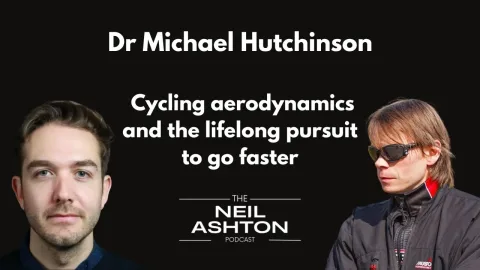
Dr. Michael Hutchinson — Cycling aerodynamics and the lifelong pursuit to go faster
Watch on YouTube
Dr. Michael Hutchinson — Cycling aerodynamics and the lifelong pursuit to go faster
YouTube video
Watch this episode
YouTube is contacted only after you choose to play the video, keeping this page fast and private by default.
Listen to the audio
Episode overview
In this episode of the Neil Ashton podcast, we delve into the fascinating world of cycling, focusing on the critical role of aerodynamics and the evolution of training techniques. Featuring Dr. Michael Hutchinson, a former top-level cyclist and expert in cycling aerodynamics, the conversation explores Dr.
Hutch's journey from competitive cycling to becoming a prominent figure in cycling media. The discussion highlights the importance of power meters in training, the cultural landscape of cycling in the UK, and the technical innovations that have transformed the sport. In this conversation, we discuss the evolution of cycling performance, focusing on the impact of training, nutrition, and equipment.
We highlight the importance of training less, the advancements in nutrition that allow cyclists to perform better, and the diverse training approaches that exist among athletes. The conversation also touches on the professionalism of cyclists, the rise of women's cycling, and the significant role of aerodynamics and equipment in enhancing performance. In this conversation, Neil and Dr Hutch discusses the intricate balance between power and aerodynamics in cycling, the evolution of rider trust in aerodynamic advice, and the significant impact of wind tunnels on performance.
He explores the challenges of wind tunnel testing versus real-world validation, the role of computational fluid dynamics (CFD) in cycling aerodynamics, and the regulatory challenges that arise with advancing technology.
Chapters
- 00:00 Introduction to the Podcast and Cycling Passion
- 02:57 The Intersection of Cycling and Aerodynamics
- 06:02 Dr. Hutch's Journey into Competitive Cycling
- 08:57 The Evolution of Aerodynamics in Cycling
- 12:13 The Role of Power Meters in Cycling Performance
- 15:01 Training Techniques and the Shift to Power Metrics
- 17:58 Transitioning from Cycling to Media and Writing
- 20:50 The Cultural Landscape of Cycling in the UK
- 24:13 Technical Innovations and Personal Experiments in Aerodynamics
- 27:01 The Impact of Power Meters on Training and Performance
- 32:51 The Power of Training Less
- 34:15 Evolution of Cycling Performance
- 38:30 Nutrition: The Game Changer
- 39:47 Diverse Training Approaches
- 42:31 The Professionalism of Cyclists
- 48:11 The Rise of Women's Cycling
- 50:33 Aerodynamics: The Key to Speed
- 56:06 The Impact of Equipment on Performance
- 01:05:08 Balancing Power and Aerodynamics in Cycling
- 01:07:05 The Evolution of Rider Trust in Aerodynamics
- 01:10:55 The Impact of Wind Tunnels on Cycling Performance
- 01:12:21 Challenges of Wind Tunnel Testing and Real-World Validation
- 01:20:26 The Role of CFD in Cycling Aerodynamics
- 01:25:31 Regulatory Challenges in Cycling Technology
- 01:31:08 The Future of Cycling: Balancing Technology and Tradition
References and links
Transcript
This transcript was created from the corrected YouTube captions, with names and technical terminology reviewed. Download the corrected SRT file.
Hi and welcome to the Neil Ashton podcast. In each episode, we explain some of the fascinating ways that science and engineering are changing the world around us. We talk to leading engineers from elite-level sports like cycling and Formula One to some of the world's top academics to understand how fluid dynamics, machine learning and supercomputing are bringing in a new era of discovery. We also hear some of their life stories, their career advice and lessons they've learned on the way that I hope will be helpful to you too. So sit back and enjoy this episode. Hi and welcome back to the Neil Ashton podcast. So today's episode is all about cycling and it's something that anybody knows me.
I'm passionate about. I'm a keen cyclist. I'm one of these people who watches uh nearly all the races, not just the Tour de France, but the Classics, the other um Grand Tours and basically any cycling race. I'm kind of obsessed with it and uh that's partly because I just enjoy cycling, but also because I think there is a fantastic and super interesting link to aerodynamics, aerodynamics for cycling is uh one of the key differentiators. Uh and actually to model the flow over a bike is also extremely challenging for methods such as computational fluid dynamics modelling, the movement of the legs and the transition between laminar and turbulent flow.
And that's why the person that I'm speaking to in this episode, Dr Michael Hutchinson, or Dr Hutch as some people know him, is one of the foremost experts on the practical application of improving aerodynamics or the aerodynamic efficiency of a cyclist, whether it's a track cyclist or a WorldTour cyclist. In this uh in this episode, we um we talk about so many different things. I think he is a really unique character because he was a very top-level cyclist himself. He holds numerous uh world records in terms of time trials. He did racing, he then moved on and and continues to do. And I, I guess what a lot of people know him as is a journalist writing for Cycling Weekly.
He does some commentary on uh on Eurosport. He's written books, he acts as a coach. He was very involved with British Cycling in some of the foremost years where those marginal gains and the real sort of development of aerodynamics came in, and I think he is one of those pioneers who, as we, you know, discuss in the early days was doing things in wind tunnels, even talks about having his own wind tunnel in his lounge. Really someone who wanted to tinker and really understood the importance of it arguably well before it's commonplace today, uh one of the first people to have power meters on his bike to try to figure out where the gain was coming from.
Just so many things that I found fascinating. And I also took the opportunity to speak to him at length about how things have changed. One of the common questions you get is: Why are the cyclists today so much faster than the ones before? Is it to do with equipment? Is it to do with training? So we go through all those discussions about how training has changed, nutrition, aerodynamics. Like I said, this was a dream for me. It was talking about stuff that I found fascinating and hearing from one of the experts was great. So this is one definitely for cycling fans, but hopefully also for people just interested in aerodynamics
cycling, CFD, and just hearing from a fantastic person about his life story, even though, yeah, it's nowhere near complete. So yeah, sit back and enjoy this episode with Dr Hutch. How did you get into cycling? What age were you when you became a cyclist? Uh I was 22 or 23. I'd been a rower, hadn't cycled at all. And I started— I rowed for Cambridge Lightweights and then I stopped doing that because I started doing a doctorate and I just didn't have the time to hang about the boathouse while eight undergraduates got their lives together. Um, and I took up cycling as a kind of,
kind of a means to not get fat. Really. I just was looking for a sport that I could do and I tried running and I wasn't amazing at running. And my now partner's father was a cyclist and he said, yeah, borrow a bike, go for a ride, see how you like it. And I liked it, and that's how I got into it. I liked it. It was also It was also immediately obvious that I was good at it, you know, so you can kind of just tell I got kind of five minutes into my first bike ride and I thought actually, yeah, I can kind of do this. It just felt right. So that, that's how I came into it and that's why I ended up having a slightly funny cycling career because I started 10 years too late.
Yeah. So that's, so that is quite late, isn't it? I mean, you know, a lot of people now are like eight years old on a bike or something, but you have to Thirteen or 14 or something. Thirteen or 14 or something It would be a good time to take up cycling because you're kind of, you're old enough to, plenty of people take it up younger. But if you took it up by 13 or 14, you wouldn't be losing out very much if you take it up when you're in your twenties, you are, you're going to be running to catch up. Some, some people do it. And how, how did you, then what made you want to go? I mean, there's a keen amateur cyclist which you can get, but,
but you went further than that. So, what were you always a competitive person to do that? Uh, yeah. Well, it's, yes, it's partly that it's also the kind of the feeling you find something you're good at. How good can I be? Because I was a reasonable rower, but I was obviously not rowing internationally. University-level rowing was clearly my limit, and I found something I thought I could probably be better at and I could do it on my own. So I wasn't dependent on anybody else. So I, I kind of just chased that and got faster over two or three seasons. Um, and then in 1999 which feels a long time ago I was second in the National 10-Mile Championships.
I won the season-long Circuit Series, all of which was a little bit of a surprise. I, you know, I'd had a good winter. I trained well and suddenly that year I was, I was flying, I was maybe my third season. Um, and yeah, that hadn't necessarily been the plan. I hadn't started out when I took up cycling thinking I am going to win this, this, this, this and this, I just sort of followed what I thought would work. I did actually, I mean, I started being interested in the aerodynamics of it back right back then because it seemed to me, well, you kept reading that 80% of the drag was, was, was from the, from aerodynamics. You think,
Well, why is everyone else ignoring this? Do we not believe this? And I did um I did a four-up race, a university four-up race, with amongst other people, an engineer who sat down and did some really basic modelling with, I mean, literally a piece of a piece of paper and a calculator and said, right, the optimum way to ride this is for Michael to sit on the front for 50 Ks and we'll sit behind him because he just, he just modeled it backwards from the differences between our personal best times. And we all went well, that doesn't make any sense. And we went and did the race and it was blindingly obvious afterwards that he was absolutely right.
The fastest way the four of us would have got around the course would have been if I had just sat in the front and the three of them had sat behind me because I was quite a lot quicker than them. And it just made me think. Ok, so if you look at the kind of the physics of cycling that people talk about. Actually, this, this, you know, if you follow that, you get somewhere. So that's kind of, it's both how I took up cycling. And I mean, I almost immediately became a little bit interested in this side of things. Then I finished my doctorate. Um I was working in an academic job that was a one-year contract, and that came to an end and I started looking for a job for the following year.
And at around about that point, somebody rang me one day and said, would you like to come and ride for my team? We'll give you some— they'll give you some bikes. There were a few thousand pounds of money involved in it. I mean, it was about the same amount of money as I'd have been getting from the academic contract. So it wasn't nothing. And I thought, yeah, let's go and do that. Let's take a year and see. And part of it was, honestly, I just liked the novelty of becoming a middle- aged, slightly overweight, middle-aged professor of international law and having undergraduates go, 'Hey, Professor Hutchinson, he was a cycling champ,' and the other ones going, 'No,
no, he couldn't possibly.' I just kind of like, I like the idea of it being a kind of a slightly funny piece of backstory and that was kind of, it's not a great reason to become a professional cyclist, but it's more or less where I came at it from. And so what team, what, tell us more about what, what was that, what was that like? I was riding for a team that was essentially a one-man team, but I had a team manager who ran a specialist time-trial equipment shop. Well, I could have said an online shop. I think at this point it was probably literally a mail-order shop. I think you phoned him and told him what you wanted. It was like the Dark Ages.
Um And he, he'd done a deal with Giant with Giant because Giant at that point were making it were, they were making the Mike Burrows concept of the compact bike where instead of having bespoke frames, you had three basic sizes, a whole pile of different seat pins and stems, and Mike Burrows' idea was that anyone could fit anyone from sort of 5 ft, nothing to 6 ft five could fit in one of these three basic sizes using the right bits. Um And Andy who was running the team looked at this and looked at this concept and said, well, that might be true and it might not. But I tell you what any one of these things can be turned into a time-trial bike because you can get,
you know, suddenly all of the lengths and heights were sort of independent of each other. So you weren't dealing with having to build a special bike that was a little bit short or a little bit lower. You could actually do the specialist geometry by using all the bits that Mike had, had designed to make it fit anyone. Um, and he went to Giant with us and they, and they said, well, if you're right, we're going to be able to sell these in vast quantities to time trialists. And he said, well, let me, let me go and recruit you a time trialist and we'll prove this point. And he recruited me and, basically, my job was You know,
to get my picture in the cycling press by whatever means necessary. It was sort of proto- social media. That was almost the main objective. The easy way to do it was to win a lot. So that's how I did it. Ah, ok. So this and things have moved on, I guess at that time, that whole aerodynamics, I mean, compared to now where, you know, it is a massive differentiator. Every everybody, even an amateur cyclist is a sort of aero-obsessed person, I guess. Then it was very different. Was it almost the opposite, where people didn't believe in it? And you were a slight outlier on that side? Yeah, they believed, and they didn't, everyone kind of,
it was perfectly clear that tri-bars were faster than not using tri-bars because tri-bars came in in the late nineties. So everyone was sorry, the late eighties. So it was a long time before I arrived. But it had been completely clear from that, that you went significantly faster if you used aero bars than if you just kind of gripped the cowhorns in the old style. So it wouldn't be quite right to say that people didn't believe in it. I think there was a scepticism about the subtleties of it. I think if you got in a time machine now and went back and said, 'Well, the difference between this pointy helmet and this pointy helmet is,
uh, two seconds a mile. I think you'd have encountered some scepticism about that. I think people would have gone on the basis that pointy helmets were— skinsuits would have been the other big one because, you know, you you made it out of Lycra, you made it reasonably tight. That was it. A skinsuit was a skinsuit. So people believe in aerodynamics. They just didn't believe in the small differences. Um, and I kind of did because I couldn't see why if putting a pair of tri-bars on your bike was going to make you two minutes faster Over 25 miles. Surely there are other things you could do that would make you 30 seconds faster over 25 miles. So,
yeah, I started an awful lot of very misguided home-brew aero Research, but along the way, I stumbled, I stumbled into some things, and I can't emphasise how much more that was luck than judgement. But is there something, you know, you're, you know, having done things like the 12-hour record and 100 miles, to me as an amateur cyclist, this sounds just horrendously painful. Is there a, do you enjoy putting yourself through that? So is there something about those longer distances that appealed to you? No, not at that point. I hated 12-hour races. I did 12-hour races because I was under a degree of sponsor pressure to do them.
Um, I might have, I might have done the first one anyway, out of curiosity, I wouldn't have done the second or third that I did in that era. Um uh But yeah, the interesting thing about something like a 12-hour is it's a competition between your aerodynamics and your digestion. You, as a bike rider, are, you know, the actual, you, if you're aerobically good, you, yeah, you've got an advantage, but the big challenge is actually keeping eating and keeping aero. Um, and I did, I've done some 24-hour racing in the last couple of seasons as a sort of a kind of retirement project. And it's, again, it's the same thing. It's about, it's about eating and about aerodynamics
and how, um, so I would say I, I don't particularly enjoy putting myself through things. I'd much rather ride a 10 than a 12—a 10-mile time trial than a 12-hour, believe me. Ok. Ok. So it was more I thought, do you have some sort of, I don't know, a thing that makes you just love the, the, the torture of going through long distances. Um, no, no, not to me. I always kind of liked the races less as the distances went up. I like, I liked the short races better because I enjoyed the kind of focus of that and the high powers and the kind of the speed and how all of that balanced quite critically. Um, I like that much better than the adventure of going off and trying to do a 12 hour.
I mean, to be honest, a 100-mile time trial isn't very different from a 10-mile time trial, Um, because particularly if you're doing it in sort of three hours, three hours, 20 or something, it's not a particularly long ride because you're going quite quickly, you cover a certain amount of distance, but there are plenty of people who go and ride hard for three, three and a half hours. It's not, it's not that hard, it's a little bit hard. I was going to say it's not kind of a long distance torture. I guess it's more the, um, being in the position that I, well, I guess it depends on your flexibility doesn't it? And how used you are to being
in that position and how, how you train in the position because it's one of the changes I made fairly early on was thinking if, if I, if I race in a time trial position, why am I spending my winter riding around on a road bike? So I built the world's first winter low-pro, a low-pro with mudguards on it, from probably 2004, 2005 before I came up with that one. But yeah, I had a mudguard low-pro for winter training. And what did people think about that if they saw you on the road? Did they sort of take a double look? I don't think anyone ever really commented on it. I mean, I didn't take it on club runs or anything, so,
I'm not sure how many people really kind of stopped and went, hang on a second. Those things don't go together. I did a race on it once because my, my, my bike for that year, it was an early season race and my bike for that year hadn't come through yet and it was muddy and I thought, Oh, stuff it, I'll do this race with mudguards. We never actually put them in the wind tunnel, but maybe, maybe they're a fairing. I don't know. This is what you're going to see now in the next track: mudguards. Um, so what what was, how did things then progress from there? So you've gone out of doing the PhD, going into, uh, I guess, like you said, why not?
Let's, let's try and do something exciting. Maybe talk. What, what was the life after that like, or how did things progress? Uh, well, the idea had been to do a year, a couple of years, um, and two or three years in, I was still winning a lot and I reckon I could win a lot more. So I plugged away at it. I had quite a nice deal in terms of royalties on bikes and things like that. So I was making a reasonable amount of money and I thought, well, I could go back to being a legal academic. I think I'm happy here, actually. So I kept going, did things like the Commonwealth Games, managed not to get selected for the Worlds until I'd more or less retired,
but I just found I kept making progress. I kept finding new ways to go faster. Uh I kept meeting new people who could help me go faster. Um I did the Hour Record in 2003. I didn't break the World Hour Record, but I learned a huge amount about particularly aerodynamics in the course of doing that and aerodynamic testing. And I always felt that every year I was working through, I was getting a little bit better I was finding new ways to do this. There kept being stones I wanted to turn over to see what would happen if, um, and somewhere around about 2005 or 2006, I was thinking actually probably a little difficult to just walk straight back into an academic
job now, because they're going to want to know where I've been for the past seven years, and I'm not sure telling them I was doing the Commonwealth Games is really going to be a big selling point if you kind of arrive at the Cambridge University Law Faculty looking for employment. Um, so at that point I thought, well, I might as well ride this to the bottom. So I kept, I kept going, I wrote, I rather, I started writing books and things like that. That sort of headed me in a different direction because I, I sort of became a cycling media guy. I started writing magazine columns and writing books, um, and things like that.
So that, that was a change as well. I was gonna ask about that. Was that something that you'd always like doing? Did you ever do stuff with student newspapers or did you ever have sort of journalism media thing before? No, not really. Um, I, I did some sort of freelance writing in the winters in the early early season in the kind of 2001, 2002, This gets a long way from cycling. There was a friend of my girlfriend's who was editing uh, a book or a travel guide to Ireland and there was a section of Belfast, which is my native city. And she said, could you read this because some of this doesn't feel quite right to me.
And I read it and said, it's not really right. No, she said, could you rewrite it? And I said yes. So I wrote quite a lot of it, a travel guide to Ireland and I did quite a good job of that. So I spent kind of a couple of winters actually writing and editing travel guides. Um, so I had a little bit of experience of that world. And then when I did the Hour Record, somewhere a week or two after that, I thought, hang on, that's quite a good story because there's my Hour Record attempt, which was a little bit chaotic in the end. It's like all these things you start off with the best of intentions and it ends up being,
you know, slapstick. And there's a whole history of the Hour Record, and there wasn't an English-language book about the Hour Record. So I said, I wrote a proposal and sent it to a few literary agents. It helps that my girlfriend is a publisher, so I knew I knew the world of, of what you tried to do. Um, and yeah, somebody somebody bought that as a book. So I then spent a year writing my first book, which did reasonably well. Um, and so that's, that took me there. But no, it certainly wasn't the case that I did the Hour Record So I could write a book. The Hour Record—and one or two of the reviews sort of said, 'Oh,
there's this joker who's had a go at the Hour Record just so he can write a book about it.' I thought, well, that's not really how it worked. I'm not a terrible bike rider. Um, and then I did another couple of books after that and wrote for magazines and things and that was kind of the direction I went in for maybe three or four years before starting to kind of get a bit more interested back into some of the technical sides of cycling. And, and I think actually, um, you know, your columns bring, uh, the sort of funny side I remember reading something about, like, bike ownership recently. You know, so many of the things relate, like cycling is one of those.
Um, it is very well known and equally not, you know, it, it's sort of got a weird relationship, isn't it? And to some people it's, it's like a really hot topic but it's not from what I understand. And I don't know. But, you know, in Belgium and in Holland it really is like a national sport, where the UK, it feels like it's like a subculture almost, you know, some of my friends are on WhatsApp all the time talking, while other people have no clue. Other than the Tour de France. It's, yeah, everybody knows what it is because more or less everybody can ride a bike. So there's a familiarity to it. Everybody knows what it looks like.
It's one of those sort of slightly second tier as a sport. It's one of those slightly second tier sports like Wimbledon or like, like tennis, which comes up every year when Wimbledon's on. Everyone's a tennis fan for two weeks. There are a lot of people who, when the Tour de France is on become something of a cycling fan, more so maybe a decade ago. There was such a high-water mark after London 2012. Then the Tour de France was in Yorkshire. The Giro d'Italia was in Ireland. It really was massive at that point. Everyone was a cyclist and now we've got to the point where most people can remember that. So, actually they know what they knew.
Then they're still a little bit interested and they kind of, but they pick it up and set it down a bit as a, that sort of as a sport as a pastime. Uh, a little bit the same. Probably, I think, we have people who took up cycling through the 2012– 2014 period, when it seemed to be everywhere. Um, and a lot of them are still there and still around but it, it hasn't become, it's not like football or there's probably only space in any country for one or two really sort of dominant sports that everyone is interested in, in Belgium. Cycling is the sport, uh, in the UK, it's, it's football and it always has been. So you're always kind of scuffing around looking for whatever else you can find.
Um, Before maybe talking about some of your other media things, I was interested: you know, you said you started to get more into the technical side. So after the Hour Record. So how, when did you start to or could you describe the link then? Because that was sort of a bit earlier, but just as British Cycling was really trying to get into more of the aerodynamics and the marginal gains. How was your sort of relationship and overlap with some of that timing? Yeah, I mean, like I say, I kind of had some real, real home-brew stuff. I built a wind tunnel in my sitting room, which didn't really work. I always say, 'I built a wind tunnel in my sitting room,' and then I add,
'It didn't really work,' as if anybody thinks it might have done. Um, You know, it produced results that made sense, but, I mean, it was basically making little models of myself. Um And I'd kind of created a balance for that. It didn't make a lot of— but it was interesting. You could actually see that, off the kind of little posable model you could see actual repeatable differences from quite small changes. So that was a little bit interesting. Um The big thing that I really started to do when I was getting ready for the Hour Record—actually, I think the biggest thing there was the other thing I used to do, which was frontal-area analysis.
My finest hour there was realising that if you took a photograph of yourself head on and then took another photograph of yourself head on in a different position, printed both the photographs out onto a nice heavy sheet of photographic paper and got a scalpel and cut away everything that wasn't you or your bike and just weighed the paper. You actually had quite a, wow. I mean, probably at that point you could just about— you could probably just about have done it in a, in a, in a photo processing software with a pixel count maybe on the early side for that. If you knew what you were doing, you could have done that. But I,
I did it in a really kind of analogue way. Um So there were things like that, but the first real point that I started getting actual proper uh quantitative results was using a set of power cranks um in an era when power meters were unusual just going and doing track testing with a set of power cranks. Um, and you did a 12- or 16-lap run, and you just looked at speed against power and I'd got a really kind of basic, really basic spreadsheet model. Um, that would just correct for, you know, correct power for speed so that you could correct everything to 50 kilometres an hour. And it would just give you your power for 50 kilometres an
hour and it clearly it wasn't dealing with any of the vertical forces and there was a certain amount of noise in the system and you couldn't find your watts one at a time. But you could certainly, if there was a 10 or a 15 watt difference between things, you could, you could see it and it was repeatable. Um, it was laborious and it wasn't cheap, but one of the pluses I had was that at that point, my sponsors were paying for my track time so I could book the track in Manchester and have it to myself for three or four hours at a time. and do 12-lap runs, 16-lap runs, Um, come back down, download it. Take, take, take kind of a nice section in the middle of it somewhere.
Um, that was just nice and even I very quickly learned that if you were on a rising or a falling power trend, you were in all sorts of trouble because that just because the, your speed lags behind your, your power. So if the power curve wasn't flat, but you could almost always kind of deal with it by making sure the section you were taking started and finished on the same power. That usually dealt with it. If you were getting faster the whole way through the run, it was junk. But if you had someone trackside who was giving you your splits as you went, after a couple of laps, you settle in it. It took a bit of experience.
You certainly, you couldn't have done it as a consumer experience. You couldn't just have brought in a stranger and said, yeah, come and do this, we'll do your aerodynamics. It took a lot of skill and practice to make it work, but it, it produced good repeatable results that, that then kind of would validate in the real world. Um, and it, the, the other really basic thing that was interesting about that was if you did something like five laps of the track with your elbows in a natural position and then you tucked your elbows right in and you watched the trackside coach. a lap after you started doing that, they would have taken
several steps away from the start finish line, which would indicate that you had just started going faster and it had an immediacy that you wouldn't ever see in the real world. By doing that and looking at a bike computer because you were maybe only gaining 0.3 or 0.4 of a kilometre an hour. But when you do it in a controlled environment like a track and you're getting that kind of lap by lap feedback, you can immediately see the difference it's making. So it, it kind of firstly had the effect of really making me realise how very small changes could produce very significant results. And, you know, the beginnings of actually trying to quantify these things.
And it seems like that's actually a good point about the power meters. So when you know, again, they're so commonplace now. So in the, when did you start seeing them more commonly used? Would it be in the early 2000s? Uh 2000, I was involved with the GB squad in 2000 and I used one on the track there. Then, in 2001, I bought one because I had a lottery grant. Um, and I, I and I raced for Northern Ireland. The lottery-grant system there was: you couldn't have like a living grant, they would just buy you equipment. And the thing I asked them to buy me in 2001 was an SRM power meter, which I think in 2001 cost something like 2,500 pounds.
Um It was an, it was an expensive thing, and it didn't work brilliantly. I ended up with two of them because essentially you needed one to use and one on its way to repair, repair or on its way back from being repaired. Um But it was, it was, it was such a powerful tool. Um And I was still riding, doing stuff with British Cycling, and they were very keen that I have it because even in 2000 everything they were doing had started to hang off power as the core metric. Simon Jones, in that era, was the head track coach, and he was a very, a very numbers driven coach. Um So, yeah, the 2002, but at that point, people would come up to you at a race and point at this thing on your bike and say,
what's that? And you'd say, 'It's a power meter,' and they'd go ha ha, what's one of those? And you would explain the concept and a lot of some, some people went, oh, it's brilliant. A lot of people just went, 'But why don't you just see how fast you go?' And you would try to explain why this was a more useful number. Um But yeah, and I would say that was at least a decade before they became really commonplace. Um And they'd been, I mean, they'd been kind of prototypes of them around for a few years before that, But that was, that was pretty much the beginning I think I was kind of in on the ground floor on that one.
And did you, you know, in terms of your training, I guess before you were training on feel or heart rate, did you, did you notice a performance difference? transitioning from heart rate to power meters as well? And to be honest, not a huge difference, it meant what you were doing is much more controlled. You've got kind of real confidence in it. Um It probably it isolated kind of training zones a little bit better and particularly for kind of lower effort training zones, you could judge those more accurately because, if you're trying to get like a zone two off a heart rate monitor, heart rate monitors are, they'll tell you how hard you're working, but they'll also tell you how warm you are,
how dehydrated you are, how stressed you are, what your blood volume is. They'll tell you all sorts of other things that will come into that. And, you know, if you use a power meter, now you notice there's quite a lot of heart rate drift even across the length of a session. So it made that more accurate. It probably got a bit far. My performance probably improved around that era because up to that point I had probably overtrained a bit. Um I if you go back to the 19 nineties and that wasn't really what we were coming out the far side of that, but the training volumes people did were insane. Um I was, I'm doing it.
I'm writing another book at the minute, which includes some training stuff. And one of the things I was looking at was kind of like some historical training things. Um And I found a recommended, a coach-recommended training programme for doing a 24-hour time trial, which was assuming you had a full-time job, but it was suggesting that you could fit in a couple of hours before work and probably another three or four after work and you did that five days a week. So what does that add up to? Five hours—15—that's 25 hours a week. Then it suggested some long rides at the weekend It sort of said you could do six hours on Saturday and six hours on Sunday.
So it's racking you up to kind of 38 39 hours a week. It said you should start doing that in October and do it till the beginning of the season. And, you know, I think this was being presented as sort of a serious training programme for someone who really wanted to go places, but nobody in the world does that anymore. And you were probably doing it harder than zone two as well because you were probably just going out to ride it kind of as hard as you could. So I had a great season in 2001— sorry, 2000. 2001 wasn't as good because I thought, oh, I'm good at this. I'll train harder. And I realised part way through 2001 that
actually I was just knackered the whole time. There was a man called Pete Keen who was the first performance director of the British Cycling organisation as you would now recognise it. Um And I met him for the first time in, in Manchester, around about that era. And he said, you're the most exhausted looking cyclist I've ever seen, you need to train less. And he did that. Literally, I met him in a corridor and he stopped me and said, you're Michael Hutchinson. I know you, you need to train less. Um And he seems to have been right. So that was—right, it's a confounding variable because that's around about the point where I got my first power meter.
And of course, I trained, probably dropped my training mileage and my training volume by probably a third between 2001 and 2002. So who's to say The power meter helped do that because it gave you the confidence. You could see you could see that the numbers were going in the right direction. You could quantify that and you could, you could see that on your own all winter. You, you because before that you would train all winter and your first race of the year would be terrifying because you just wouldn't know. So you turn up to some dumb race in February and ride until you could taste blood in your mouth to just prove that you could still do it.
As soon as you've got a power meter on the bike, you get to February and go, 'Well, last February I won a race on 430 watts. This February I can clearly do the same thing. So, unless everybody else in the world has got 10% better, I'm going to be just fine. So it gave you that degree of confidence to, to, to have faith in the training you were doing. So it was quite important from that point of view. And the thing is that's what everyone does. Now, the idea of that being novel seems kind of absurd. Well, that, that's kind of maybe one of the central questions I'd love to dive a bit deeper with you is why if you look at a Tadej Pogačar
or these, you know, the current leading top riders and then you contrast it back into the 1990s or the early 2000s, what is it that is making them beat all the records and, and smash away with it. Is it the bikes? Is it the training? Is it nutrition? Like how have you, how do you analyse the progression and the influence of each of those factors in how they're going so much faster now. I, I think nutrition is a lot of it. Um, if you go back, even 10 years, the standard target was 70 or 80 grams of carbohydrate an hour. Um,
and if you've got a six- hour— if you've got Milan– San Remo, six or seven hours, all of Milan– San Remo really is in that last hour. So you've got to survive that first five hours. Um, and you can kind of, the more you can eat, the more you've got left at the end, if you can eat 80 grams of carbohydrate an hour. Well, that's okay. If you can eat 100 grams of carbohydrate an hour over five hours, that's another 100 grams of carbohydrate. That's like another half-hour of high level riding in terms of energy that you've stashed away. Um And most of the most decent pros these days can do 120, 130, maybe 150 grams of carbohydrate in an hour.
So they're getting on towards doubling what we used to do. Um And that's made a huge difference and that's largely based on improved um sports nutrition technology because there are, for example, there are different sorts of carbohydrate, have different transport across the gut membrane. So fructose goes a different way to glucose. So the first thing that somebody realised was that if fructose and glucose aren't absorbed the same way, well, you can combine them into one sports drink. So suddenly, instead of 80 grams of carbohydrate an hour, you can do 100 just because you take your standard 80 grams an hour, you put 20 grams of fructose in it.
You give it a shake. This is literally we used to buy fructose from the supermarket, like from the jam making department put it in. I mean, it was the sweetest thing known to man. and it would probably have been quite hard to sustain for a very long time. But suddenly you could do another 20 grams of carbohydrate, you could do another 20 grams of carbohydrate. And now, and it's, we've moved that on again into kind of different delivery systems. So that makes a difference that also helps with your training, that helps in racing, but it supports better training. Um And that, that helps, that I think training has got more specific because we can measure it better.
You can, you know, it's much more straightforward to go to a lab and get good results and then go and do kind of lab-type testing in the field. So that, so that the physiologists who work with teams can actually monitor what's going on and what progress they're making without having really to go to a laboratory anymore. Um So to that extent, training has improved, like a lot of things, sometimes people say, what do I think has made the biggest difference in cycling in the last 20 years? And I say the ability to measure stuff because it's so much, there's so much less guesswork involved and a lot of the time it's not something that a physiologist or an aerodynamicist from
the year from 1999 wouldn't have understood. It's just that a physiologist or a nutritionist or an aerodynamicist from 25 years ago wouldn't have been able to measure except under very specific laboratory conditions. Um, all of the, all of these things make, make, make a difference. Um, and there, there is also, there's a psychological aspect in that the expectations people have of themselves feed into the relationship between psychology and physiology is not one or two separate things. There's an extent to which the, you know, there's a central nervous system input to your physical capacity. Um, so that's an area that there's a lot of
interesting stuff going on now that I must admit, I don't absolutely understand. Um, but so there's some very good work in that. So the reason they're going, there are a lot of reasons they're going faster. The first one I would point out would be nutrition. And do you think, um, so if, if you say nutrition and I'd agree with you and that's sort of interesting link to what you're saying before is like, can you stomach it? you know, if you're doing like a seven-hour or, I guess, a Grand Tour every day, have you got bowel issues. Are you able to sort of continually do it? I guess you have to be, uh, physiologically not have issues with digestion or, you know,
irritable bowel syndrome or something that just rules you out from, uh, from that? But what about the training? Do you think that maybe it's more as a, a non-professional? I sometimes almost get a bit confused by the different advice, you know, that you see on various websites or YouTube channels. Do you think the teams and the riders all pretty much train the same and they know, or do you think there is still a lot of variation and uncertainty on the balance of zone two, zone four, zone five? I, I think, I think you can get where you're going a lot of different ways in training. I don't think there's a single right way to train.
Um, I think you could train the same athlete two different ways and get the same result. The things you do certainly do need to be aware of are overall load. The things you certainly do need to be aware of are overall load, because overtraining is a proper problem. Um, again, it's easier to measure now. It's, it's hopefully easier to avoid those problems. Um, I mean, I kind of, I interviewed within the space of two weeks a few years ago, I interviewed two different coaches from the same elite team. Um, and one of them said it's just about load just, you know, you give the rider the load they need. It doesn't matter if it's zone two, zone three, zone four sprints, whatever,
give them the load they need, adapt it by what they like and what they'll do and what they're good at and you're fine. Um, and a week later I interviewed another coach, slightly more senior coach, but from the same team and I did the thing that you do when you want to look like an expert, which is you quote what the last expert you talked to said to you and you quote that to an expert. And I sat back expertly in my chair and said, well, of course, it's all about load, you know, and he went, no, no, no, no, no, no. It's real, really specific. You have to. And he, he started into explaining to me how you have to find the right
gradient of road at the right altitude to simulate the exact effort for. So you work out where the attack on Alpe d'Huez is going to be and you find a road that's that gradient at the right altitude and you rehearse that and I was like, it was completely different, I think, but, but, but you guys are literally training the same bike riders. Um And that, that really interested me. Um I think specificity helps, I think it also helps with, with, with motivation and it helps give athletes a lot of confidence and this is where it, It helps give athletes a lot of confidence, and athletes are very complicated things, and, and training an athlete
is thereby, is a complicated thing. Um, I mean, athletes that I've coached, I tend to work backwards from the demands of the event. Um, with WorldTour riders, it gets a little bit more complicated and you maybe are in the position where they've got a target event, but they're actually going to spend a lot of their time doing something else that they need to do to keep their place in the team to keep actually being that WorldTour bike rider and living in that environment. Um So you do often at that level, you have a lot of compromises, but it still does basically revolve around the specificity of the event. And as I say, the fact that you can measure people's progress better,
but I don't feel like training has changed a huge amount in the last 10 or 15 years. People talk about, oh, we're in modern training and I think coaching has got better athletes have got better at providing feedback. We've got better at measuring it, but it's, it's been a fairly marginal gain. It, it hasn't been the same scale as some of the aerodynamic gains, some of the nutritional gains. I think, uh you know, you'll probably publish this podcast and I'll get furious emails from coaching friends of mine saying, 'No, we've changed this, we've changed that,' but at the end of the day, it's not like, you know, obviously there's a doping issue in cycling's past—and
a little in the present, probably. But that's another topic, which makes it quite hard to look over time at things like records, power-to-weight performances and so on because you go back to a point where those were skewed by doping. Um, but it's not as if in the last 10 years, amateur athletes with decent coaching have started doing six watts per kilo where they were doing five, maybe athletes who were doing 5.05 watts per kilo, with better coaching and a slightly more refined approach, get to 5.2 watts per kilo. Um, it, it, it's not night and day, it's an improvement and if you're at a race, well, yeah, it's, it's gonna be a decisive difference but it's not as if people
are suddenly finding 75 watts where they couldn't have found them before. Yeah. And I kind of wonder as well of, um, the salary side of things, the professionalism that, you know, if you're being paid millions now compared to, I guess, what was tens or hundreds of thousands, whether the, the professionalism, you know, you see that in other, like football where they'd say, oh, we'd go for a drink, you know, after the game or something. And now you would never do that, you know? Did you, did you see that as well that the level of professionalism has just, um, the, the other stuff outside of cycling almost, maybe, maybe I,
my feeling is that most of the riders I've known or worked with have been pretty professional. Um, I think probably more professional than a lot of other sports. The ones who've been good at it and done well. Certainly, in my later years— the later part of my career— I would go to kind of international events as sort of someone who was kind of approaching 40 you know, riding in a team with riders who were 21, 22, maybe even a little younger than that. And I was always really impressed by, you know, they did their strength and conditioning, they did their stretches, they went to bed early, they took nutrition seriously.
You know, I think things like that, I've often been impressed with riders who've done well, seem to pick that stuff up quite early on. Um, and I'm not sure that it's got vastly more professional. I, I don't think the attitudes among the top riders. I think they always rode like that. I suppose it's possible that if you come down a bit further to a kind of a slightly more mediocre level, there's a higher degree of professionalism because people, it's, it's that much more straightforward, things like social media, it's that much more straightforward to see how people—how the good riders live, how they do it. You can follow
a top WorldTour pro on Strava and sort of see that. Yeah, in the off season. Yeah, they reckon they're not really riding their bike but you know what? They're still getting out, they're doing some nice easy rides. They don't take that long off, they ease themselves back into it because there's all these things that you kind of know you're supposed to do. But it's very educational to see someone who's really good at actually going out and doing them. It's why in a, a team like the, the, the British track team, there are always at any point where I was involved in it. There were always one or two kind of tent-pole athletes
who the other athletes looked up to. Um, Chris Hoy was probably the, the, the clear, probably the clearest example of that because he took it seriously. He approached it like a, like a, like a job. He did the things, the strength and conditioning coaches wanted him to do and people would look at that and go, ok. Well, that's this, you know, that, that's how Chris does it and Chris has, I don't know how many Olympic gold medals. Well, you know, that's, that's how I'll do it. There is a, there is a leading by example, if, if you can see it, it's much easier to, to follow him. Yeah, maybe you're right then. Maybe I should say
the professionalism of the top riders maybe hasn't changed. But it's maybe that more of the, that everybody is being more professional. So it's sort of like the domestiques are rising up because everybody's um, more, but so training has largely sort of stayed, there is improvements. But you're saying it's not a massive and nutrition for sure. I think, I think what we have with training is, I think what we have with training is a better version of fundamentally the same thing. I don't think anything enormous has changed. Um, and I think, you know, we, we're better at suiting the athlete to the, to the training, to the athlete and getting the athlete to do the right training.
But fundamentally, yeah, and, and I guess the, um, as you said, the, the data driven decisions, the fact that TrainingPeaks and all this sort of stuff means you can see them where I guess before, maybe as you say, they, they knew what they needed to do but they didn't have the ability to track it or analyse it. Um, to, to the same extent, um, Maybe I should counterbalance some of this. We've mainly been talking about men's cycling, but there's been a huge transformation also of women's cycling. Um, did you see how have you seen that change? Is it, is it similar to the men in terms of just nutrition training or do you think there's
bigger differences on the, the women's side than the, the men's side? I, I think, I think that the, the increasing opportunities for, for, for, for women in pro cycling means that there's an opportunity to get it. Right. I think the women's peloton has always known how to do it, but very often, even at relatively high levels, you've got athletes who are also working as coaches or having to kind of balance things. And I think that's been, that's been, the big change is actually, you know, we're getting on towards properly sized contracts for a lot of the women's peloton. And if you went back 10 or 12 years, the top riders were very,
you know, they weren't getting the same contract as the guys, but they were at least able to ride as proper full-time pros, but that's been extended further down the peloton. So I wouldn't say they're more professional in the sense that there's been an improvement in, you know, compliance to training programmes and so on. I think there's been an improvement in people's ability to actually take on, you know, the kind of training programme that, that helps them get to their, it helps them get to their, to their best. I think that's been a change. Yes, I don't think it's been a change of attitude. It's literally been a change of the business model. Yeah, I guess you
As soon as people can have it as a full-time job, I guess you can do more training, you don't have to skip and it's, it's, it's a version of, you know, if you go back to what happened in cycling, in track cycling in the UK. In the very early part of the 21st century, the biggest change, there was money that allowed riders of both genders. It was mainly men in that era, but it allowed riders of both genders to be full time, to take it seriously to, to, to approach cycling, the way they knew would work. And it was just giving people that opportunity. It's just money and that's the balance, isn't it? Here? Some people
in some ways don't like the way that cycling is becoming more commercial and more things, but equally, that's bringing more money into the sport. And I guess encouraging, particularly on the women's side allowing sort of uh more progression. So I guess it's always a balance of the uh of the two sides. Um but maybe shifting to the aerodynamic side. So obviously that has been a major change. But in what in what sense? So would you, out of, let's say, the bike, the skin suit, the helmet, if you, if you were to take the—what is the one thing that you think has been the most dominant, and and how would you say that's progressed
uh of, of the components? I think all the things it depends where you start, it's the same as I run wind tunnel sessions and somebody comes and says, oh, you know what, what's the most important thing going to be? And I say, well, it depends how, it depends how you arrive. So there is that, um, it depends if your baseline bike is from 2010 or from 2000 because they were very different. Um, in the time I've been involved in it, the biggest change I think has been just looking at equipment this year. I think the biggest change has probably been skin suits. because in the period of time I've been looking at this properly, the bikes
the bikes were, were decent. Um We've had very few really bad bikes in the last 15 years. There've been a few, but yeah, most decent manufacturers produce decent bikes. The wheels have been pretty decent. Um But the skin suits have really moved on. Um, because if even sort of up to, I mean, the real watershed for that was probably 2008, which was the GB plastic skinsuit, which was non- air-permeable and had trip seams on it, and all the riders had lessons on how to put them on so that the trips were in the right place. Um And you would talk to riders in the track squad. We had a, had a session a few, a couple of weeks before the Olympics where we all
got our Olympic suits and we were allowed to wear them and we all went onto the track to do kind of training efforts. And suddenly we were setting PBs left, right and centre. We just we just couldn't believe it because they told us about these amazing suits. And we thought, well, a skinsuit's a skinsuit, you make it tight, it doesn't flap, it doesn't have any wrinkles. There we are. Job done. And we put these things on and suddenly people were riding, you know, uh two seconds a kilometre faster. And that was a real wake-up. Those suits immediately got banned. But at that point, everybody suddenly was saying, OK, so this is,
this is not as simple as we thought. And the first skin suit projects I was involved with were already happening by the end of 2008 and this was the lead up to the London Olympics, I guess where the real sort of moment happened. Yeah. Yeah, they, I mean, the UCI changed the regulations so that all the skinsuits had to be a textile. Basically, the rule was you had to be able to blow through it. Um So it had to be a knitted fabric essentially. And I think the assumption was that that was going to be the end of this kind of plastic-skinsuit malarkey. Um But you rapidly discovered that what you do with textures and trips,
It, it all still works on a, on a textile suit and actually a textile suit is much better because you couldn't wear one of the plastic suits for a 40k time trial because you'd be like a boil-in-the-bag chicken. You know, you, if you, if you wore one of those suits, you couldn't, you couldn't feel the air hitting you apart from your knees and your face. Um, it was, I mean, I never wore one but everyone I know who did said it was a very odd sensation because you had these big tall overshoes that came to just below your knees and your shorts that came all the way. So he said the only place your kneecaps would feel cold and everything else would be cooking.
And as soon as you transfer all of that know-how to making a textile suit, you can wear it for a 40k time trial. And suddenly it's of interest to WorldTour teams because WorldTour teams aren't interested in riding 16 laps of a track. WorldTour teams are interested in riding 40 kilometres. So suddenly there's a lot of interest, there's a bit more funding. Um, and the differences you were seeing in terms of the total global drag on a, on a bike rider. You're seeing differences of 4% or 5% between old skinsuits and the good, well-fitted modern, current suits, which is, it's just huge. It's, it's more than you're gonna get from a
bike and unless you're moving from like a real old steel bike with exposed cables and round forks and all the rest of it, but it's it's that kind of, it's, it's covering, you know, maybe two or three generations of bike development. So also I suppose covering a couple of generations of suit development. But, you know, So is that maybe translating it to the WorldTour teams, the people that maybe we see on TV. So they're all wearing from what I understand, sort of skin suits or, or, or partial skin suits almost all the time. Not a lot of jerseys around anymore. So the difference and that, so therefore that must explain some of the
difference in the speed from the 1990s. So 4% or 5%, and they're going faster. So I guess the influence of the skin suit is also therefore bigger. Would you say that is a, a sort of one of the key elements that is making them—if you put a skinsuit on one of the 1990s riders, they would probably also go 4% faster or something uh on a, on a time trial. Yeah, it's fairly simple. It translates across. It's more complicated on a road stage because a big Grand Tour road stage for a GC rider is almost certainly getting decided uphill where aerodynamics counts for a little bit less, you then need to factor in how much energy have they saved by being more aerodynamic
for the, excuse me, how much have they saved by being more aerodynamic for the sections of the race where they're sitting in the wheels? What influence is the aerodynamics having on their domestiques, who are maybe trying to control the race if they're now controlling it at a slightly higher speed? So is everybody riding at the same intensity but going because if you're riding at the same intensity but just going faster on the flat, it's not going to do you much good when you get to a hill, because you'll have put in the same amount of effort and suddenly you're riding uphill, where aerodynamics matters less. And actually, it's kind of a wash.
if you're at a time trial. Clearly, it matters if you are, you know, if you've got better technology than, than, than another team. Um and you can launch one or two of your riders off up the road in a break, well, then you can make the other team work that much harder because your aerodynamics is better on a, on a road stage. It's quite complicated because, you know, it, all you've achieved is everybody's going faster or have you managed to find some way to make your aerodynamic advantage count? Um So it, it, it plays into the tactics and it's not always straightforward. Um Most of the time when we're looking at speed records in WorldTour cycling and Grand Tours, we're
we're just looking at, at climbing where the influence is a little bit smaller in terms of aerodynamics in that moment. But if the aerodynamics have saved you some energy getting to the climb, so it kind of depends how that balances out. Yeah. And that's a really rubbish answer. I'm sorry, I didn't really give you anything you could work with there at all. I said it's complicated. I should have said that and shut up. No, no, no. The reason I say it is, I'm always wondering is when you watch and obviously we can get into this, you know, when, if you watch the commentary on TV, or the analysis afterwards, um, if you take Formula One,
it is very well established that the car plays a huge part to the point that it even outweighs the driver. Uh and that there is no way that someone with a lesser car is gonna, you know, go as well. But with cycling, unless I'm mistaken, it's not often discussed as much that the bike they're using or their skinsuit, I think could actually be making a difference if it's only 30 seconds they win by. Do, do, do you see that or do you think the difference between the teams is not as big or do you think that is actually one of the reasons why one team could be sort of doing better. Yeah. I mean, I think it can, I think that can happen. Um,
certainly on the track you see some very tight margins in, in things like pursuits and kilos in the timed events and, quite certainly, yeah, At that point, the technology can make a difference. Um, it also depends a little bit what you define as the technology. If you take a, I mean, I've taken bunch race track riders to the wind tunnel to work on their position on the bunch bike, on a drop-handlebar upright bike. Um, and then you see one of them clipping off the front in the scratch race four or five laps before the end. There's a question of how, how are they going to stay away from the bunch? So, if you can pick them up,
uh, let's call it a quarter of a second a lap and they've got 16 laps to stay away, Well, then that's, that's four seconds and you haven't gained that through hardware or skin suits. You've just gained that through education. Um, but you can get, I think you get the same thing. I've certainly seen kind of elite-level World Championship time trials that are being won by someone who had, they been riding the equipment of the guy who came second. Well, they'd have been second. Um, a lot of the time the margins are big enough that it doesn't make any difference. But as soon as you're down around, if you're into anything much, under a second, a kilometre,
there's the potential for a good, I think the best WorldTour-type setup to get that kind of margin over an average-to-poor WorldTour-type setup. So as soon as you're into that bracket, you have to accept the possibility that maybe the guy that won, it won it because of, of, of the kit he was using. But it's, you know, he or she is also responsible to some extent for that kit. There are choices that get made. The team decides where it's spending money, it decides what bike sponsor it's going with. There's a tendency to regard that as kind of an act of God and it's a series of decisions that a team and a rider have made.
And, you know, if you go to Formula One, I read an article a couple of days ago that was speculating on why Mercedes last season was it? Mercedes F1 produced a terrible car that bounced up and down, and there was— I read an article that was speculating on why that was, and it was talking about, kind of, they reckoned the wind tunnel team had got it wrong and they were regarding the wind-tunnel team—that's, you know, it's not as if the wind-tunnel team are a different thing From the drivers and the team at the race. It's, it's all one organisation. It, it's the same in cycling. People are, you know, making these decisions and, and doing the research.
That's, that's kind of what I'm wondering if the next few years evolution or five years of pro cycling is gonna go more into the equipment because they are going faster. And as soon as they see that actually their setup can be more, then it will only increase the investment because they see it as a legitimate area to advance and, and to sort of, um, as you said, even just saving the domestique—if they have to do 20 watts less, they're gonna be fresher. They can, they can push more. Whereas, um, Whereas, like in one of your articles—and I think we've all felt that— how do you really know the difference between two bikes?
You know, every advertisement comes out that it's eight watts more efficient or something. And then you think? Yeah. But what rider was on that bike, you know, what was the system level drag? And it all seems a bit hand wavy. You know, it doesn't seem very like scientific. And if you go to, I read a white paper on a bike that was saying it was—what was it? I can't remember. Was it 10 watts faster than their leading competitor who they didn't name? And if you look at the white paper, they were testing at 55 kilometres an hour and 30 degrees. yaw, which is that's a blow-you-off-your-bike type crosswind. At that point you're not worrying about how fast you're going.
You're just trying to stay on the road. Yeah, it's, but, Yeah, I think, I think you're right. I think that can be quite difficult to keep track of. Um, I think the good teams are already doing a lot of this, um, because they're well aware of, you know, what we've talked about, which is, you know, if you can save energy, if you can make life easier for you, for your domestiques, even if you're making, if, if, if you've got a team that's got a GC rider and, and maybe a sprinter in it and you are responsible for controlling the race for stage after stage after stage. If you can do that for 20 watts less cost, day after day after day for your whole team.
After three weeks, you've, you've saved a lot of energy. Um, so I think the good teams are already working with their, their sponsor, working with their equipment suppliers to, to try to get these things. Right. Um, and certainly if you, it's interesting how much WorldTour riders know about everyone's equipment because they all talk to each other. So you'll find them, you know, the entire bunch will know whose helmet is the fastest, because they'll be told one of the riders will have done the testing for it in a wind tunnel and they'll know the results and they'll say, yeah, we tested our helmet, we tested yours.
We tested theirs, we tested those guys. Our helmet was five watts faster than yours. 10 watts faster than theirs. They all, they all kind of know this stuff. Um, and I think, yeah, a lot of the, the better funded teams can afford to take, can afford to take this seriously. Um And there is a trickle out of knowledge because you can get quite a long way by just going and, if you go around asking riders in the bunch what the best stuff is, they know they'll tell you. Um, and that then gets fed back to equipment manufacturers and there's a certain amount of kind of cross cross pollination. Let's be polite about it and not call it
theft. Um If somebody comes up with a good shape or a good idea or, or even like a good tunnel protocol, sometimes the engineers talk to each other and somebody finds like a good way to test the helmets that produces better results in the real world. You know, this, this stuff isn't kind of isn't sealed off from each other. So there is, there is kind of a, a level of progress, but what's very difficult is for one team to suddenly find 2% or 3% that nobody else is finding because everyone's working at it at the same time. And I guess the, um, but the counterexample, I guess, to some of the aero is um, some of the sprinters like, you know, Milan,
who are these massive guys, where you think surely aerodynamically they must be paying a massive penalty and yet they're doing like nearly 2000 watts or something. And you think, ok. Well, I guess if you're powerful enough aerodynamics doesn't really matter. But then you have these other riders who are like in a tiny little ball. So I guess there's always a, um, a balance, isn't there? Well, there are biomechanical issues just in terms of how particular riders get the power out. I mean, yeah, if you're sprinting at 2000 watts, well, aerodynamics counts for something because you're, you're only trying to win by half a wheel or less and you might only have
effectively a single, I would think of it as kind of a sprint. a road-race sprint happening over more or less a single lap of the track, but you can gain a quarter of a second per lap on aerodynamics. If, if you've got good versus bad, you're not kind of really having to deal with the, the absolute outliers. So, yeah, you can gain that. But if you're doing it, you're compromising what someone can do in terms of their power, you have to balance those things and for those guys, yeah, it works out a bit differently. I mean, I know one sprinter who talked about wanting longer axles on his pedals because he felt that gave him
more leverage as he throws the bike from side to side, he's got more width. So I'm not completely convinced about that. But it's one of, it's an interesting example of the kind of thing that actually if you were looking at the system properly, that's one of the things you would, you would have to look at because it's not in most cycling, most endurance cycling is centrally governed in that it's got to do with the heart, the lungs, the aerobic system, those kind of sprints aren't um biomechanically, they're very different. Um And you could produce a better, a better aerodynamic solution, but you would be well advised to do it in consultation with, with,
with the biomechanists. Now, one of the things that I found interesting when I was doing some stuff myself with BC was the riders and I'm just wondering how you have found this, which is I observed quite a lot of um like superstition almost. And um you know, people felt like this is better do riders now more firmly trust, sort of aerodynamics advice and positioning advice or how much do you find there is still a um gut feelings and superstition. I don't know if you understand what I'm getting at. Yeah. I understand the question. I think there's been such a history of the science being right,
that most riders at the very least acknowledge that they ought to try things. Um, The GB sprinters were the first guys who turned up with 35-centimetre minimum-width bars and as I understand it, a lot of that had to do with Chris Hoy. Um, because all the, I mean, most sprinters in In 2007, 2008, if you said, 'Right, we need you to race on 35-centimetre bars,' they'd say, oh, no, we won't have the, we won't have the leverage. We won't have the control, we can't do that. Um, and, and Chris, I think, said, I tell you what, let's try it The only way we're going to find out—let's go and do a Nations Cup or something, and
we'll do it on the narrow bars and we'll see how it works and it worked. And it's one of the reasons you need those riders in your team is that you want somebody like him to say, let's try it. Um, and Jason Kenny was kind of the same. Um, he would be a guy who would, who would say, ok, new bike. Yeah, let's try it. And, and if he tried it and liked it, a lot of the other riders would go, well, if it's good enough for Jason, it's good enough for us. Um, but yeah, I think, I think bike riders, if you test people in a tunnel, It's surprising how often they turn up and say I do this because of this. Um There would have been a point,
there would have been a point. kind of before I was really—but at a point where I was more in the tunnel as a subject than in the tunnel as a technician. But there were points where people would have turned up and said, 'I want my elbows shoulder-width apart because that's in front of my knees, because that's fastest because that test and Often they'd be talking back to things like when Chris Boardman did his first tunnel sessions way back in 1992 for the Barcelona Olympics. They said, OK, you need your arms flat and you need them knee-width apart, so it all lines up, and fairly basic testing, also running at zero
yaw, because they're getting ready for the track. But 20 years later, there'd be people who would still turn up because that was a data point that they'd had faith in for 20 years. And there was a logic to it and you'd sort of say, well, we need to change that and there would be a bit of resistance just because firstly, they genuinely think it's faster. So secondly, if they're wrong and they've spent 20 years getting this wrong. So there's almost a sunk-cost fallacy to it. Um It's a superstition, isn't it? Yeah, I know what you mean by superstition. It's not really what we're dealing with but it, it's just people who tested something or have a friend who tested something.
I think it's got less because more people test individually and accept that it's different for different people. I mean, I still occasionally read magazine features asking, 'What's the fastest helmet?' You go, Well, that's Well, there's not really an answer to that question. You can find the fastest helmet on you for a particular race if we're gonna be picky. Um, but I think there's less of that because I think there's much more of an acceptance that it is quite individual and you have to find what works for you and what works for you. Even if you look at things like the, um, team pursuit squads. Now, it's not at all unusual to see four riders wearing four different helmets
and it's not that long ago that they would always have worn matching helmets because one of the riders who would have done all the tunnel testing, so one of the riders would have optimised their setup, and all the other riders would wear what they wore because the assumption was, well, this helmet is fastest on Lucy. So it's going to be fastest on the other three. and you know, it's, it's not, if you're going to get really picky, you can start sort of saying, well, which is the fastest helmet on what rider in what position in the string because does it depend on the rider in front and you can disappear down a, down a rabbit hole? Um
Plenty of engineers these days do, Um, because you can find, you can find very small margins in these things. And how much, I mean, we spoke at the beginning about track testing. So, you know, you have power meters and obviously you have the, the real thing. So, I mean, for certainly for track testing. But how much have you seen wind tunnels change and evolve and transform the sport? Would you say that wind tunnels have been one of the biggest influences, and the fact that you can more readily go to them like the Silverstone facilities. It's, it's, it's made, yeah, it's made a very big difference. Um because most of the serious riders now will test individually in
a wind tunnel and you don't have to go back that far before wind tunnel testing was something that was really only done by a handful of top end riders and top end teams. And even then they wouldn't test all the riders. They'd have one or two riders who would do all the testing. Sometimes even riders who weren't competing anymore would do it all. Jason Queally did a huge amount of testing for Team GB after he retired. They did a lot of skinsuit testing with Jason. So yeah, it's the availability of, it has made a difference in that. Firstly, individuals go to a wind tunnel, they find stuff out and it's, it's much faster than track testing. It requires less skill than track testing.
Um And you can get a lot more data. There is to me a little bit of a debate in that you can produce vast amounts of data from a wind tunnel session. But how it translates to the real world, sometimes it's very easy to produce a riding position in a wind tunnel that a rider then will not do In reality. If you test on the track, you're testing in a slightly more realistic environment. Partly that's the skill of the wind tunnel aerodynamicist, partly it's properly briefing the rider and partly it's the rider understanding what they need to do. So you can get things badly wrong in a wind tunnel. But you can also, in three hours in a wind tunnel,
you can belt through maybe 25 or 26 different setups. And if you think about the sheer physical nature of doing 25 setups, 16 laps at a time, so that's 25 times, that's 100 kilometres. You've got to ride 100 kilometres in a day at race pace, at pursuit pace. That's not going to happen. Um So wind tunnels have made a very big difference, and the tunnels that we use have improved in that they've become much more focused on what we need from them. We started off using aeronautical tunnels and motorsport tunnels, which are fundamentally designed to do something slightly different. So that, that's helped a lot The tunnels have got better.
One of the things that I've been interested to know your thoughts on this that I saw as a challenge is um sort of repeatability because you've got a human in a tunnel who you're asking to be in a position, and then you're trying to test the difference between two things that may only have a very marginal difference. Um And I remember, you know, various people have started to explore mannequins, then moving mannequins. And um I kind of wonder how that, again, that's my interest between Formula One and cycling. I just kind of wonder where this is going, where this will go to. Are we going to have some, you know, robotics uh moving around to replicate?
Um Yeah. How challenging is it to really find the gain when there may be a difference in the rider? Uh the way that they s you know, sit on the bike, it repeats, repeats, repeats, you just do it again and again and again, if you've got the time you just do the repeats, I mean, anything down below half a percent starts to, starts to be in the noise for a normal rider and a normal test. And for most decent riders, you know, if you're a decent male WorldTour-level rider, that's a couple of watts. If somebody says, 'Oh, we did such-and-such and we found a watt,' I say, how many times did you do it? And if they say once I say, well, you don't really know in that case, maybe it's good,
maybe it's not do it three or four times. Get it three or four times then. Yeah, it's probably real. And as you get to finer and finer— you know, trying to get finer and finer resolution— you can do more repeats. Some riders are really good at it. I did a skin suit project using um a team rider who was phenomenal. Um in terms of her repeatability, you would kind of do a test, you'd say right, get off the bike, walk around the tunnel for two minutes, get back on the bike, let's do that again. Try to hit the same position and she perfectly regularly would be capable of doing three or four baseline runs within 0.2% of each other,
which you'd nearly see that much variation if you just did a bare bike in the tunnel. Um So if you find one of these people, if you're developing a skin suit or developing a helmet or something, you find one of these people, you hang on to them. Um It's no coincidence that she was a scientist. She's got a science PhD, So she understands what you're trying to do and how important it is. Um A lot of riders can do yeah, under 0.5% levels of repeatability. And if you want to start looking at things like wheels or tyre interfaces, and you want to do it with a live rider on the bike, preferably, you find someone who's good at it and
you do several repeats and if you do that, you can get to a pretty granular level. Um What of course you then struggle to do is validate on the road, whether that's really worked because it's now such a small margin. You're taking a lot of trust out of the tunnel. Um And, you know, you get to a level where I think we worry a lot about the repeatability in the tunnel and maybe not enough about the validation back out into the real world because wind tunnels are quite artificial environments. The air in them is it's been through that lovely honeycomb. So it's all non-turbulent and flowing in lovely parallel lines. Go out into the real world, go and ride a WorldTour time trial where
there's a motorbike up the road, there's maybe a guard bike there have been, you know, maybe if you catch another rider, you're going to be in the, in the wash of their team car for maybe two or three minutes. Uh And it's, I think one of the things that we're going to see in the next 10 years is better examination of the real world conditions because we've got quite good at designing things that work really well in wind tunnels. Um I'm not completely convinced that all of that transfers into, into the real world, even at a really basic level, you know, the, the go, no, no, I was gonna say even at a really basic level,
you're dealing with a bike that's bolted to the floor. So the bike doesn't, doesn't do that. So if you think a little bit of sway, what does that do to the effective yaw angle? Because almost nobody rides in a ruler-straight line. So, you know, you're dealing and then if you've got slightly different, yaw angles, or is the yaw angle the same for the front wheel as it is for the rest of the bike. Yeah. And that's probably in practice, the difference it makes is quite small, but we're starting to look for very small margins. Now that's so interesting. And I think, to your point, in Formula One, from speaking to some colleagues who still work in Formula One, I think that is
the growing challenge of exactly that of correlating, you know, many, like you said, the Mercedes issue—a lot of it is because they develop in the wind tunnel and then go to track and when they test on the track, they don't necessarily see and they're like, how do I know and what's the difference between the wind tunnel and the track? But they can't do track testing to the same extent. Um, but that leads me to the other. Now, this is sort of my, um, a lot of my focus, but I'm interested what your opinion is this particularly as someone who does a lot of testing and coaches and works with companies, CFD—computational fluid dynamics—
is sort of billed, certainly if you look in the automotive sector, as part of the solution, uh because you can model things and you're not confined to the limitations of a wind tunnel, but you have accuracy issues. How much have you seen that be used in the development of helmets and bikes more so than just pretty pictures? Or is, is it still the case that it's slightly not trusted? And people still really use the wind tunnel as their, you know, development tool? Most, most of what I've been involved in has really just used the tunnel. Um I've really only used CFD to help visualise um flow patterns to think. Well,
OK, that's interesting. There's a big low pressure area there, that might be an interesting place to put a bottle fill in that low pressure area, things like that. Um It's also fair to say that most of what I've been involved in, I've done more riders and skinsuits and things like that, which is kind of bluff body aerodynamics, which isn't really CFD's absolute strong suit. it's getting better at it. Um, but if you try to develop a skin suit using CFD, you might get it right, you might get it wrong. To be honest, it'll give you some things to play with when you get to the tunnel, but you could nearly just as well have made a few
more prototype suits and done them in the tunnel. Hardware like bikes and helmets. CFD is a much more powerful tool. I haven't done a lot of that. Helmets, I think, are a very useful place for CFD. Bikes are a great place for CFD. Um, not least because in suits and, and riding positions and so on, you're working within some, some quite tight constraints, the shapes and positions, things you do with a bike. Despite the UCI rules, there's quite a lot of space to play with, like the Hope Lotus bike that Team GB use. That's not what the UCI expected when they made the rules, and the UCI thought they'd come up with a set of rules that
produced a normally shaped bike and suddenly you arrive and go, well, here's a different thing. And if you wanted to make a series of randomly shaped bikes and put them in a wind tunnel, you'd have made a lot of prototypes before you got to, that so particularly for hardware, it can be a great way of producing models to look at and paradigms to experiment with, because the, the danger of any wind-tunnel testing is that you perfect the wrong model. My favourite was the forks that Team GB did for 2008, which were very, very narrow and just hugged just down the disc and flared out to the hub. And then 2012, they suddenly produced a set of forks that were the absolute
opposite and going in the direction of the Hope Lotus bike. And it kind of turns out that it doesn't matter what you do to a set of forks. As long as you don't do the standard straight-leg fork to the outside of the hub, wider is better and narrower is better. But obviously, if you're doing this in a wind tunnel, you say, 'Well, let's make a narrower fork.' You make one that's narrower, it's better. You go narrower again, we make it narrower again. You go brilliant. What have we done here? And what you never tried doing was making it wider. Um You know, if you are one of the things I would do in a tunnel, if I'm working with a rider who's got time and they've got the budget to do it.
Let's say we go down 10 mm at the front end. Very simple intervention: make the elbow pads 10 mm lower, and that's better. And we go down 20 mm and that's better again, and we go down 30 mm and that's a little bit worse. So you go, 'Great. 20 mm. Done. Job done.' If you've got the time, you should go up as well because up might be faster too. It might just be that your rider was in kind of a dead spot, in kind of the bottom of a U somewhere. Um, And, and, and you need to go in both directions. It's one of the problems is that because you're a bit limited on budget, you can end up taking your best guess at what ought to work,
finding it sort of works and deciding that, that that's a triumph job done. Let's go home when actually, you really ought to look at a lot of other options as well. I think that's where CFD can be good for that. Exactly. That's where I think CFD does hold a lot of promise. And, um, but at least from my experience, the problem is Formula One is really complicated, and so are cars, but cycling is far more complicated because you have moving legs which is incredibly difficult to model in CFD. You have transition effects by design with skin suits and that's really difficult to model. Um And then you put them all together
and you have a problem that's probably even harder than modelling a car or, or an aircraft and you're probably doing it with far less budget because it's just less money in, in cycling than Formula One or cars. So So it feels to me there's so much more that could be done. You know, there are more avenues. Like you said, most of the time you come into a tunnel and you test five things rather than 500 things because you just can't manufacture 500 things. Um But where maybe the question then to you is more around, where should it go? Because you could extrapolate this and say, you know, aerodynamics is gonna do more and more and more. But at
what point do you think there should be the, where should the regulations sit to avoid it going too far? What, where do you think there's a balance of the sport versus the, the technology and is the balance correct now? Ok. Uh Question of philosophy. Really? What do you think the sport should be? Let's wind it all the way back to the Hour Record. The Hour Record attempt that I made was called the Athlete's Hour Record. So you had to do it—the idea was you had to do it on Eddy Merckx's bike. Basically, you had to have a round-tubed bike which the UCI had kind of envisaged being made of steel, but you could make it as something else if you wanted
with a pair of old-fashioned drop handlebars, and the idea this was going to be completely standard. First thing any of us did when we got involved in this was ok. What if we make a really long bike? What if we make the bars really narrow? Let's get the spokes out of the wheel. You kind of— and you ended up bringing all the same measuring and testing to bear on it that you would have done to anything else. You made less difference, but because the margins were small, you still had to do it. Formula One works on the basis that they're going to restrict, effectively, either cash budget or time budget, Um And, and they restrict the amount of testing,
which is a very direct way of trying to level the playing field in terms of the budgets that people have to play with. Um I think it would be a difficult job to create that effect by changing the actual regulations because the tighter you make the regulations, you've got less literal space for innovation in terms of what shapes and things you can make, but you're still going to find the top teams looking for the margins and measuring them. Um So maybe maybe you come up with a really tight set of skin suit regulations that make the difference between the best skin suit and the worst skinsuit stops being 3% and starts being 1%.
Do you think Visma–Lease a Bike are going to say, 'Well, tell you what, we won't bother looking for that 1% anymore'? That 1% matters even more. It matters just as much as it did before because everyone's gonna finish closer together, but the winner is still going to be the winner. Um, so I think doing that with regulations is really difficult and one of the, one of the things the UCI have done that's been a mistake in the past is they've actually tried, they haven't done it for a while. They've learned, I think they've tried to reduce costs by changing the regulations to make things more restrictive and what you do every time you do
that is give a huge advantage to the teams that have got the budget because every time you change the regulations, you're starting again from scratch. So whoever's got the biggest budget, you know, if the great example of that is if they'd left the plastic skin suit legal after 2008, by 2012, everyone would have had a plastic skin suit and they would have been quite close together. They changed the regulations and Team GB particularly went, 'Hey, that's great. We know how to develop skinsuits, and the know-how from developing the plastic skinsuits transfers straight across to developing a textile skinsuit. We're going to have an even bigger advantage in London 2012.'
Um And that's kind of, that's an example from kind of the last, from a decade ago. But, uh, it, it's, you will get that. If you keep changing the regulations to try to keep costs down, you're just giving an advantage to the teams with the budget. You can, you can now go and win a WorldTour time trial on a five-year- old time-trial frame which you could buy third- or fourth-hand and get resprayed. in terms of budget. You could do that on the cheap. It's not, not particularly the issue because WorldTour teams are getting their bikes free anyway. But that kind of type-forming means that the playing field has become a little bit more level
because if you can get the deltas between setups down from 5% to 2%, Well, you're much more within the, in the area of, what a rider can do now, because if you have a 5% delta between a really good setup and a really bad setup, what a rider who's at the soggy end of that is going around looking for 20 watts to catch the guy at the front. If you can cut that down to 2%, suddenly he needs seven or eight watts. So and in some ways leaving things as they are, is, is not the worst approach. Or you find a way of saying we need to limit the amount of research you can do. That then runs into problems because Specialized, say,
do a new time trial bike. And you say, 'Oh, well, yeah, but you're developing that for a WorldTour team, So you can only test that for so many hours. But they say, but we're selling this, we're not testing, we're not testing it for Quick-Step. We're testing it for all mankind. Anyone who wants to buy a bike that would get quite difficult. This is the same loophole in Formula One, where there was a certain team would, would develop things through one of their subsidiaries and then, you know, transfer the technology back. And as you say, it's very hard to, um, to close the loophole. But I guess maybe you would agree that it
is still quite exciting times for cycling in that there is a lot more focus on it and there is a focus on the technology and I actually think that's only in a way a good thing commercially, it helps probably more sponsors want to come in because they see it as like an exciting technology sport as well as the human um side. And, um, I guess my main question was just to make sure it doesn't create a too much of a two-tier system where it really is because of the technology. I think, I think, I think it produces more issues at junior levels and things. I think that is more of a problem. Um, I, you know, I have the national,
the Junior 10-Mile Time Trial a couple of years ago was just down the road from me, And I went, I went over, actually, I went over to report on it because the magazine I write a column for, didn't have a reporter for it. So I said I'd go and do it, which is kind of my job from about 12 years ago. But I went and did that and I was chatting to a friend of mine who I used to race against and whose son was now racing and that didn't make me feel old at all. Um, but he said, yeah, his son's racing this year was going to cost him. was it £15,000? Um And some of that's things like accommodation, but he, he said that a certain amount of it is wind tunnel time now.
and this is a 17-year-old rider who reckons to be competitive. He needs, you know, he needs a good bike. He needs the best skin suit, he needs the tunnel time. And the thing is, it's one of the suggestions you find is, oh, we should, we should make junior riders ride certain, you know, age of bike or they should have to ride a road bike. But the problem is, it's, it's not, it's not the equipment, it's the tunnel time. And that's always what you boil down to in any of this. Is that because you're not developing hardware. If you're developing a car, it's a hard object if you're developing. And you know, it's not like Mercedes,
develop one car for one driver and a different car for the other driver. There will clearly be some mechanical-setup differences, But in terms of the aerodynamics are the same because cycling is so individual, you need to test every rider needs to test individually so that, that produces a significant skew. And I don't know—that feels to me like more of a problem because once you're a WorldTour team, well, once you're a WorldTour team, it's a business. It's up to you how, how you run that, how successful you are. If you've got riders who are trying to make it and actually get into a good development squad and maybe get into an international team to show what they could do.
There are, the money can make much more of a difference there than it did 20 years ago, 20 years ago, the fastest 17-year-old bike rider in the country, whoever won the Junior National 10, was probably the fastest junior time trialist in the country if it was very tight maybe. But even then, there'd been an element of luck, so it didn't feel quite the same. Now, you might have someone who's winning the Junior National 10 by two seconds who has done 10 hours of wind tunnel time. Squeaking in a couple of seconds in front of someone who hasn't done any. And you think, well, quite honestly, and if you're a team manager looking to sign someone,
you can't even look at these two guys and go, 'Oh, well, you see, this guy's riding a disc Shiv. It's a great bike. He's got, you know, a nice pair of moulded WattShop bars. He's riding a great setup. This guy's riding a steel bike from 1999. I know which one of them is faster. If the difference between them was wind-tunnel testing, you can't even see that anymore. Yeah, that, that's a very good point actually. And I guess the problem is then it may be the case that the, they get selected to, you know, to make it as a professional. I guess the teams do look at the physiology, don't they look at their, you know, power numbers?
And I guess there's, it is true but it's also attracting attention because, you know, nobody's looking at the physiology of three different random 17-year-olds who turned up in the top 10 of a National 10 somewhere, because the National 10 it's not even, particularly where people find the next big rider. I mean, it is much more road race based and that probably is a bit fairer. Um, but there still is, you know, there still is to me and to me that kind of, that level of the sport is more of an issue than the elite level. Well, this has been, um, fascinating and I'm sure we can continue talking for hours. This is what I love about cycling.
There's so many, like little rabbit holes where it does make a difference and it's, it's sort of the beauty, I guess of, of cycling in the cycling industry. But, um what, what, what's going on with you over the, you know, the next 12 months? So are you, um, So you're writing a book— Just finishing a book at the minute. And can you say when that's coming out? Or— I don't want to put you on the spot. —It will be out next—it'll be June 2025. That will be great. Um And then what about you look forward to the commentating? Is that something you uh that you love doing it? So I actually love listening, especially when you have somebody who knows something about
aerodynamics and can sort of like chip in, especially during time trials or things like that. Uh Yeah, I do a bit of that. I tend to do the World Championship and European Championship time trials, a few other odds and ends. I probably don't do, I don't think I do as much commentary as people think. I probably only maybe do 10 days a year. I, I mean, I, I enjoy doing it. It's, um, yeah, I very happily do more of it, but it's one of those things you're always sort of struggling to fit in and there are, I, I tend to do, say, more time trialling than road racing. I'd like to do more road-race commentary, but you end up kind of pigeonholed slightly because that's the side of the sport,
you know, a lot about, um, and they're always looking for people who know about time trialling because most pro cyclists hate time trialling. So the last thing on earth they want to do is spend the day talking about it, whereas I sit and go, 'Oh, brilliant— four hours to talk about time trialling.' So, but hopefully I'll be keeping, keeping that up for the next couple of years. Amazing. Amazing. Well, I'll, um, I'll put some, um, uh, links um, for people to look because you've already got a couple of books out. They're great. Obviously, there's the Cycling Weekly column and some of the other uh, things that you've done.
So I'll, I'll, I'll put some links below so people can catch up because there was stuff we didn't manage to talk about that. I think people could, uh, catch up on. But, yeah, I really appreciate you coming to chat all things aero in cycling and, um, yeah. Thanks so much. Thank you.